

Introduction to Extrusion Machining
Extrusion machining is a term that may be used to describe manufacturing operations involving extrusion, machining of extruded components, or related material-forming processes. In modern manufacturing, extrusion and machining are two distinct techniques that can be used independently or together to produce components with specific shapes, dimensions, and surface finishes.
Extrusion is a manufacturing process in which a material is forced through a specially designed die to create a continuous product with a defined cross-sectional shape. Machining, on the other hand, involves removing material from a workpiece to achieve the required dimensions, geometry, and surface quality. When these processes are combined, manufacturers can produce near-net-shape components through extrusion and then use machining operations to achieve more precise features.
These technologies are widely used in the plastics, metalworking, automotive, construction, electrical, and industrial equipment sectors. Understanding how extrusion and machining work, the materials they process, and their respective applications helps manufacturers select the most appropriate production method for their requirements.
What Is Extrusion Machining?
The term extrusion machining does not refer to one universally standardized manufacturing process. It is commonly useful to distinguish between extrusion manufacturing and the machining operations performed on extruded products.
In extrusion manufacturing, raw material is processed and pushed through a die that determines the product’s cross-sectional shape. The resulting product may be a pipe, tube, sheet, film, profile, or another continuous component. The extrusion process is particularly suitable for products with consistent cross-sections along their length.
Machining is often performed after extrusion when a component requires features that cannot be produced directly by the extrusion die. These features may include holes, slots, threaded sections, precision-cut ends, grooves, and customized mounting points.
For example, an aluminum extrusion may be cut to a specific length and then drilled or milled to create mounting holes. Similarly, an extruded plastic profile may undergo trimming, drilling, or other secondary operations before assembly.
In the plastics industry, extrusion primarily refers to processing polymer materials through an extruder and die. The equipment, operating conditions, and downstream operations differ from those used in metal extrusion.
Understanding the Extrusion Process
Extrusion is widely used because it can produce continuous products with consistent cross-sectional geometries. The process involves several stages, from preparing the raw material to forming, cooling, and finishing the final product.
1. Raw Material Preparation
The first stage involves selecting and preparing the material according to the intended application. In plastic extrusion, common raw materials include polypropylene (PP), polyethylene (PE), polyvinyl chloride (PVC), and acrylonitrile butadiene styrene (ABS).
Depending on the product formulation, manufacturers may combine the base polymer with colorants, stabilizers, fillers, processing aids, or other additives. Some materials require drying before processing to reduce moisture-related defects.
In metal extrusion, the feedstock is typically prepared as a billet or another suitable metal form. The preparation requirements depend on the alloy, extrusion method, and required product characteristics.
Proper material preparation helps maintain stable processing conditions and improves the consistency of the finished product.
2. Material Feeding and Processing
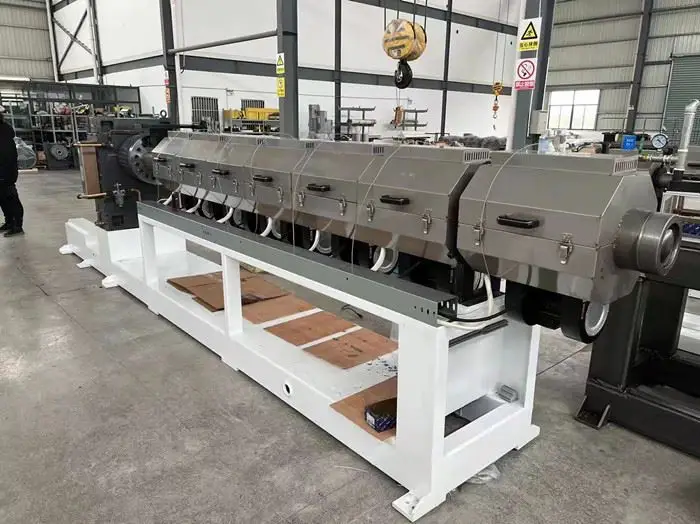
In plastic extrusion, the raw material is fed into an extruder through a hopper. A rotating screw conveys the polymer through a heated barrel, where heat and mechanical energy melt and mix the material.
The screw design, temperature profile, rotational speed, and feed rate influence material flow and extrusion stability. These parameters must be adjusted according to the polymer’s processing characteristics.
In metal extrusion, a billet is forced through a die under substantial compressive force. Depending on the metal and manufacturing requirements, extrusion may be performed at elevated temperatures or under cold or warm conditions.
Although plastic and metal extrusion share the principle of forming material through a die, their equipment and processing mechanisms are significantly different.
3. Die Forming
The die is one of the most important components of an extrusion system because it determines the cross-sectional geometry of the product.
For plastic extrusion, the die may be designed to produce pipes, sheets, films, tubes, or complex profiles. Flat dies are commonly used for sheets and films, while specialized profile dies are used for products with more complex cross-sections.
In metal extrusion, the die opening determines the profile of the extruded metal. Die design must account for material flow, deformation behavior, temperature, and the mechanical demands of the process.
Accurate die design and appropriate operating conditions are essential for achieving the required dimensions and minimizing defects.
4. Cooling and Dimensional Control
After plastic material exits the die, it must be cooled and stabilized. Cooling systems may include water tanks, calibration units, vacuum sizing equipment, chilled rollers, or air-cooling arrangements, depending on the product.
For metal extrusion, the cooling procedure depends on the alloy, extrusion temperature, product dimensions, and required mechanical properties. Some alloys require controlled cooling or additional heat treatment.
Dimensional control is important in both processes because variations in temperature, material flow, and processing speed can affect the final geometry and properties of the product.
5. Cutting and Secondary Processing
After extrusion, the continuous product is cut into the required lengths or prepared for additional manufacturing operations.
Plastic pipes and profiles may undergo cutting, trimming, socketing, printing, or other finishing processes. Sheets and films may be wound into rolls or cut into individual pieces.
Metal extrusions may require sawing, drilling, milling, tapping, deburring, or other machining operations to create the final component geometry.
These secondary processes allow manufacturers to convert standard extruded shapes into finished products that meet specific application requirements.
Types of Extrusion Processes
Different extrusion methods are used depending on the material, product geometry, production volume, and required properties.
Plastic Extrusion
Plastic extrusion is a continuous process used to manufacture polymer products such as pipes, tubes, profiles, sheets, films, and panels.
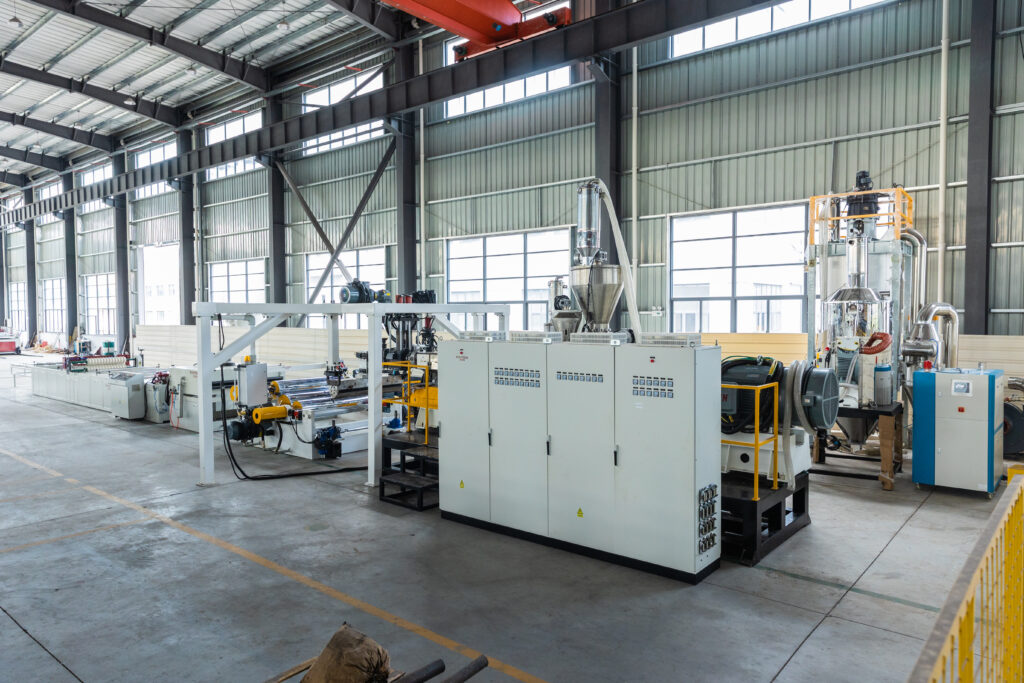
The polymer is melted in an extruder and forced through a die before being cooled and stabilized. Downstream equipment controls the dimensions and prepares the product for cutting, winding, or further processing.
Plastic extrusion is widely used in packaging, construction, agriculture, electrical applications, and industrial manufacturing. Production lines are configured according to the required product type, polymer, dimensions, and output.
Metal Extrusion
Metal extrusion is used to manufacture products with defined cross-sectional shapes from metals such as aluminum, copper, and other suitable alloys.
The metal is forced through a die under high pressure, producing profiles that can be used in structural systems, heat exchangers, transportation components, and industrial equipment.
Depending on the material and process, metal extrusion can be performed using hot, warm, or cold working conditions. Each method offers different advantages in terms of deformation behavior, dimensional control, surface finish, and material properties.
Hot Extrusion
Hot extrusion is performed at an elevated temperature that improves the material’s ability to deform. It is widely used for metals that require substantial plastic deformation during forming.
Heating reduces the resistance to deformation, allowing complex shapes to be produced under suitable processing conditions. However, temperature control is critical because excessive heat or unsuitable cooling conditions may affect surface quality and mechanical properties.
Cold Extrusion
Cold extrusion is performed at or near room temperature, depending on the specific process and material. It is commonly used for suitable metals when dimensional accuracy, surface finish, and material strengthening through deformation are important.
Cold extrusion may be used to manufacture selected fasteners, sleeves, shafts, and other components. The required forming force and achievable geometry depend on the material’s properties and the design of the process.
Direct and Indirect Extrusion
Direct extrusion involves pushing the billet through a stationary die in the same general direction as the material flow.
In indirect extrusion, the die moves relative to the billet so that the material flows through the die in the opposite direction to the movement of the die assembly. This method can reduce friction at the billet-container interface under appropriate operating conditions.
The choice between direct and indirect extrusion depends on the material, equipment design, production requirements, and desired product characteristics.
Machining of Extruded Components
Machining is frequently used to improve the functionality and dimensional accuracy of extruded components. While extrusion creates the basic profile, secondary machining operations produce features that require localized material removal.
CNC Milling
CNC milling uses rotating cutting tools to remove material from a workpiece. It is commonly used to produce slots, flat surfaces, pockets, and other features in extruded metal or suitable plastic components.
Computer numerical control allows machining paths to be programmed and repeated, supporting consistent production of complex parts.
Drilling
Drilling creates holes in extruded profiles, tubes, panels, and other components. The hole dimensions, position, and surface quality depend on the workpiece material, tool selection, cutting parameters, and machine setup.
Drilling is frequently used to prepare extruded components for fasteners, mounting systems, and assembly operations.
Sawing and Precision Cutting
Sawing is used to cut extruded products to specified lengths. Depending on the material and dimensional requirements, manufacturers may use circular saws, band saws, or specialized cutting systems.
Precision cutting is particularly important when extruded parts must fit together during assembly or meet strict length tolerances.
Turning
Turning is a machining operation in which a workpiece rotates while a cutting tool removes material. It is suitable for producing cylindrical features on compatible extruded or formed components.
Depending on the geometry, turning may be used to create precise diameters, grooves, and other rotational features.
Tapping and Threading
Tapping and threading operations create internal or external threads for fastening and assembly. These operations may be performed on suitable extruded metal components after cutting and other preparation steps.
The choice of tool and machining parameters depends on the material, thread specification, and required production quality.
Materials Used in Extrusion and Machining
Material selection influences the manufacturing process, equipment requirements, product performance, and cost.
Polypropylene (PP)
Polypropylene is widely used in plastic extrusion because of its low density, chemical resistance, and versatility. It can be processed into sheets, hollow boards, pipes, profiles, and other products.
Machining may be used to cut or modify suitable PP components after extrusion. Because PP can deform under heat and clamping pressure, appropriate cutting conditions and workholding methods are important.
Polyvinyl Chloride (PVC)
PVC is commonly used for pipes, profiles, panels, and cable protection products. Its formulation may be rigid or flexible, depending on the intended application.
Extrusion conditions must be carefully controlled because PVC is sensitive to excessive heat and may degrade if processed incorrectly. Secondary cutting and drilling operations must also be adapted to the product’s formulation and geometry.
Polyethylene (PE)
Polyethylene is used in pipes, films, tubes, sheets, and other extrusion products. Different grades provide different combinations of flexibility, stiffness, impact resistance, and environmental stress resistance.
When machining PE components, manufacturers must account for the material’s relatively low stiffness and tendency to deform under heat or clamping pressure.
Aluminum
Aluminum is one of the most widely used metals in extrusion manufacturing. Its combination of low density, corrosion resistance, and useful mechanical properties makes it suitable for building systems, machine frames, transportation components, and industrial profiles.
After extrusion, aluminum components can be machined to create holes, slots, mounting surfaces, and precision interfaces.
Copper and Other Metals
Copper and selected other metals can be extruded into suitable shapes for electrical, thermal, and industrial applications. The process depends on the material’s mechanical properties, temperature requirements, and intended product design.
Additional machining operations may be necessary to achieve specific dimensions or assembly features.
Industrial Applications of Extrusion Machining
Extrusion and subsequent machining operations are used in industries that require continuous profiles, customized shapes, or components with precise finished dimensions.
Construction and Architecture
Extruded products are used in window and door systems, building frames, cable conduits, wall panels, and other construction components.
Aluminum profiles may undergo drilling and milling to prepare mounting points and connection features. Plastic extrusion products are often cut, trimmed, or modified to meet installation requirements.
Automotive Manufacturing
The automotive industry uses extruded metal profiles, plastic components, tubing, seals, and other products.
Aluminum extrusions may be machined to produce structural components and mounting features. Plastic and rubber extrusions are used in selected interior components, protective systems, and sealing applications.
The required material properties and manufacturing tolerances depend on the component’s function and applicable industry specifications.
Packaging Industry
Plastic extrusion is widely used to manufacture packaging films, sheets, hollow boards, and other packaging materials.
These products may undergo cutting, slitting, printing, laminating, or other downstream operations to prepare them for packaging applications. The required process depends on the material structure and intended use.
Electrical and Electronics
Extruded plastic conduits, cable insulation, protective profiles, and aluminum heat-sink profiles are used in electrical and electronic equipment.
Machining may be required to produce mounting holes, interfaces, or specific dimensions. Electrical applications may also require materials that meet defined insulation, thermal, or flame-performance standards.
Industrial Equipment and Machinery
Extruded profiles are commonly used to build machine frames, guards, supports, and modular structures. Aluminum extrusion systems are particularly useful when standardized profiles can be assembled into different configurations.
Machining operations can create the holes, slots, and interfaces required for accurate assembly and alignment.
Factors to Consider When Selecting Extrusion and Machining Equipment
Choosing the correct equipment requires evaluating the intended product and the complete manufacturing sequence rather than focusing on a single machine.
Product Design and Dimensions
The product’s cross-sectional shape, length, wall thickness, and dimensional tolerances determine the required extrusion die and downstream equipment. Additional features that cannot be formed directly through extrusion may require machining.
Material Properties
The selected material affects processing temperature, forming force, cutting behavior, cooling requirements, and final performance. Equipment and tooling must be compatible with the material being processed.
Production Volume
High-volume manufacturing may benefit from continuous extrusion lines, automated cutting, and CNC machining systems. Smaller production runs may require a different balance between tooling costs, machine flexibility, and setup time.
Precision Requirements
The required dimensional accuracy and surface finish determine whether secondary machining is necessary. Extrusion can produce consistent profiles, but certain holes, slots, interfaces, and tight tolerances may require additional operations.
Operating Costs and Maintenance
Energy consumption, raw materials, tooling, labor, spare parts, maintenance, and downtime all contribute to the total manufacturing cost. Evaluating these factors helps manufacturers choose an equipment configuration that meets their production and financial requirements.
Advantages of Combining Extrusion and Machining
Combining extrusion with machining allows manufacturers to use the strengths of both processes. Extrusion produces the basic geometry efficiently, while machining adds features that require greater local precision.
Efficient material forming: Extrusion can create long products with consistent cross-sections without removing large amounts of material.
Customized component geometry: Machining allows holes, grooves, slots, and other features to be added after the initial forming stage.
Reduced material waste: Producing a near-net-shape profile through extrusion can reduce the amount of material that must be removed during subsequent machining, depending on the component design.
Repeatable manufacturing: Controlled extrusion and CNC machining can support consistent production when the equipment, material, and process parameters are properly managed.
Wide material selection: The combination can be applied to suitable plastic and metal products, although the equipment and methods differ according to the material.
Flexible production planning: Standard extruded profiles can be adapted into different finished components through changes in cutting and machining operations.
The actual benefits depend on the design of the component, production volume, material properties, dimensional tolerances, and the cost of the required secondary operations.
Common Defects and Quality Control
Maintaining quality during extrusion and machining is essential for producing components that meet dimensional and performance requirements.
In plastic extrusion, common defects may include uneven thickness, surface irregularities, dimensional variation, warping, and material degradation. These problems may result from unsuitable temperature settings, unstable material flow, incorrect die design, or insufficient cooling.
In metal extrusion, potential defects include surface cracking, internal imperfections, dimensional inaccuracies, and variations in mechanical properties. Their causes may involve material quality, temperature, extrusion ratio, die design, or process conditions.
Machining can introduce additional issues, including burrs, poor surface finish, dimensional errors, tool marks, and deformation caused by unsuitable cutting conditions or workholding methods.
Quality control procedures may include dimensional inspection, surface examination, thickness measurement, material testing, and verification against engineering drawings. For critical applications, additional testing may be necessary to confirm the component’s structural or functional performance.
Regular equipment maintenance, operator training, and effective process monitoring help reduce defects and maintain consistent production quality.
Conclusion
Extrusion machining is best understood by distinguishing extrusion, which forms material through a die, from machining, which removes material to create specific features and dimensions. Although they are different manufacturing processes, they can be combined to produce a wide range of industrial components.
Extrusion is particularly effective for manufacturing continuous products such as plastic pipes, sheets, films, profiles, and metal sections. Subsequent machining operations can add holes, slots, threads, and other features required for assembly and specialized applications.
Successful manufacturing depends on selecting appropriate materials, designing suitable dies, controlling processing conditions, and applying effective machining and inspection procedures. By understanding the capabilities of both processes, manufacturers can develop production methods that balance product quality, dimensional accuracy, material utilization, and operating efficiency.