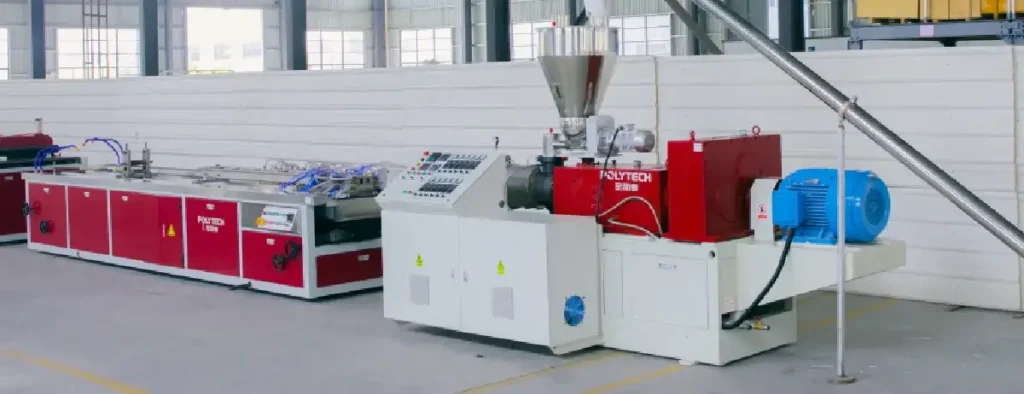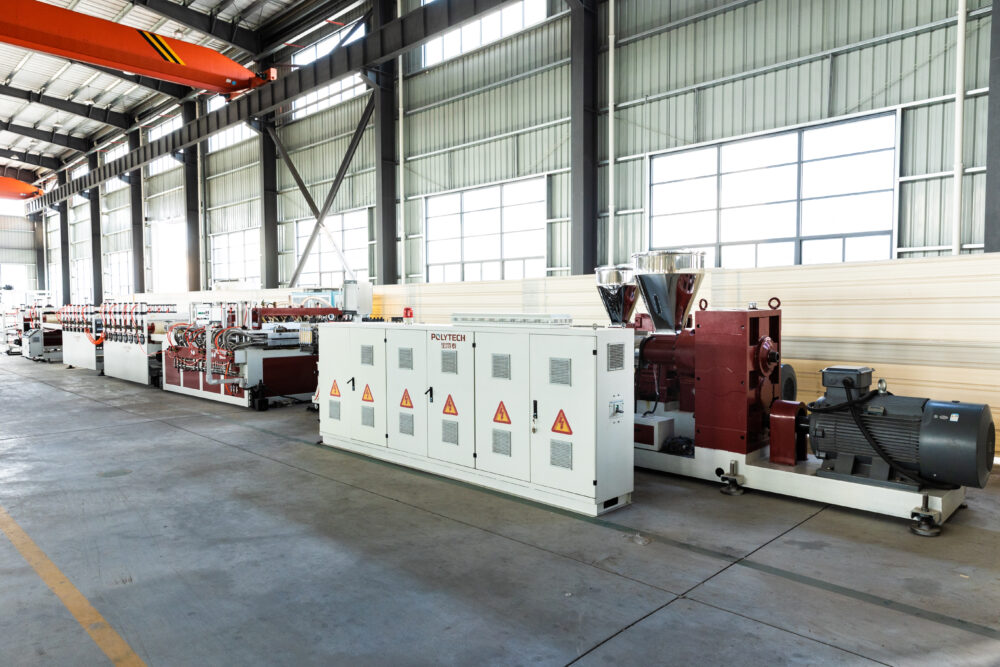


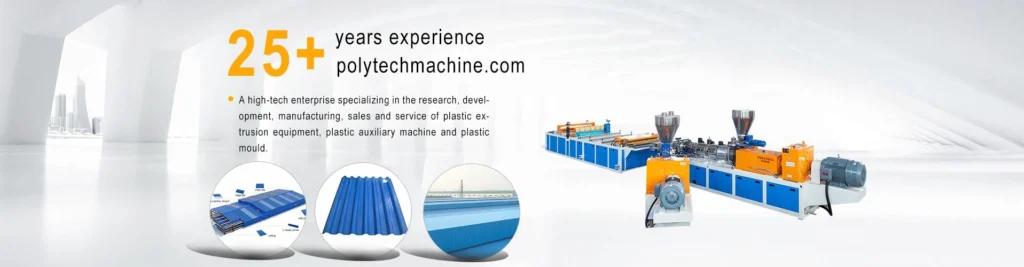
Plastic extrusion is a continuous manufacturing process for producing items with consistent cross-sectional profiles. In an extrusion line, raw thermoplastic material (in pellet or powder form) is melted and pushed through a shaped die, emerging as a continuous length of product (e.g. a pipe, sheet, or profile). As long as material is fed in, the line will continuously output product, making extrusion highly efficient for high-volume production. The typical extrusion line includes an extruder (which melts and pressurizes the plastic), a die (which gives the product its shape), and downstream equipment for cooling, sizing, pulling, and cutting the extruded material to length. This coordinated sequence allows manufacture of pipes, panels, films, or other profiles to precise dimensions with consistent quality. Modern extrusion lines feature synchronized controls and sensors to maintain stable output and minimize waste, ensuring reliable, industrial-scale production.
POLYTECH’s 25+ Years of Experience and Turnkey Solutions
POLYTECH is a veteran manufacturer in the extrusion machinery industry, established in 1998. With over 27 years of expertise in designing and building extrusion lines, POLYTECH has become a pioneer in several technologies – for example, it was one of the first in China to develop UPVC roofing sheet extrusion machines and WPC (Wood-Plastic Composite) co-extrusion board technology. The company’s equipment is used worldwide: POLYTECH has delivered more than 3,000 extrusion lines to clients in over 50 countries, serving markets across Asia, Europe, Africa, the Middle East, and the Americas. This global track record reflects a strong international presence and a deep understanding of diverse client requirements.
POLYTECH distinguishes itself by offering turnkey solutions and comprehensive client support throughout the project lifecycle. In addition to manufacturing the extruders, dies, and auxiliary equipment, POLYTECH provides end-to-end services – from factory layout design and utilities planning to on-site installation, commissioning, and operator training. The company emphasizes “whole solutions” for new projects, leveraging decades of know-how to advise on optimal raw materials, formulations, and even local market considerations. After machine delivery, clients are supported by POLYTECH’s robust after-sales network: the company has regional service teams (e.g. in the Middle East, South Asia, South America) that can respond quickly on-site, and it maintains spare parts warehouses in those regions to minimize downtime. Many POLYTECH extrusion lines come equipped with DCS smart remote control systems, enabling engineers to perform online diagnostics and process optimizations when the equipment is internet-connected. This commitment to customer support – local technicians, remote monitoring, readily available parts, and a standard 12+ month warranty – gives industrial clients the confidence of a true turnkey partnership. POLYTECH’s business approach is firmly B2B-oriented: it focuses on delivering reliable production solutions, meeting technical specifications, and ensuring that each client can smoothly ramp up manufacturing with minimal risk.
Below, we outline the major types of plastic extrusion lines that POLYTECH manufactures, along with their functions, compatible materials, primary applications, and key technical features.
Pipe Extrusion Lines
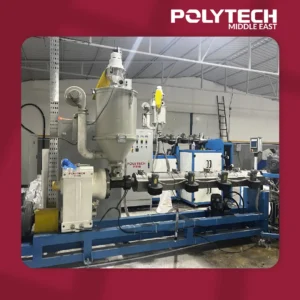
A POLYTECH pipe extrusion line for irrigation tubing, showing the downstream dual-station winding unit (enclosed for safety) which coils the finished flexible pipe. Continuous extrusion allows long lengths of pipe to be produced efficiently.
Function & Output: Pipe extrusion lines are integrated systems used to continuously produce pipes and tubes of various diameters and lengths. In a typical pipe line, a polymer (such as PVC or PE) is melted in the extruder and forced through a ring-shaped die to form a hollow continuous tube. As the pipe exits the die, it passes through a calibrating sleeve and vacuum sizing tank which ensure the pipe maintains the correct diameter and roundness while it cools and solidifies. Downstream of the cooling baths, a synchronized haul-off unit (caterpillar puller) draws the pipe at a steady speed, and a cutting saw or planetary cutter cuts the pipe to the desired length if rigid, or a coiler winds it if the product is flexible tubing. This continuous process yields pipes with uniform wall thickness and smooth surfaces suitable for pressure or conduit applications. Notably, POLYTECH pipe lines utilize either conical twin-screw extruders (for materials like PVC that start as powder and require intensive mixing) or single-screw extruders (for polyolefins like HDPE/PP that are typically fed as pellets). This ensures optimal melting and throughput for each material type.
Compatible Materials: POLYTECH designs pipe extrusion lines for all major thermoplastics used in piping. This includes PVC (unplasticized PVC for rigid pressure pipes or plasticized PVC for flexible hose), various grades of polyethylene such as HDPE (high-density PE widely used in water and gas pipes) and LDPE/LLDPE (low-density PE for hoses, drip tapes), PP (polypropylene for hot-water pipes or industrial drains), as well as specialty materials like PERT, PPR (used in plumbing and heating systems) and even multi-layer composites. Thanks to the flexibility of the extrusion process, many lines can be configured for co-extrusion to produce multi-layer pipes – for example, PE pipes with an inner adhesive layer and outer oxygen barrier, or PVC pipes with foam core layers – by adding additional extruders and concentric dies.
Main Applications: Plastic pipes are indispensable in numerous industries, and POLYTECH’s extrusion lines are engineered to serve a broad range of these applications. In the civil infrastructure and construction sector, pipe lines produce pipes for water supply and distribution, sewage and drainage systems, and natural gas pipelines (using HDPE or PVC depending on specifications). In agriculture, specialized pipe lines (like drip irrigation tubing lines) produce micro-irrigation tubes and drip lines that deliver water directly to plant roots, greatly improving water use efficiency in farming. Industrial applications include chemical transport pipes and protective conduits (e.g. PVC conduit for electrical wiring or cable ducting). There are also niche uses such as medical tubing, automotive fluid hoses, and even decorative or structural tubes. In summary, plastic pipe extrusion lines enable the manufacture of products used to convey liquids, gases, and other materials, or to serve as hollow protective/structural components in countless settings.
Technical Features: POLYTECH’s pipe extrusion lines incorporate a number of advanced features to ensure high productivity and product quality. Precise temperature and pressure control in the extruder barrel and die maintain consistent melt quality, which is crucial for uniform pipe walls. The lines often include automated gravimetric feeding systems to blend raw material with additives (stabilizers, color masterbatch, etc.) in exact ratios, improving consistency. Downstream, the vacuum calibration and cooling tanks are typically made of stainless steel with controlled water temperature and vacuum level, allowing fast cooling without warping. Servo-driven haul-offs and cutting units are synchronized to the extruder speed via PLC control, so the haul-off speed adjusts in tandem with output to prevent any stretching or compression of the pipe. Many pipe lines feature online diameter measuring devices and thickness scanners that monitor the pipe dimensions in real-time, automatically fine-tuning the puller speed or extrusion throughput to keep dimensions within tolerance. For certain products like drip irrigation pipes, the lines integrate auxiliary equipment such as dripper insertion systems (for embedding emitters in the tube wall), high-speed hole drilling units (to perforate holes for drip emitters), and dual coiling stations to wind finished tubing efficiently. These sophisticated downstream modules operate in unison to create a streamlined, automated production line. Overall, POLYTECH’s pipe extrusion lines are known for their stable operation, high output rates, and the ability to produce pipes with excellent surface finish and property uniformity. With decades of know-how in this field, POLYTECH can customize pipe lines to the client’s exact diameter range, throughput requirement (e.g. 50–1000 kg/hour), and automation level, whether the need is for a simple single-layer pipe or a complex multi-layer irrigation tubing with embedded emitters.
Profile Extrusion Lines
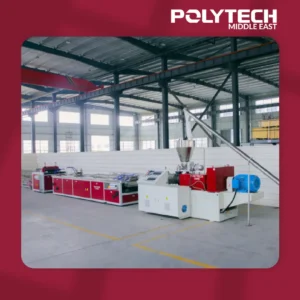
Function & Products: Profile extrusion lines are used to manufacture continuous lengths of plastic profiles – essentially any shape that is non-flat and non-pipe, often with a complex cross-section. Unlike pipes (which are round) or sheets (which are flat), profiles can have almost any shape: they may be solid or hollow, symmetric or asymmetric. Common examples of extruded profiles include window and door frame sections, plastic moldings and trims, cable channels, fencing and railing components, and weatherstripping or gaskets. Profiles can also be structural, such as T-bar, U-channel, I-beam shapes, square tubes, etc., made from plastics for specialized uses. POLYTECH’s profile extrusion lines are highly versatile, capable of producing everything from small technical profiles (like PVC edge banding for furniture or rubber seals) to large construction profiles (like vinyl window frames or siding panels). The basic function of a profile line is similar to other extrusion lines – an extruder pushes melted plastic through a custom-designed profile die that forms the desired cross-section. The delicate part is that many profiles have intricate shapes with multiple chambers or tight tolerances, so the hot extrudate usually enters a calibration table immediately after the die. This calibration unit (often a series of vacuum calibration sleeves or molds) cools and fixes the profile’s shape and dimensions as it emerges. A haul-off then continuously pulls the profile, and a cutter or saw cuts it to standard lengths (e.g. 4 m pieces for window frames). POLYTECH offers a range of profile extrusion setups, including co-extrusion lines where multiple extruders feed a single die to create profiles with layered materials (for example, a weather-resistant ASA or PMMA cap layer co-extruded on a PVC window profile). With the right tooling, a single line can even produce multiple small profiles in parallel (using a multi-cavity die) to maximize throughput for high-volume products like strips or tubing.
Compatible Materials: POLYTECH’s profile lines can process a variety of thermoplastics, with PVC (Polyvinyl Chloride) being one of the most prominent for rigid profiles. Both uPVC (unplasticized PVC) for construction profiles and flexible PVC for seals are commonly run, as PVC’s melt properties and affordability make it ideal for window frames, ducts, and more. In fact, PVC is the most popular plastic for extruded profiles globally. However, many other materials are supported: HDPE and LDPE (polyethylenes) for items like clips or utility profiles, PP for certain technical profiles, ABS for automotive or appliance trims, PMMA (acrylic) and PC (polycarbonate) for transparent profiles, as well as WPC (wood-plastic composites) which combine plastic resin with wood fiber. POLYTECH has developed profile lines for WPC decking and wall cladding, a product that extrudes like plastic but mimics wood in appearance and feel. In an example from POLYTECH’s offerings, they list specialized profile machines for ASA profiles (acrylic-styrene-acrylonitrile, often used for weather-resistant caps), PC profiles, PP/PE profiles, etc., highlighting the breadth of materials their lines can handle. The extrusion screws, barrel, and downstream equipment are selected or customized to suit the material – e.g. twin-screw extruders for PVC or WPC (which need good mixing and feeding of powders), versus single-screw extruders for polyolefins. This materials flexibility means POLYTECH profile lines can be tailored to the target polymer and the mechanical or aesthetic properties required in the finished profile.
Main Applications: Extruded profiles have wide-ranging applications across construction, industry, and consumer products. POLYTECH’s customer base for profile lines includes building and construction companies who produce PVC window and door frames, baseboards and crown moldings, sidings and roofing trims, and WPC decking boards and fence pickets – these products are used as durable, weatherproof building materials. Many furniture and interior décor manufacturers use profile extrusion lines for making items like picture frame moldings, edging strips, curtain tracks, and cable trunking for concealing wires. In the automotive and appliance sectors, profile lines produce seals, gaskets, and trim profiles (often in flexible PVC or rubber substitutes) for doors and windows, or protective bump strips. Electrical and telecom industries use plastic profiles for cable insulation, PVC cable trays, conduit profiles, and fiber optic ducting. Even retail and display sectors use clear PC or acrylic profiles for signage holders and shelf edges. Essentially, any long part with a defined cross-section – be it a hollow multi-chamber window profile or a solid decorative strip – can be manufactured efficiently with a profile extrusion line. POLYTECH notes that its WPC decking and PVC window profile lines are especially popular in markets from South America to the Middle East and Asia, due to rising demand for these products in construction. The ability to incorporate wood flour in WPC profiles has opened applications in outdoor decking and wall cladding where a wood-like appearance is desired with higher durability. Profiles for infrastructure (e.g. highway guardrail reflectors, drainage channels) and logistics (plastic pallets components) are further examples. In summary, profile extrusion lines enable a huge variety of plastic components used for building, finishing, sealing, and protecting in countless industries.
Technical Features: POLYTECH has more than 25 years of experience in PVC profile extrusion, which is reflected in the engineering of its lines. Key technical features include the use of conical twin-screw extruders for PVC/WPC profiles, providing high torque and excellent mixing of the PVC powder, additives, and fillers. This ensures uniform melt and consistent density along the profile. The profile dies and calibration systems are precision-made – POLYTECH provides the extrusion tooling (die head and calibrators) optimized for each profile shape, often using vacuum calibration tables with multiple calibration stations for complex shapes. For example, a window frame profile might pass through 2–4 vacuum calibrators in series to maintain tight tolerances on all dimensions. Downstream, the cooling baths are extended enough to fully solidify the profile without internal stresses. POLYTECH’s profile lines are equipped with caterpillar haul-offs with adjustable clamping to handle delicate or foamed profiles without deformation. Automated cutting saws with length sensors ensure each profile is cut cleanly at the exact length needed, and stacking or conveying systems gently collect the extruded pieces. Many lines now come with PLC control systems that coordinate extruder speed, haul-off rate, and cutter timing. Notably, POLYTECH highlights the integration of DCS remote monitoring on their WPC profile lines, which allows technicians to remotely adjust parameters and troubleshoot. Another feature especially relevant to WPC or foam profiles is the ability to foam or emboss: POLYTECH can supply co-extrusion for a foamed core or an embossing unit to imprint woodgrain textures on WPC deck boards as they exit the calibrator. The machinery is built for durability and continuous operation, using hardened screws and corrosion-resistant barrels (since composite fillers can be abrasive). With these features, POLYTECH’s profile extrusion lines achieve high outputs (often 150–500 kg/h per extruder on large machines) while maintaining the quality and finish required for end-use products. The combination of robust equipment and process support (including formulation guidance for materials) has made POLYTECH a go-to supplier for companies producing PVC/WPC profiles on an industrial scale. In fact, POLYTECH reports having sold around 3,500 profile extrusion lines worldwide over its history, underscoring the reliability and acceptance of its technology in the market.
Sheet Extrusion Lines
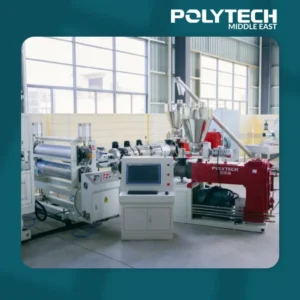
Function & Products: Sheet extrusion lines are designed to produce flat plastic sheets or films of uniform thickness, which can be wound into rolls or cut into panels. POLYTECH’s offerings in this category cover a spectrum from thin flexible sheets to thick rigid panels. In the extrusion process for sheets, a flat sheet die (also called a T-die) is used instead of a round die, creating a wide molten plastic ribbon that is then cooled and solidified into a continuous sheet. For thinner sheets and films, the extrusion line often includes a set of chill rolls (calender rolls) that the hot sheet is fed through, which press and cool it to the desired thickness and surface texture. For thicker boards or hollow sheets, a calibrating platform or roller stack might be used for cooling and sizing. POLYTECH builds sheet lines both for solid sheets and for hollow structured sheets (like twin-wall polycarbonate panels or PP hollow construction formwork panels). In a hollow sheet line, a complex die creates the multi-wall structure, and a vacuum calibration table sets the web and rib dimensions as it cools. Generally, sheet extrusion lines excel at producing wide products – typically in widths of 0.6 up to 2 meters or more, depending on the line – with a continuous process that ensures consistent thickness across length and width.
Compatible Materials: A variety of thermoplastics can be run on sheet extrusion lines, and POLYTECH supplies different configurations optimized for each. Polypropylene (PP) and High-Density Polyethylene (HDPE) are commonly used for rigid sheets (e.g. PP hollow sheets for construction formwork, HDPE sheets for industrial liners) because of their toughness. PVC is another major material – for example, PVC rigid sheet lines or PVC foam sheet lines (which we discuss separately in the foam board section) are offered. POLYTECH also has lines for polycarbonate (PC) and PMMA sheets, which are transparent materials often used for glazing, skylights, signage, etc. Additionally, the company’s portfolio includes composite sheets such as SPC (Stone Plastic Composite) which is a mix of PVC resin with calcium carbonate filler to make flooring boards. In fact, POLYTECH has specialized in SPC flooring sheet production lines, which combine PVC with limestone powder and stabilizers to extrude rigid floor planks that are later cut and laminated into interlocking floor tiles. Another example is PP construction formwork sheet lines, which produce thick (e.g. 15–18mm) hollow-core PP panels designed to replace plywood in concrete formwork; these panels are lightweight, reusable, and water-resistant, demonstrating the versatility of plastic sheets in construction. In summary, POLYTECH’s sheet lines handle polyolefins (PP/PE), PVC (and composites thereof), engineering plastics like PC/PMMA, and even layered combinations (co-extruded sheets with different surface materials). Each material may require different screw designs and temperature control (for instance, PP/PE often run on single-screw extruders, whereas a PVC sheet line would use a twin-screw to handle PVC’s heat sensitivity and additives). The company’s engineering ensures that the extruder, die, and downstream equipment are matched to the material’s melt behavior, so that the final sheets have minimal internal stress and high optical or surface quality as needed.
Main Applications: Extruded plastic sheets have numerous applications across industries, often as a semi-finished stock that can be further thermoformed, machined, or fabricated into end products. Some key applications include: Construction and architecture – e.g. wall cladding panels, roofing panels, glazing sheets (twin-wall PC sheets are used for skylights and greenhouses, flat PVC or PC sheets for windows and facades). Building formwork is a major use, where PP hollow sheets are used as reusable molds for concrete (replacing traditional wood panels). Flooring is another area: the SPC rigid sheets made by POLYTECH lines are cut into luxury vinyl tiles or planks for residential and commercial flooring, offering a water-proof and durable alternative to wood floors. In the advertising and signage industry, extruded sheets like PVC foam board or acrylic are used for billboards, display stands, and printing substrates (these are covered more in the foam board section, but they originate from sheet extrusion processes). Packaging uses extruded sheet in the form of thermoformable roll stock – for instance PET or PP sheet rolled up from an extrusion line, then later thermoformed into cups, trays, or blister packs. While PET is not a POLYTECH focus, they do provide lines for vinyl flooring and protective sheets, indicating the breadth from thick structural panels to thin films. In industrial and consumer products, flat plastic sheets are used for making tanks, containers, enclosures, as well as hobbyist materials. Specialized multi-layer sheet lines can produce geomembranes (for landfill or pond liners), or co-extruded barrier sheets for packaging with EVOH layers, though POLYTECH’s core competency leans toward construction materials. To summarize, sheet extrusion lines enable the production of plastic sheets and panels that find use as construction materials, decorative surfaces, protective barriers, and inputs for packaging – virtually any application requiring a flat plastic form factor.
Technical Features: POLYTECH’s sheet extrusion lines are engineered for precision and high output, given that sheet products often demand exact thickness control and smooth surfaces. A critical feature is the sheet die (T-die) design: POLYTECH supplies dies with adjustable lip gaps and flow distribution to accommodate different widths and thicknesses, ensuring uniform flow across the sheet width. Many lines include an automatic thickness control system, where thermal bolts on the die can fine-tune the flow in zones to correct any thickness deviations detected downstream by a thickness scanner. The cooling and calibration system differs by product type: for example, an SPC flooring line will have a multi-roll calender stack that presses the sheet to a specific gauge and embosses a texture, whereas a PP hollow sheet line uses a long vacuum calibration table to shape the hollow flutes. POLYTECH has incorporated advanced PLC control in these lines to synchronize extruder speed, the haul-off (roll pulling speed or belt puller for boards), and the cutting unit. In high-speed lines, a flying knife cutter or guillotine cutter is used to chop sheets on the fly without stopping the line. If the product is taken in roll form, automatic winding machines with tension control ensure the sheets are rolled uniformly without wrinkles. Another feature often offered is co-extrusion for multi-layer sheets – for instance, adding a thin cap layer of a different plastic for UV protection or coloration (common in roofing sheets where an ASA cap is co-extruded on a PVC base for weather resistance). Optional add-ons include edge trim refeed systems (trimmed edges of the sheet are chopped and recycled back into the extruder), and surface treatment units like corona treaters (for sheets to be printed or laminated). The lines are built with robust motors and gearboxes to handle wide dies; for example, a PVC/PMMA twin-layer sheet line might use twin extruders (one for each layer) feeding a 1400mm die and achieve outputs of several hundred kg/hour. POLYTECH also emphasizes automation and ease of use: centralized control panels, recipe storage for different product runs, and safety features for operators. These technical qualities result in sheet lines that can consistently produce flat, stress-free sheets with tight tolerances. An illustrative example from POLYTECH is their vinyl flooring sheet line, which they note has more than 15 years of development behind it and can produce SPC flooring with high automation and reliable quality. In summary, POLYTECH’s sheet extrusion lines combine precision engineering (for accurate thickness and surface finish) with high-throughput capabilities, meeting the stringent requirements of B2B customers in construction and manufacturing.
Roofing Sheet Extrusion Lines
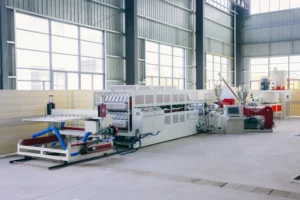
Function & Products: Roofing sheet extrusion lines are specialized sheet extrusion systems focused on producing roofing materials – typically in the form of corrugated or profiled plastic sheets and tiles used for roofing. POLYTECH is particularly renowned in this area (having introduced UPVC roof tile technology early in China), and offers complete lines for various types of plastic roofing sheets. The function of these lines is to take a resin like PVC (often blended with impact modifiers, UV stabilizers, etc.) and extrude it through a sheet/plate die or profile die to form a continuously running roofing panel profile. Unlike flat sheet lines, roofing sheet lines include a forming unit that imparts a corrugation or tile shape to the sheet while it is still hot. For example, a PVC corrugated roof sheet line will have a forming mold or a pair of shaping rollers that create the sinusoidal (wave) or trapezoidal corrugated pattern as the extrudate comes out. The sheet is then cooled (often on a long conveyor or via calibrated rollers) so that it retains the corrugated profile. It is subsequently cut to length, typically producing standard roofing sheet lengths (e.g. 6m or customized). Similarly, for synthetic Spanish-style roof tiles or glazed tiles, the extrusion line may use a mold press or vacuum forming section to shape the continuous sheet into a tile profile and then cut individual tile lengths. Some advanced lines can produce dual-layer or multi-layer roofing sheets by co-extrusion – for instance a layer of ASA or PMMA on the surface for UV resistance, and a structural PVC or PC layer beneath. POLYTECH’s roofing lines cover products like UPVC corrugated sheets, UPVC/APVC twin-wall sheets (hollow core for insulation), ASA/PVC composite roofing sheets, PC (polycarbonate) corrugated and solid sheets, and even recycled compound roofing sheets. The end goal of these lines is a durable, weatherproof panel that can be used as roofing on structures.
Compatible Materials: The primary materials for POLYTECH roofing sheet lines are PVC and UPVC (Unplasticized PVC) often in combination with surface layers of ASA (Acrylic-Styrene-Acrylonitrile) or PMMA for enhanced weatherability. PVC is popular for roofing because it is naturally fire-retardant (contains chlorine), corrosion resistant, and cost-effective. Co-extruding a thin ASA layer on PVC roofing sheets is a common practice to improve gloss color stability and UV resistance – ASA can significantly extend the life of the roof’s color under sun exposure. POLYTECH’s lines support this via multi-extruder setups for co-extrusion, so the material compatibility includes PVC blends for the substrate and ASA or other cap layer materials. Another material is Polycarbonate (PC) for clear or translucent roofing panels; POLYTECH offers PC hollow sheet lines which produce twin-wall PC sheets used in greenhouses and skylights, and PC corrugated sheet lines for lightweight, impact-resistant roofs. Additionally, FRP (fiber-reinforced plastic) and PP/PE may be processed in certain roofing sheet configurations (though PVC and PC dominate). There are also formulations of recycled PVC or PVC with fillers (like calcium carbonate) to reduce cost – POLYTECH even developed a plastic recycled roofing tile machine to utilize recycled plastics in roof production. In summary, POLYTECH’s roofing sheet lines are compatible with rigid thermoplastics that can withstand outdoor conditions, primarily PVC-based compounds and polycarbonates. The machines are built with corrosion-resistant contact surfaces (since PVC with additives can be corrosive) and precise temperature control to handle these materials’ processing windows. For instance, UPVC has to be extruded carefully to avoid degradation; the twin-screw extruders used in these lines allow good mixing of heat stabilizers and pigments into the melt.
Main Applications: The output of these extrusion lines – plastic roofing sheets and tiles – is used as roofing material for buildings. Key applications include roofing for industrial factories, warehouses, and sheds, where PVC or polycarbonate sheets provide a lightweight, corrosion-proof alternative to metal sheeting. For example, in corrosive environments (coastal areas or chemical plants), PVC corrugated roofs do not rust like metal does. Agricultural buildings (barns, poultry houses, greenhouses) also benefit from plastic roofing; translucent PC sheets are often installed to allow sunlight in (greenhouses), and PVC sheets are used in barns for their insulative and anti-corrosive properties (ammonia from livestock won’t corrode PVC). Many developing regions use UPVC or ASA/PVC roof tiles for residential and commercial buildings, since they can mimic traditional clay tiles in shape but are much lighter and easier to install. The ASA-cap UPVC Spanish tiles produced by POLYTECH lines are marketed for homes, gazebos, and villas, especially in tropical climates where metal roofs would heat up too much. APVC (ASA-coated PVC) sheets are common for carports, patios, and awnings, providing a durable shelter that is also aesthetically pleasing. Twin-wall hollow roofing sheets (UPVC or PC) are used when thermal insulation is desired – the air gap in the twin-wall structure reduces heat transfer, suitable for warehouses or structures in hot regions. POLYTECH cites usage of twin-wall UPVC roofing in large projects like factories and markets, where the combination of strength, insulation, and weight advantage is valued. Additionally, some public infrastructure uses these products: for instance, PVC roofing sheets have been used in railway station sheds, bus stop shelters, stadium stands, etc. because they are non-corroding and low maintenance. In summary, plastic roofing sheets serve as an innovative roofing solution for industrial, agricultural, and residential structures, offering benefits like lightweight installation, chemical resistance, and in the case of translucent variants, light transmission. POLYTECH’s widespread sales (over 800 roofing sheet extrusion lines delivered worldwide as of recent years) underscores the global demand in these application areas and the trust in their equipment to produce roofing that meets local building requirements.
Technical Features: POLYTECH’s roofing sheet extrusion lines are built to ensure the roofing products meet the demands of outdoor exposure and structural performance. Key technical features include multi-layer co-extrusion capability – for example, the line can co-extrude a weatherable ASA cap layer simultaneously with the PVC base layer, bonding them in the die to produce a single integrated sheet. The extruders (often a combination of a conical twin-screw for the base and a single-screw for the cap layer) are synchronized for even layer thickness. The calibration and forming systems in roofing lines are specialized: a corrugation forming unit molds the sheet into the target profile. POLYTECH uses methods like calibrated forming rollers or vacuum forming molds to achieve uniform corrugation pitch and depth. Temperature control in this section is critical – the forming mold is usually temperature-controlled to allow the sheet to shape properly without sticking or warping. After forming, long cooling brackets or water spray cooling solidify the profile. The haul-off (puller) must accommodate the corrugated shape; typically, a set of profiled rubber belts or caterpillar tracks grip the sheet without deforming the waves or tile shape. Cutting systems are often flying cutters that can cut the continuous sheet into desired lengths on the fly without disrupting production. POLYTECH’s roofing lines also incorporate features to enhance the product properties: for instance, precise feed metering of UV stabilizers and color pigments to ensure each sheet has consistent coloration and UV protection throughout. The machines can produce sheets with thickness in a typical range (e.g. 1–3 mm for single-layer corrugated sheets, or thicker for multi-layer) and at high outputs (POLYTECH mentions roofing lines reaching up to 700 kg/hour capacity, producing thousands of square meters per day). The use of PLC control with recipe settings allows quick changeovers between sheet dimensions or formulations. Quality control is also considered: an embossing roller can be added to imprint textures (like a tile surface pattern) on the sheet if needed, and the gloss of the surface is controlled via the cooling rate and mold finish. POLYTECH emphasizes aspects like flame retardancy and weather resistance in the final product – their machinery ensures the proper gelation of PVC (for strength) and homogeneous distribution of additives (for flame resistance, etc.). They also provide testing and know-how so that the produced sheets meet standards (for example, tensile strength, Vicat softening point for heat resistance, etc.). An impressive service aspect is that POLYTECH’s experience (25+ years in roof sheet extrusion) means they often assist customers with formulation support (e.g. optimizing ASA/PVC blends) to achieve the best product. Finally, durability of the line itself is addressed: since roof sheet production can be an around-the-clock operation, the machines use hardened gears and quality electrical components to minimize downtime. The collective result is an extrusion line that can reliably mass-produce roofing sheets which satisfy rigorous outdoor performance criteria (UV, impact, temperature) while maintaining dimensional and color consistency. This combination of technical precision and practical output has solidified POLYTECH’s reputation in the roofing extrusion domain.
Foam Board Extrusion Lines
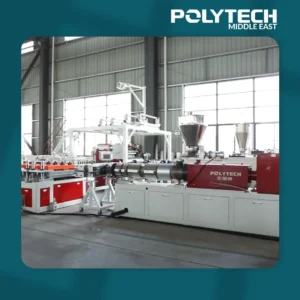
Function & Products: Foam board extrusion lines (often specifically PVC foam board lines or WPC foam board lines) are engineered to produce lightweight, expanded (foam) plastic boards with a rigid structure. The core idea is to create a sheet or board with a foamed cellular internal structure, which reduces density while maintaining a solid outer surface. POLYTECH’s foam board extrusion lines typically use a twin-screw extruder (for good mixing and gas dispersion) to melt a PVC or PVC+wood composite formulation that includes a chemical blowing agent. As the melt is pushed through a flat T-die, the sudden pressure drop causes the blowing agent to form gas bubbles, expanding the sheet thickness and creating a foam core. The emerging board then passes through a calibrating and cooling station that fixes its thickness and surface texture. There are two main types of PVC foam boards produced: celuka foam boards (which have a smooth, hard outer skin formed by calibrators) and free foam (expanded) boards (which freely expand and have a uniform closed-cell surface). POLYTECH’s lines cover both “skinning” foam board (with a polished skin layer) and free foam. The function of these lines is to continuously extrude boards that are usually in standard sheet sizes (e.g. 1220 mm width, with thickness ranging from 5 mm up to 20+ mm). Some lines are equipped for co-extrusion, adding a thin cap layer of pure PVC on top of a foamed core for improved surface hardness (useful in furniture boards). Additionally, POLYTECH offers WPC foam board lines where wood fiber is mixed with PVC to make a composite foam board (often used for construction formwork or furniture panels). In all cases, the line’s job is to precisely control the foaming process so that the board has consistent density and dimensions, and then cut the board to size at the end.
Compatible Materials: The primary material for these lines is PVC (polyvinyl chloride), thanks to its ability to be chemically foamed and its suitability for applications like signage and building boards. Formulations typically include PVC resin, stabilizers, foaming agents (like AC blowing agent), cell regulators, and other additives to ensure a fine cell structure. POLYTECH’s PVC foam board machines are designed to handle these formulations and produce stable foam with good cell distribution. Another variant is PVC with wood flour (to create WPC foam boards) – the presence of wood requires tweaks in screw design and process (wood fills can increase viscosity and require venting due to moisture), and POLYTECH as a pioneer in WPC co-extrusion addresses this with specialized screw profiles and feeding systems. Besides PVC, some foam board lines can also work with PS (polystyrene) or PE for specific foam sheets, but those are less common in POLYTECH’s product line (PS foam boards are usually made by a different extrusion process with physical blowing agents). For PVC, the lines can produce both celuka (skin) foam and free foam; in celuka, the calibrator cools the outer layer fast so it forms a skin while the core is foamed. The equipment must be compatible with frequent starts and stops as well, because foam PVC can degrade – POLYTECH likely uses high torque extruders to be able to run at lower RPM when needed and has die designs that allow uniform flow even as the foam expands. In summary, these lines are optimized for PVC-based materials – plain PVC or PVC with fillers (wood, calcium carbonate) – and come with the necessary controls to manage the foaming action (e.g. temperature profiling, screw venting, etc.).
Main Applications: PVC foam boards are a highly versatile product with applications in advertising, construction, and furniture making. One of the most common uses is in the signage and display industry: PVC foam board (sometimes known by trade names like Forex or Sintra) is a popular material for printing signs, exhibition panels, and backing boards because it is lightweight, has a smooth printable surface, and is easy to cut. POLYTECH’s foam board lines produce boards that exhibit excellent printability and moisture resistance, ideal for outdoor signs or graphics displays. In construction and interior design, foam boards serve as interior decorative panels, wall claddings, and false ceilings, owing to their combination of low weight and dimensional stability. They are also used for PVC kitchen cabinets, bathroom vanities, and partitions – essentially replacing wood-based plywood or MDF in environments where water resistance is important (PVC foam boards do not swell or rot with moisture). The furniture industry uses WPC or PVC foam boards to make things like cabinets, shelves, and doors with the advantage that these boards are termite-proof and can be directly screw-fastened similar to wood. POLYTECH’s lines can produce thicker high-density foam boards that can be used as construction formwork panels or building templates, again as a reusable alternative to plywood. Additionally, foam boards find use in the automotive and marine sectors for non-structural interior components, due to their light weight and sound-insulating properties. Even the advertising and crafts sector uses thinner foam boards for making models, props, and backing for artwork. The key theme is that foam boards combine some characteristics of wood (they can be cut, drilled, screwed, and even laminated or painted) with the advantages of plastic (waterproof, uniform, often fire-retardant, and available in various colors without painting). For instance, a furniture manufacturer can directly use colored PVC foam boards cut to size for a cabinet, eliminating the need for laminating a separate decorative layer. Given these broad applications, many companies find foam boards to be a high-demand product, and POLYTECH has delivered numerous foam board extrusion lines globally to meet this need. They highlight that the material’s versatility allows it to penetrate sectors from advertising to tourism and environmental projects, indicating how foam boards can even be used in innovative applications like exhibition booth construction or outdoor kiosks.
Technical Features: POLYTECH’s foam board extrusion lines feature specialized technology to achieve a uniform, high-quality foam structure in the boards. One of the core elements is the twin-screw extruder with precise temperature control – foam extrusion requires very careful management of melt temperature: too hot and the foam can collapse; too cool and the melt won’t foam properly. The screws are designed to evenly distribute the blowing agent and create a homogeneous melt. Often these lines include a blowing agent injection system (for chemical foaming, the agent is usually a powder mixed in the dry blend; for physical foaming, an injection of gas can be done, though chemical is more common for PVC). The extrusion die is engineered to handle the expanding melt; for celuka processes, a calibrating die at the exit helps form the outer skin. POLYTECH provides a shaping calibrating platform with multiple cooling zones and vacuum hold-down to form the board to exact thickness and a smooth surface. This is typically a stainless steel table with adjustable calibrators that can be set for different board thicknesses. As the board moves along (often on a belt conveyor with cooling fans), it solidifies. The downstream has a haul-off with multiple pairs of pull rolls to guide the fragile foam board without deforming it – POLYTECH mentions using 8 pairs haul-off in one of their lines for steady pulling. Cutting is usually done by a flying saw or cross-cut saw, giving clean, right-angle cuts at sheet lengths like 2440 mm (8 feet) or other customer-specified lengths. POLYTECH’s lines likely include an edge trimming device at the die exit to trim the edges for exact width and recycle the trim (as hinted by their mention of components like feeder, extruder, T-die, shaping mold, haul-off, cutter, stacking frame, etc.). The stacking frame at the end neatly stacks the boards for removal. From a control standpoint, PLC systems manage the coordination, and often the foam lines have additional feedback control like density measurement or thickness gauges to ensure consistent product (though much of density control comes from formulation consistency). Another notable feature is the use of co-extrusion for skin layers: POLYTECH’s foam board lines can include a second extruder to lay a thin un-foamed PVC cap on one or both surfaces of the board (for a harder, scratch-resistant skin). This co-extrusion is synchronized so that the skin bonds firmly to the foamed core as it exits the die. Material-wise, the interior foam can have high foam ratio (expansion) to reduce weight, and the company assists in recipes to achieve this while keeping surface quality. On the mechanical side, these lines are built to handle the high pressures in foam extrusion dies and have robust cooling since foaming is exothermic. The calibration table length (often 6–12 meters) and the number of cooling zones are designed to guarantee the board is fully hardened before cutting – preventing later shrinkage or warping. POLYTECH also emphasizes energy efficiency and ease of operation in their marketing, which for foam lines might include inverter-controlled drives and comprehensive safety enclosures (since the process uses chemicals, ventilation is considered). Ultimately, POLYTECH’s foam board extrusion lines enable consistent production of lightweight, rigid boards with fine cellular structure, suitable for high-finish applications. Their technology ensures features like smooth, non-adhesive surfaces (for easy demolding), sound and thermal insulation properties, and the ability to work the boards with common tools. These are exactly the selling points of the foam board product, which the extrusion line must impart through proper foaming and cooling. The long service life and reliability of the equipment are also touted, meaning factories can run these lines continuously to meet large orders without significant downtime. In the B2B context, such assurances of throughput, quality, and support (for example, POLYTECH providing professional formulation support and quick spare parts) are as critical as the machine specs themselves.
Conclusion
POLYTECH’s range of extrusion lines – spanning pipe, profile, sheet, granulation, roofing sheet, and foam board systems – demonstrates the company’s comprehensive capabilities in plastic processing technology. Each line is engineered with application-specific features, whether it’s a high-speed drip irrigation pipe line with inline emitter insertion, a profile line turning out precision window frames, a multi-layer roofing sheet line for durable building panels, or a foam board line for lightweight cabinetry materials. Across all these types, POLYTECH leverages 25+ years of design and manufacturing experience to deliver machinery that meets industrial clients’ requirements for quality, efficiency, and reliability. Equally important, POLYTECH backs its equipment with strong technical support and turnkey services, from initial layout planning to after-sales training and spare parts supply, allowing customers to ramp up production with confidence. This combination of a broad product portfolio and end-to-end client support has established POLYTECH as a trusted partner for plastic extrusion solutions in the international B2B market. By investing in a POLYTECH extrusion line, manufacturers are not just buying hardware, but also gaining a complete solution optimized for their product and backed by a quarter-century of know-how – ensuring that they can produce competitively, innovate with new materials, and receive support whenever and wherever it’s needed. The result is a win-win for customers looking to expand or upgrade their production of plastic pipes, profiles, sheets, and beyond, with POLYTECH’s equipment providing the backbone of their manufacturing operations.