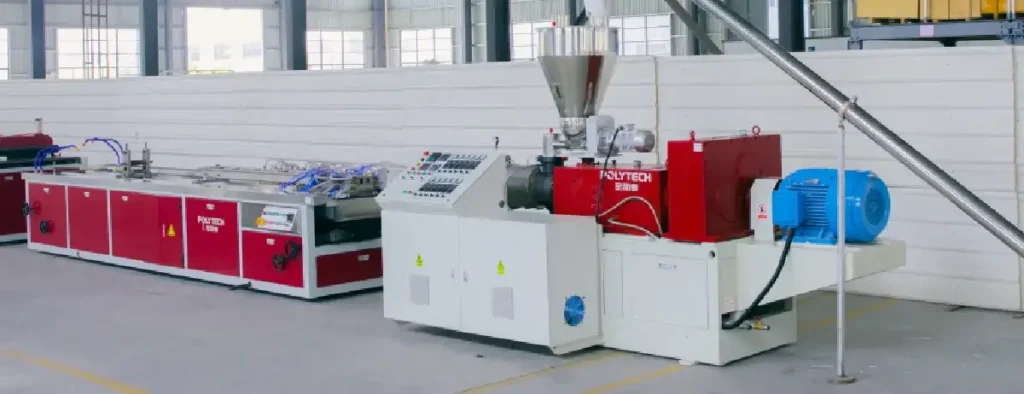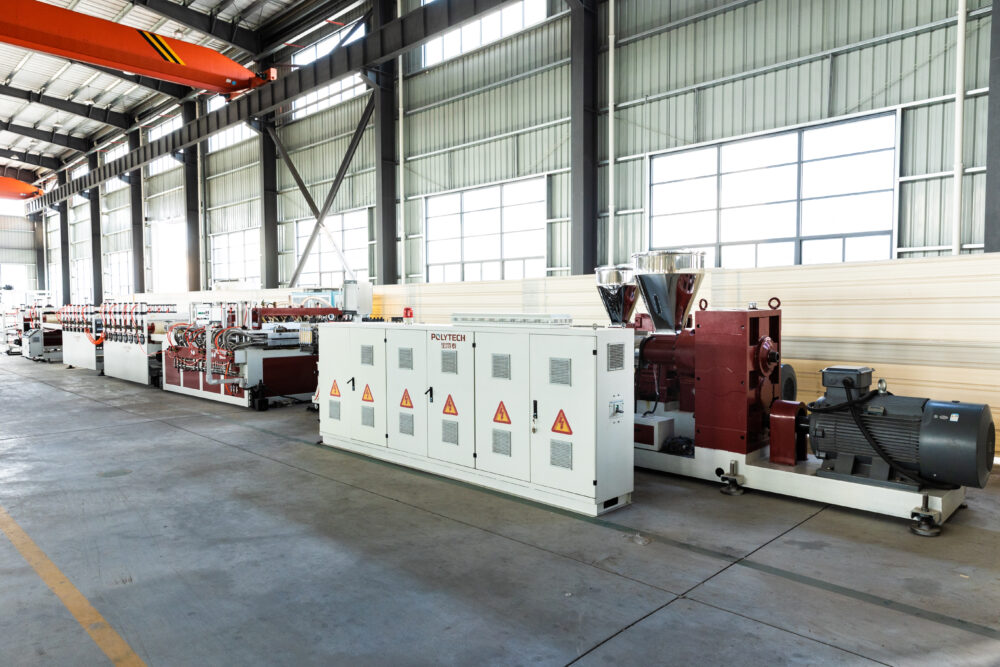


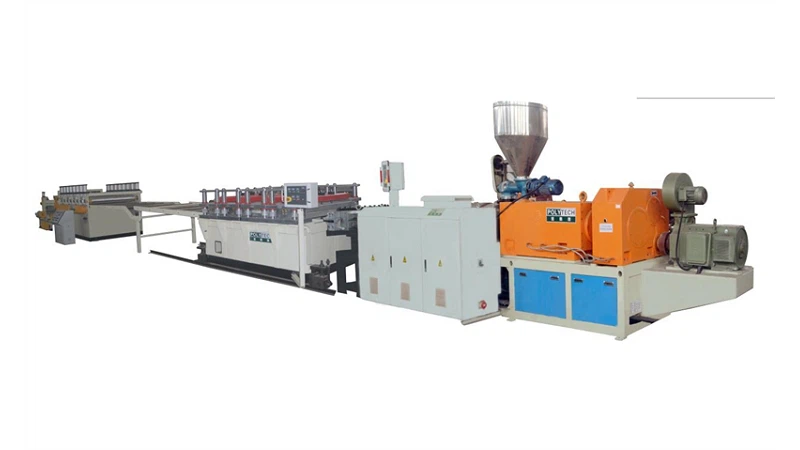
Extrusion lines are integrated manufacturing systems used to produce continuous plastic products with uniform cross-sections. In an extrusion line, raw plastic material (usually in the form of pellets or powder) is melted and extruded through a specialized tool called a die to form products such as pipes, profiles, sheets, and more. The line operates continuously – as long as material is fed into one end, a continuous length of product comes out the other. This makes extrusion highly efficient for high-volume production. Below, we provide an overview of extrusion lines, their main components, common types, materials processed, industrial applications, advantages, and key considerations for choosing the right extrusion line for your needs.
What is an Extrusion Line?
In simple terms, an extrusion line is a complete set of machinery arranged in sequence to carry out the plastic extrusion process from start to finish. The line typically includes an extruder to melt and push out the material, a die to shape the molten plastic, and various downstream equipment to cool, size, pull, and cut the continuous product. Extrusion lines can be designed for a wide range of products – from pipes and tubing to flat sheets, panels, and complex profiles. Because the process is continuous, extrusion lines are ideal for manufacturing long lengths or large quantities of product with consistent quality and cross-sectional shape. Industries value extrusion lines for their ability to produce everything from water pipes and window frames to packaging films and vinyl siding in a reliable, automated manner.
Key Components of an Extrusion Line
An extrusion line is composed of several key components, each playing a crucial role in turning raw plastic into finished products. The main components and their functions include:
The heart of the extrusion line, the extruder is a machine that melts and pressurizes the plastic material. It consists of a motor-driven screw inside a heated barrel. As the screw rotates, it conveys the plastic forward, heating and mixing it into a uniform melt. Extruders can be single-screw or twin-screw designs. For example, twin-screw extruders (including conical twin-screw models) are often used for PVC and WPC materials to ensure thorough mixing and consistent output. The quality of the screw and barrel is critical – high-performance screws and barrels for extrusion provide better melting efficiency and durability. In fact, a conical twin screw barrel is commonly employed in PVC extrusion for improved heat control and mixing stability
The die is a custom metal tooling at the end of the extruder that gives the molten plastic its shape. As the plastic melt is forced through the die opening, it takes on the die’s cross-sectional profile (be it a pipe, sheet, profile, etc.). Dies are precision-engineered for each product shape. Along with the die, calibrators or form inserts may be used immediately downstream to hold the soft extrudate to exact dimensions until it cools. For complex profiles or hollow products, vacuum calibrator units are common – these help the hot extruded profile keep its shape by cooling and sizing it under a slight vacuum. High-quality extrusion toolings and moulds are essential to achieve accurate dimensions and smooth finishes on the final product. These tooling components are often custom-made for each product and can be changed out to produce different sizes or designs.
After exiting the die (and calibrator, if used), the hot plastic must be cooled and solidified quickly to retain its shape. Extrusion lines include cooling systems tailored to the product type. For pipes and profiles, this often involves a cooling water bath or series of spray cooling tanks where the extruded part is gently cooled as it is pulled through. In some cases (like vacuum calibration tables for pipe/profile lines), cooling and calibrating happen together. For flat sheets or thin films, cooling may be done by passing the extrudate through chilled cooling rolls or conveyor belts. Proper cooling is critical to prevent warping and to lock in the dimensions imparted by the die.
To maintain a continuous process, a motorized haul-off unit (puller) grips the extruded product and pulls it down the line at a controlled speed. The puller typically uses belts, caterpillar tracks, or rollers to draw the profile/sheet/pipe without stretching it out of shape. Synchronizing the haul-off speed with the extruder output is important for achieving consistent product thickness and geometry. The haul-off ensures the extrudate moves steadily through the cooling phase and prevents sagging or accumulation between machines.
Finally, the continuous extruded product needs to be cut or coiled for handling. Depending on the product type, extrusion lines include end-of-line equipment such as cutters or saws (for cutting profiles, pipes, boards to length) or winding machines (for rolling up long sheets, films, or coils). For example, a pipe extrusion line will have a cutting unit to chop pipes into standard lengths, while a sheet extrusion line might have a flying cutter or a stacking table to cut panels to size. Some specialized lines (like fiber or filament extrusion) use winders to spool the product. This stage makes the products ready for packaging or further assembly.
Each component in the extrusion line must work in harmony. The extruder’s output rate, the cooling length, and the haul-off speed are all balanced so that the product comes out with the desired dimensions and properties. Modern extrusion lines often feature synchronized control systems and sensors (temperature, pressure, speed) to maintain this balance automatically, ensuring high quality and minimal waste.
Types of Extrusion Lines
Extrusion lines are tailored to produce specific categories of products. While all extrusion lines share the common principle of forcing molten plastic through a die, their designs differ based on the output shape, size, and material. Here are some of the main types of extrusion lines:
These lines are designed to produce plastic pipes of various diameters and lengths, commonly using materials like PVC, HDPE (high-density polyethylene), or PP. Pipe extrusion lines typically include a single or twin-screw extruder (PVC pipes often use conical twin-screw extruders for better mixing), a circular die to form the pipe shape, a vacuum calibrator/cooling tank to set the pipe diameter, a haul-off, and a cutter. They are used to manufacture water pipes, gas pipes, electrical conduit, irrigation tubing, etc., with high consistency in wall thickness. Advanced lines can produce multi-layer pipes or corrugated pipes using special dies and formers.
Profile lines manufacture continuous shapes other than round pipes – for example, window frames, door profiles, decorative trim, cable trays, and other custom cross-sections. A uPVC profile extrusion line is a common example, used for making vinyl window and door frames. In such a line, PVC material is extruded through a profile die, then passed through a series of calibrators and cooling tables to maintain the intricate shape until it hardens. Puller and cutter units complete the process. These lines often run uPVC (unplasticized PVC) or other plastics and can produce complex multi-chamber profiles for improved strength and insulation. A dedicated uPVC profile extrusion line can have multiple downstream cooling sections and even co-extruders if adding gasket strips or co-extruded layers to the profile.
Sheet extrusion lines produce flat plastic sheets or films, typically ranging from thin films a fraction of a millimeter thick up to thicker sheets several millimeters thick. They usually consist of an extruder (often single-screw for polyolefins like PP/PE or PET, but can be twin-screw for PVC or high-filled materials), a flat sheet die (often a wide rectangular slot opening), and a set of polishing rollers or calender rolls that press and cool the extruded melt into a solid sheet of precise thickness. After the cooling rolls, the continuous sheet may be trimmed at the edges and either wound into large rolls or cut into panels. Roofing sheet extrusion lines are a special category that produce panels for roofing applications – for instance, a roofing sheet extrusion line can make corrugated PVC roofing panels or multi-wall polycarbonate sheets used for skylights and shelters. These lines may incorporate forming stations to impart a corrugated profile or multi-wall structure to the sheets before cooling.
These lines produce foam boards or foamed sheets, which are lighter and often more rigid due to their foamed core. A PVC foam board extrusion line is a common example – it extrudes PVC mixed with a foaming agent to create sheets that have a cellular structure inside. The result is a lightweight yet strong board used in signage, furniture, and construction (often as an alternative to plywood or solid plastic sheet). Foam board lines typically use a specialized twin-screw extruder (to mix gas or a chemical blowing agent into the melt), a flat T-die, and a calibration/cooling section that allows the foam to expand and cool into a consistent thickness. For instance, a PVC foam board extrusion line produces durable foam sheets with smooth surfaces, using precise temperature control and vacuum calibration to achieve uniform cell structure and thickness.
Wood-Plastic Composite (WPC) lines can be considered a subset of profile or board extrusion lines, but they are notable for processing a mixture of plastic (often PVC or PE) with wood flour or fibers. WPC extrusion lines produce items like composite decking boards, WPC profiles for doors or frames, and other products that mimic wood but have plastic’s durability. These lines often employ twin-screw extruders (for good mixing of wood fiber and polymer) and specialized screws/barrels to handle the abrasive nature of the wood filler. Downstream, they resemble profile or board lines with calibration, cooling, and cutting units. The products need additional cooling and sometimes extended haul-off sections because WPC materials retain heat longer than pure plastics.
Not all extrusion lines make end-use products – some are used for compounding or recycling, producing plastic pellets (granules) that can be reused in manufacturing. Granulation or pelletizing extrusion lines take in raw polymer (and possibly additives or recyclables), melt and mix them in an extruder, and then form them into small cylindrical pellets for easy handling. After the die, instead of forming a profile, the molten plastic is cut into pellets typically by a rotating blade (in strand pelletizers, the extrudate is cut after cooling, whereas hot die-face pelletizers cut the pellets right at the die face). These lines are crucial for making compounded materials (e.g., color masterbatches, filled plastics) and for recycling waste plastics into reusable pellets.
Materials Processed in Extrusion Lines
One of the strengths of extrusion technology is its versatility with different plastics. Common materials processed in extrusion lines include:
PVC is widely used in extrusion due to its rigidity, flame resistance, and affordability. It’s the material of choice for pipes (e.g. water and electrical conduit), window and door profiles (uPVC frames), siding, and foam boards. PVC extrusion often uses twin-screw extruders (especially for formulations with heat-sensitive additives like stabilizers or for mixing with wood in WPC). Both rigid PVC (for construction products) and flexible PVC (for things like tubing or cable jacketing) can be extruded with the right equipment and screw design.
Polyethylene, including HDPE and LDPE, is a common extrusion material for applications like water pipes (HDPE pipes), drip irrigation tubes, wire insulation, and film/sheet. PE has high toughness and chemical resistance. Extrusion of polyethylene typically uses single-screw extruders and can achieve high output rates. LDPE is also used for film (though that involves blown film lines, a specialized kind of extrusion line).
Polypropylene is another polyolefin that is extruded into pipes (e.g., PP-R pipes for hot water), sheets, automotive profiles, and various profiles. It has a higher temperature resistance than PE and is often used when a stiffer or heat-resistant product is required (e.g., certain appliance components or automotive trims). PP extrudes in a manner similar to PE, often on single-screw extruders. It’s also commonly used in sheet extrusion for thermoforming applications.
As mentioned, WPC materials are a composite of plastic (often PVC or HDPE) with wood fiber or other natural fibers. The presence of wood flour requires good mixing and controlled temperatures. WPC is extruded into outdoor decking, fencing, cladding, and profiles that benefit from a wood-like appearance with lower maintenance. The extrusion process for WPC can be more demanding (due to higher melt viscosity and material abrasion), so robust twin-screw extruders and wear-resistant screws/barrels are used. For instance, conical twin-screw systems are popular for PVC-based WPC profiles, providing the necessary shear and mixing.
Extrusion lines can also handle materials like ABS (used in profiles or pipes requiring impact resistance), polycarbonate (often in sheet form, e.g., multi-wall PC roofing sheets), PET (for sheets and strapping tapes), and more. Each material has its specific temperature requirements and may need different screw designs or even vented extruders (for moisture-sensitive plastics like PET). Some extrusion lines are designed to be flexible and run multiple materials with minor adjustments, while others are optimized for one polymer type.
Choosing the right material for a product involves balancing properties like strength, flexibility, weather resistance, and cost. Many extrusion line manufacturers configure equipment (screws, barrel lining, die design, etc.) to suit the primary material that will be processed, ensuring optimal melt quality and throughput.
Industrial Applications of Extrusion Lines
Extrusion lines play a pivotal role in numerous industries by producing a vast array of plastic components and products. Some notable sectors and applications include:
Perhaps the largest user of extrusion products, this sector relies on extrusion lines for pipes (water supply, sewage, gas, conduit), profiles (uPVC window frames, door frames, vinyl siding, cable ducts), roofing sheets (PVC or polycarbonate panels for sheds, greenhouses, roofing tiles), foam boards (used as insulation, wall panels, or furniture boards), and WPC decking and fencing. The durability, weather resistance, and formability of plastics like PVC, PE, and composites make them ideal for building materials.
Extruded pipes and ducts protect electrical wiring and fiber-optic cables. Conduit pipes, corrugated tubing, and cable trunking are all extruded products. Additionally, extrusion is used to insulate and jacket electrical wires (extruding materials like PVC or polyethylene around copper conductors in a continuous process). Over-jacketing extrusion lines specifically coat cables with protective plastic.
While injection molding and blow molding are common for containers, extrusion provides plastic films and sheets used in packaging. For example, extruded polypropylene or PET sheets are later thermoformed into trays, cups, or clamshell packaging. Blown film extrusion lines (a variant where a tube of plastic is blown into a film bubble) create plastic bags, stretch wrap, and agricultural films. Extruded straws, nets, and profiles are also used in packaging or product protection.
he automotive industry uses extruded plastic profiles and seals extensively. Extrusion lines produce weatherstrips, gaskets, and seals (often from flexible PVC or rubber-like TPE compounds) for doors and windows in vehicles. They also make plastic trim profiles, dashboard components, cable protection sleeves, and fuel or fluid hoses. For heavy-duty uses, nylon or PTFE tubing might be extruded for pneumatic or fuel lines. The ability to create custom profiles allows automotive designers to incorporate lightweight plastic sections in place of metal or rubber.
Many household items come from extrusion. Plastic tubing and profiles form parts of appliances, furniture edge bandings, curtain rails, picture frames, and more. PVC foam boards and sheets are used in furniture and cabinetry as lightweight alternatives to wood. Even consumer goods like garden hoses, PVC flooring (vinyl rolls), and window blinds are products of specialized extrusion lines.
Extruded pipes and profiles are used in industrial equipment, chemical processing plants, and agriculture. For instance, HDPE or PVC pipes carry chemicals or water in industrial processes and farms. Drip irrigation tubing for agriculture is made on PE extrusion lines (often with multiple small channels). Extruded PTFE tubes serve in chemical laboratories due to their high chemical resistance.
In summary, extrusion line products are ubiquitous – from the pipes in our walls and the frames of our windows, to the packaging of products and components in our cars. The technology’s ability to produce continuous lengths of material with tailored cross-sections means it will continue to be a backbone of plastic product manufacturing across sectors.
Advantages of Extrusion Line Production
Using an extrusion line for manufacturing offers several key advantages, especially for high-volume and continuous production needs:
Extrusion is a continuous process, which means it can run 24/7 and generate a large volume of product without the frequent start-stop cycles seen in batch processes. Once the line is running in steady state, very little downtime is needed aside from routine maintenance or changeovers. This makes it extremely efficient for producing long lengths of product (e.g., hundreds of meters of pipe or sheet) with minimal labor intervention.
Because the process is steady and the material flows through a fixed die, the output tends to have very uniform cross-section and properties along its length. Modern extrusion lines have precise control over temperatures, pressures, and line speed, resulting in consistent dimensions and surface finish on the extruded products. This repeatability reduces scrap rates and ensures that every meter of product meets quality specifications.
Extrusion tooling (dies and calibrators) can be designed to create a huge variety of profiles and shapes, giving manufacturers flexibility to produce custom designs. Whether it’s a simple round pipe or a complex window profile with multiple hollows, the extrusion die can be made to that shape. Changing to a different product often simply involves swapping the die and adjusting settings, rather than needing entirely new machinery. This makes extrusion ideal for custom plastic profiles and allows relatively quick product changeovers.
Extrusion typically generates low waste – any scrap that is produced (e.g., edge trims from sheets or off-cuts) can often be ground up and re-extruded. The continuous nature also means there are no frequent startup losses after the initial purge. Additionally, extrusion lines can be tuned to use additives or recycled material effectively (for instance, co-extruding a layer of recycled plastic inside a pipe wall). The efficient use of material and the high throughput contribute to a lower cost per unit of product compared to many other processes.
Extrusion lines are highly automated. One or a few operators can oversee an entire line, loading raw materials and monitoring output quality, while the machines handle the melting, shaping, cooling, and cutting. This reduces labor costs and also minimizes human error. With features like automatic thickness control, gravimetric blenders for feeding exact material ratios, and inline quality sensors (for diameter, thickness, etc.), modern lines ensure quality with little manual adjustment.
Advanced extrusion setups allow co-extrusion, where multiple extruders feed into a single die to create multi-layer or multi-material products in one go. For example, a pipe might have a different outer layer for UV resistance and an inner layer for strength, extruded together. This ability to combine materials adds functional advantages to products (like a soft PVC gasket co-extruded onto a rigid PVC profile). It also means manufacturers can tailor product properties quite extensively on the extrusion line itself.
Overall, extrusion lines provide a combination of speed, uniformity, and adaptability that is highly advantageous for many manufacturing scenarios. When producing large quantities of a given profile or section, extrusion is often the most economical and reliable method.
How to Choose the Right Extrusion Line
Selecting the appropriate extrusion line for your business or project is crucial to ensure efficiency, product quality, and a good return on investment. Here are key factors and considerations when choosing an extrusion line:
Start by defining exactly what product(s) you will produce. The shape (pipe, sheet, profile, etc.), dimensions, and required tolerances will dictate the type of extrusion line and tooling needed. For example, if you need to produce hollow profiles or intricate window frames, you’ll require a line configured for profiles with vacuum calibration (e.g., a dedicated uPVC profile extrusion line). If you plan on making flat panels, a sheet or foam board line might be appropriate. Ensure the line you choose can accommodate the largest width or diameter and the range of sizes you intend to manufacture.
Different plastics have different processing needs, so the extrusion line (especially the extruder and screw design) should be suitable for your primary material. If you are working with PVC, a conical twin-screw extruder is often recommended for its superior mixing and temperature control; for polyolefins like PE or PP, single-screw extruders with smooth or grooved feed throats are common. Some lines are versatile, but it’s best to choose equipment optimized for your material to avoid issues like poor melt quality or excessive wear. Also consider if you need the ability to run multiple materials or composites (WPC, recyclates) – this might require special screw designs or features like venting (to remove moisture/volatiles) and stronger conical twin screw barrel assemblies for abrasive fillers.
Evaluate how much output (in kg/h or pieces per hour) you need to meet your production goals. Extrusion lines come in various sizes – larger extruders with bigger motors and screws can push more material and thus have higher throughput. However, higher output lines will consume more energy and have higher upfront cost. It’s important to choose a line that can comfortably meet your demand with some headroom. Consider future growth as well: if you anticipate needing to scale up production, investing in a slightly higher capacity line or one that is modular/upgradable might save you from a premature replacement.
If your products require tight tolerances, smooth surface finish, or specific mechanical properties, prioritize lines with features that enhance precision. This could include advanced control systems, automatic thickness or diameter control (using feedback from laser gauges or ultrasonic sensors), and precise temperature control zones. The cooling and calibration systems should be sufficient to maintain product shape – for instance, longer calibration tables for complex profiles to minimize warping. High-end extrusion lines often have better build quality (precision machined screws/barrels, rigid frames, etc.) which translates to more consistent output. It may be worthwhile to invest in a reputable brand or a proven model from Polytech’s full extrusion line category to ensure consistent quality over the long run.
Modern extrusion lines can come with energy-saving technologies – like high-efficiency motors, improved heating systems, or intelligent drive controls that recover braking energy from pullers. Since extrusion lines run continuously, even a small improvement in energy efficiency can lead to big savings over time. Compare the energy consumption figures (kW per kg of output, for example) of different lines. Also, consider maintenance aspects: lines that are easier to clean, have quick-change tooling, or come with durable components (e.g., bimetallic barrels, hardened screws) might have higher initial costs but lower long-term operating costs due to less downtime and longer service intervals.
An often overlooked factor is the level of support from the manufacturer or supplier. Installation, training, and after-sales service can greatly affect how quickly you get the line running at optimal performance. Check if the supplier provides local or readily available spare parts (like extra screws, barrels, heating elements) and extrusion toolings and moulds for your specific product needs. Having quick access to spare parts – for example, a spare screw or extrusion moulds – can minimize downtime in case of wear or damage. Polytech Middle East, for instance, offers not only complete lines but also auxiliary equipment like screws and barrels for extrusion and precision tooling, which can be a valuable one-stop solution.
Finally, balance the features you need with the capital investment. It might be tempting to choose the highest specification line, but the goal is to have a machine that is cost-effective for your production volume and quality level. Consider the total cost of ownership – including installation, training, energy use, maintenance, and expected lifespan – against the revenue from the products you will manufacture. Sometimes a slightly more expensive line with higher automation can pay off quickly by reducing scrap and labor costs. Develop a clear ROI analysis for the line options you are considering.
By carefully evaluating these factors, you can select an extrusion line that aligns with your production goals and resources. It’s often helpful to consult with the extrusion line manufacturer or an experienced engineer who can recommend configurations and optional add-ons tailored to your product. Every extrusion project can have unique challenges, so the right extrusion solution is one that not only meets technical requirements but also provides reliable operation in your specific working environment.
Conclusion
Extrusion lines are fundamental to producing a vast range of plastic products we use every day. From their core components – extruders, dies, calibrators, cooling units, pullers, and cutters – to the many types (pipe, profile, sheet, foam board, WPC, and pelletizing lines) designed for different outputs, these systems offer manufacturers a robust and efficient way to shape polymers into useful products. Choosing the right line involves understanding your product needs, material characteristics, and throughput targets, as well as ensuring you have access to quality tooling and support. With the right extrusion line in place, companies can achieve high-volume production with consistency and optimize their operations for the best quality and cost outcomes.
For more information or to explore a complete range of extrusion solutions, you can visit Polytech’s full extrusion line category on their website, which showcases various production lines and equipment available to meet different industrial needs. Equipped with knowledge of extrusion line fundamentals and a clear idea of your requirements, you will be well on your way to selecting an ideal extrusion line that drives your business forward.