

POLYTECH is a leading manufacturer of plastic extrusion machinery with over 25 years of experience The company has pioneered innovations in extrusion technology since 1998 and delivered more than 3,000 production lines to customers worldwide Industrial clients across 50+ countries rely on POLYTECH’s advanced extrusion equipment for producing plastic sheets and boards. This article provides an overview of sheet extrusion technology and highlights POLYTECH’s key sheet extrusion lines, including PVC Foam Board Extrusion Lines, PP Hollow Sheet Lines, ABS/PMMA Refrigerator Board Lines, TPO Waterproof Sheet Lines, and EVA Solar Film Lines. Each line’s purpose, features, materials, and target industries are discussed. The article also underscores POLYTECH’s technical innovation, global reach, and turnkey support that make it a trusted partner for B2B buyers in the plastics industry
Overview of Sheet Extrusion Technology
Sheet extrusion is a polymer processing technique that transforms raw thermoplastic materials into continuous flat sheets through a combination of heat and pressure In a typical sheet extrusion line, plastic pellets are melted in an extruder and pushed through a flat sheet die; the emerging molten sheet then passes through a temperature-controlled three-roll calendar stack for smoothing and cooling, followed by downstream equipment like puller rolls, edge trimmers, cutters, and stacking or winding units The result is a flat plastic product generally ≥0.25 mm thick (thinner products are usually considered film) Modern sheet lines can achieve high throughput (often 400–1100 kg/h) and produce either single-layer sheets or more complex multi-layer (co-extruded) sheets with engineered structures
A wide range of thermoplastics can be extruded into sheet form, from flexible polymers to rigid engineering plastics. Common materials include PVC, PP, PE, ABS, PET, PETG, PMMA, PC, PS, and others Each material offers unique properties – for example, polyolefins like PP/PE yield lightweight, chemically resistant sheets, whereas ABS/PMMA combinations provide toughness with a glossy finish. Sheet extrusion technology is used to produce products as diverse as construction panels, advertising signage, automotive and appliance components, medical and consumer packaging, and waterproof membranes. Below, we examine POLYTECH’s specialized sheet extrusion lines for several high-demand applications, detailing how each line is tailored to its target material and industry.
PVC Foam Board Extrusion Line
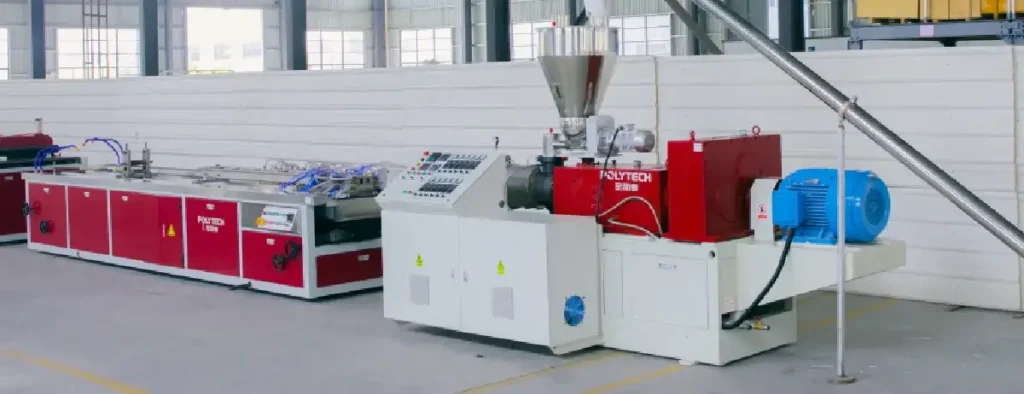
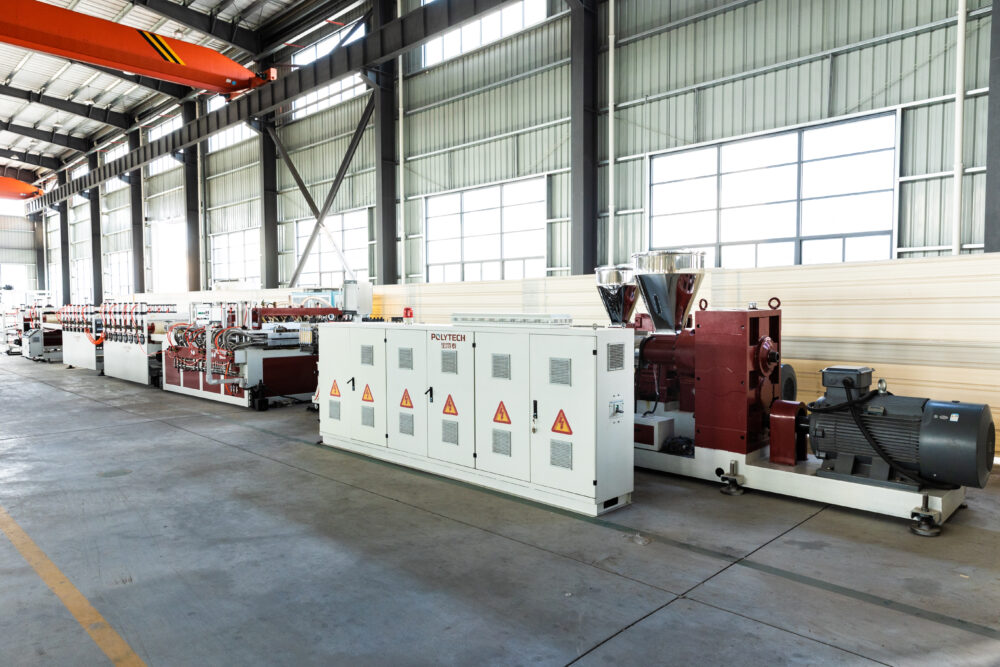
Example of a POLYTECH PVC foam board extrusion line (twin-screw extruders feeding a flat board die) in operation. The PVC Foam Board Extrusion Line is engineered to extrude and form lightweight foamed boards from polyvinyl chloride (PVC) resin Using twin-screw extruders with precise temperature control and a specialized T-die mold, the line produces rigid PVC sheets with a foamed cellular core. These PVC foam boards exhibit high durability, water resistance, and excellent printability, making them a versatile substitute for traditional wood or solid plastic sheets The foaming process yields a strong but lightweight board (typical thickness ranging from 5 mm up to 30 mm) that is easy to handle and cost-effective to transport. POLYTECH’s PVC foam board lines incorporate advanced automation and calibration systems to ensure consistent thickness and density across the sheet width, as well as a smooth surface finish.
Key Features and Applications of PVC Foam Board:
- Robust, Waterproof Panels: PVC foam boards are inherently moisture-proof and do not rot or delaminate. The extrusion process produces a smooth, non-adhesive surface that requires no additional finishing – boards come out with a ready-to-use finish and do not need painting or lamination They also provide good sound and thermal insulation and resist shock, making them suitable for both indoor and outdoor use
- Easy Fabrication: The foamed PVC sheets can be easily cut, drilled, sawed, or glued, behaving much like wood but without wood’s drawbacks They resist warping, cracking, and can be securely fastened with screws or adhesives, allowing convenient assembly and installation in various projects.
- Versatile Applications: Thanks to their light weight and durability, PVC foam boards serve many industries. Common uses include advertising and signage (e.g. billboards, display panels) where printable, weather-resistant sheets are needed They are also widely used in interior design and furniture (for cabinets, wall panels, partitions), in construction (wall cladding, false ceilings), and even in specialty areas like automotive and marine engineering as a wood-replacement for interior panels The material’s resistance to moisture and chemicals also makes it popular for environmental and outdoor applications (e.g. kiosks, marine upholstery backing)
POLYTECH has extensive expertise with PVC foam board technology, being an early adopter of this machinery in China. The company’s foam board extrusion lines feature DCS smart remote control systems for monitoring and troubleshooting – allowing Polytech engineers to guide customers online and perform remote diagnostics if needed This ensures high uptime and production stability for customers using these lines.
PP Hollow Sheet Extrusion Line (Plastic Formwork Board)
The PP Hollow Sheet Extrusion Line (often referred to as a plastic formwork board line) produces rigid polypropylene hollow sheets with a multi-wall cross-section. These sheets resemble twin-wall corrugated plastic panels and are particularly used as reusable construction formwork in place of traditional plywood. POLYTECH developed its PP hollow sheet line through in-house innovation, digesting advanced extrusion technologies and customizing them for polypropylene processing The line typically includes a main extruder (for PP melt) plus a co-extruder for surface layers or edge sealing, a special hollow-profile die to form the cellular structure, and a calibrated vacuum sizing table to maintain sheet flatness. POLYTECH’s design supports sheet thicknesses roughly in the 8 mm to 18 mm range and sheet widths up to 915–1220 mm, adjustable per customer requirements Despite PP’s semi-crystalline nature, the extruders are engineered with optimized screws and controls to ensure homogeneous melt and consistent extrusion of the hollow profile.
Key Features and Applications of PP Hollow Sheet:
- High Strength & Reusability: Polypropylene formwork sheets are extremely tough and impact-resistant. Each hollow PP board can be reused 50–100+ times in concrete casting, far outlasting plywood formwork The material’s strength and the ribbed hollow structure give it the rigidity to support wet concrete, while its durability allows repeated cycles of use, dramatically reducing formwork material costs for builders.
- Workability and Compatibility: PP formwork panels have good machinability – they can be sawed, planed, drilled, and nailed just like wood They can even be used side by side with traditional timber formwork if needed. This makes adoption easy on construction sites, as workers can apply the same tools and techniques. The panels are lightweight, which improves handling and safety during formwork setup and removal
- Smooth Concrete Finish: A key advantage of plastic formwork is the smooth surface it imparts to cast concrete. PP hollow sheets have low adhesion to concrete, so once the mold is removed, the concrete surface is uniform and smooth, meeting architectural “fair-faced” concrete requirements without needing secondary plastering This saves builders time and finishing costs. (For applications like bridge piers, patterned surface sheets can be used to achieve decorative finishes and reduce glare)
- Waterproof & Chemical Resistant: Polypropylene panels do not absorb moisture and are immune to rot, corrosion, acids, and alkalis Unlike plywood, they won’t swell or delaminate in wet conditions. This makes them ideal for high-humidity or below-grade construction (e.g. basement walls, foundations, bridges, tunnels) where wooden formwork would deteriorate. The PP boards remain dimensionally stable between –20 °C and +60 °C, maintaining performance in a wide temperature range
- Cost-Effective & Eco-Friendly: Although the initial cost per panel is higher than plywood, PP hollow formwork can save 30% or more in total formwork cost due to its reusability and reduced labor (fewer replacements and repairs) Worn-out plastic panels can be fully recycled at end-of-life, ground down and re-extruded, resulting in zero waste disposal This environmental benefit, combined with reduced wood consumption, makes PP formwork an eco-friendly choice for modern construction.
POLYTECH’s PP hollow sheet lines have been supplied to construction material manufacturers globally, reflecting the construction industry’s trend toward plastic formwork systems. The company’s technical refinements – such as a hollow profile extrusion die that tightly controls wall thickness and a stable downstream cooling/cutting unit – ensure the boards have uniform wall structure and reliable dimensions POLYTECH also provides formulation guidance (for PP and filling agents) to help customers achieve the optimal balance of rigidity and impact strength in the sheets. These lines empower manufacturers to produce high-quality formwork boards that meet the rigorous demands of large-scale concrete projects.
POLYTECH’s 25+ Years of Experience, Innovation and Turnkey Support
POLYTECH’s long history and global success in extrusion machinery give it a unique edge as a partner for industrial sheet manufacturers. The company was founded in 1998 and has since accumulated decades of know-how in plastics processing It is recognized as a pioneer in technologies like UPVC roofing sheets and WPC foam boards in China, continuously innovating to improve machine performance and efficiency. For example, POLYTECH has developed advanced remote monitoring and control systems – many of its extrusion lines are equipped with a DCS smart remote control, enabling engineers to perform online guidance, diagnostics, and even process adjustments for clients in real time This level of technical innovation and service greatly reduces downtime and speeds up troubleshooting for customers.
With an international outlook from the start, POLYTECH began exporting its equipment in 2000 and now has a global footprint. Over 100 countries have received Polytech extrusion lines, and the company maintains a network of regional support. It has established after-sales service teams in regions like South America, the Middle East, and South Asia to provide local assistance Whether it’s commissioning a new line or servicing an existing one, Polytech’s engineers can be on-site or available online to support customers. This global reach means that buyers can count on reliable supply of spare parts, prompt technical service, and an understanding of local market needs.
Crucially, POLYTECH offers turnkey project support for its sheet extrusion lines. From initial consultation through installation and production ramp-up, Polytech provides end-to-end services. This includes factory layout planning, equipment installation, and on-site testing, as well as training for operators either at POLYTECH’s facility or the customer’s plant The company also assists with process recipes and formulations – for instance, advising on polymer blends or additive usage to achieve certain product properties Customers receive detailed operation manuals and maintenance guidance, and Polytech ensures the line is producing in-spec products before handing over. Furthermore, the standard warranty and long-term maintenance support provide peace of mind that the investment is protected
In summary, POLYTECH has built a strong reputation as a turnkey solutions provider in the sheet extrusion industry. Its combination of experience (25+ years in extrusion), technical innovation, comprehensive product range, and unwavering customer support has made it a go-to choice for companies looking to start or upgrade sheet production lines. Whether producing PVC construction sheets, hollow PP boards, customers can expect robust and high-performance machinery backed by Polytech’s expertise and global service. This commitment to quality and partnership is what positions POLYTECH as a trusted leader in sheet extrusion technology for B2B industrial clients worldwide.