

Plastic formwork has emerged as a cutting-edge alternative to traditional wood and metal formwork in the construction industry. Formwork refers to the temporary molds or panels used to shape and support concrete until it cures. In recent years, plastic formwork panels – often made from robust polymers like polypropylene (PP) or polyvinyl chloride (PVC) – have gained popularity for their durability, reusability, and efficiency. This article provides a comprehensive overview of plastic formwork, including its technical characteristics, advantages over wood and metal, key applications, and environmental benefits. It also highlights POLYTECH MIDDLE EAST as a leader in plastic formwork extrusion solutions, drawing on its 25+ years of industry experience, global reach, and innovative technologies in producing PP Hollow Formwork and PVC formwork panels.
What is Plastic Formwork?
Plastic formwork consists of reusable plastic panels or modular systems that serve as molds for concrete in construction projects. These panels are designed to hold freshly poured concrete in shapes for walls, slabs, columns, and other structural elements, similar to how plywood or metal formwork is used. Unlike traditional formwork, which is typically made of timber or steel, plastic formwork panels are made from high-strength polymers (commonly PP or PVC) that offer unique performance benefits. They are engineered to be lightweight yet strong, and to withstand the pressures of wet concrete without warping or failing. Plastic formwork panels can be produced in standard sizes (often mirroring plywood sheets like 915×1830 mm or 1220×2440 mm) and thicknesses (e.g. 12–18 mm), and often feature hollow-core or foam-core designs to reduce weight while maintaining rigidity.
Plastic formwork panels (the light blue PP boards) being used as slab formwork on a construction site. These reusable panels provide a smooth mold for concrete slabs, replacing traditional plywood and metal forms.
Technical Overview: How Plastic Formwork Panels are Made
Modern plastic formwork panels are typically manufactured through a plastic extrusion process that ensures consistent quality and precise dimensions. In a Plastic Formwork Extrusion Line, raw plastic materials (such as PP or high-density polyethylene HDPE for hollow panels, or PVC resin for foam boards) are melted and extruded through a flat sheet die to form panels of the desired width and thickness. Advanced extrusion machines – like those developed by POLYTECH – maintain precise temperature control and use specialized molds to produce uniformly thick sheets with smooth surfaces. The continuous sheet is then cooled (often by a vacuum calibration table and water cooling) to solidify the panel without warping
Once cooled, the panels are cut to standard sizes using automated cutters for efficiency and accuracy. The result is a flat or textured plastic board ready for use as formwork. PP formwork panels often have a hollow grid structure (with internal cellular cavities) that reduces weight and provides insulation, while maintaining high impact strength PVC formwork panels are often produced as foam boards, which are solid boards with a foamed core – this yields a lightweight yet stiff panel with good nail-holding capacity. Both types of panels can be easily sawed, drilled, or nailed similar to wood, allowing them to be cut to fit various formwork dimensions and fixed in place on site
From a technical standpoint, plastic formwork panels and their extrusion lines have seen significant innovation. The latest generation of extrusion machines incorporate a high degree of automation and precise control systems – including automatic feeding, mixing, and temperature regulation – to ensure consistent panel quality Multi-section calibration and cooling systems reduce internal stresses in the plastic, resulting in panels with excellent flatness and dimensional stability These technological advancements by companies like POLYTECH enable the mass-production of durable, high-precision formwork panels with minimal manual intervention
Advantages of Plastic Formwork vs. Wood and Metal
Plastic formwork offers numerous advantages over traditional wood and metal formwork materials. Below are key points of comparison highlighting why many contractors and builders are switching to plastic:
- Much Longer Reusability: Plastic formwork panels can be reused dozens of times – often 30, 50 or even 100+ cycles – before needing replacement, far outlasting plywood which might only last a few uses For example, standard plywood formwork might be discarded after 5–8 uses due to warping or damage, whereas quality PP or PVC panels have been tested to endure well over 50 reuse cycles without significant loss of performance Metal formwork (steel or aluminum) also offers high reusability (aluminum systems can exceed 100 uses), but comes with other trade-offs like higher cost and weight.
- Waterproof and Rot-Proof: Unlike timber, plastic formwork does not absorb water, so panels will not swell, deform, or rot even after days of being immersed or exposed to rain. This moisture immunity means plastic panels retain their shape and strength over time, whereas wood can delaminate or decay. Plastic also won’t rust like steel, making it ideal for humid or corrosive environments.
- Non-Stick Surface (No Release Agent Needed): Plastic formwork has a smooth, non-adhesive surface that concrete does not easily stick to. This allows for easy demolding – the panels can be stripped from cured concrete without prying or special release oils By contrast, wood often requires a release agent (oil) to prevent concrete from bonding, and metal forms must be cleaned and oiled to avoid sticking and corrosion. The smooth face of plastic formwork produces a clean, smooth concrete finish straight off the mold, often eliminating the need for plastering or secondary surface finishing This improves construction quality and saves time on site.
- Lightweight & Easy Handling: Plastic panels are generally lighter than equivalent wood panels (especially when wood is wet) and certainly much lighter than steel. The light weight of plastic formwork makes it easier and safer for workers to carry, position, and dismantle he forms This reduces labor fatigue and can speed up assembly/disassembly times. Lighter formwork also means lower transportation costs and easier logistics on sites without heavy lifting equipment.
- High Strength and Durability: Despite being lightweight, engineered plastic formwork panels have high impact strength and load-bearing capacity. PP hollow boards, for instance, combine rigidity with flexibility – they have enough give to resist cracking, yet are robust enough to support heavy concrete pressures They also exhibit excellent chemical resistance (resisting acids, alkalis, and chemical admixtures in concrete) and remain stable across a range of temperatures from cold climates to high heat This durability means fewer damaged panels and lower replacement rates over a project’s life.
- Consistent Performance & Precision: Because plastic panels are manufactured in controlled factory conditions their quality (thickness, dimensions, surface smoothness) is very consistent. They do not suffer from the natural imperfections of wood (knots, grain variation) or the denting/bending issues of thin steel sheets. This precision yields accurate concrete dimensions and tight fits, reducing issues like grout leakage at joints. Modern plastic formwork systems often come in modular, interlocking designs that ensure alignment and can be assembled with minimal gaps.
- Easy Maintenance and Cleaning: Plastic formwork is easy to clean after use – usually a simple water rinse removes concrete residue, since cement doesn’t cling to plastic. There’s no need for intensive scraping or special solvents, and as noted, no need to reapply oil for each use The panels also do not splinter or rust, which means safer handling and lower maintenance effort compared to repairing wood edges or removing rust from steel.
- Cost-Effectiveness in the Long Run: Although plastic formwork panels often have a higher initial cost per unit compared to plywood, their extended lifespan and reusability make them more economical over multiple reuse cycles. Contractors can achieve a lower cost per pour since the same panels can be cycled through many sections of the project. Additionally, because plastic panels speed up construction (due to easier handling and no finishing required on concrete), there are indirect savings in labor and time. Many construction companies find that plastic formwork pays for itself after a certain number of reuses, beyond which it yields pure savings compared to continually buying new wood panels.
Below is a comparison table summarizing key differences between Plastic, Wood, and Metal formwork:
| Characteristic | Plastic Formwork (PP/PVC) | Wood Formwork (Plywood) | Metal Formwork (Steel/Aluminum) |
| Weight | Lightweight; easy to carry and position. | Moderate; heavier when wet. | Heavy (steel is heaviest; aluminum lighter but still more than plastic). |
| Reusability | High – 30–50+ uses typical (often up to 100 with care) | Low – usually 5–10 uses before replacement. High-grade plywood with plastic/phenolic coating can reach ~20 uses. | High – 50+ uses common; aluminum formwork can exceed 200 cycles with proper maintenance |
| Durability | Waterproof, will not rot or corrode; does not warp with moisture. Resistant to most chemicals. Can handle wide temperature range without losing integrity | Prone to water damage, swelling, and rot. Can delaminate or crack over time. Needs dry storage and treatment to extend life. | No rot; steel can corrode if not protected, aluminum resists rust. Metal is very durable but may dent or deform under mishandling. Requires cleaning/oiling to prevent concrete adhesion and rust. |
| Surface Finish | Very smooth surface; concrete comes out fair-faced (smooth), often no plastering needed Non-stick to concrete – strips easily without release oil | Plywood can impart wood grain texture; joints can leave marks. Typically requires paint or release agent to prevent sticking, and surface may need skim-coat plastering for a smooth finish. | Steel/aluminum give smooth finishes if clean, but metal surfaces must be oiled or they can stick to concrete. Joints may imprint lines; generally produce good finish, especially aluminum which often achieves plaster-free results |
| Handling & Workability | Easy to cut, drill, and nail with standard tools (similar to wood) Panels often modular with interlocks or tie holes. Lightweight panels reduce labor fatigue and improve safety. | Easy to cut and nail, but wood can splinter. Moderate weight – can be manhandled, but larger pieces are cumbersome. Generates a lot of waste off-cuts. | Requires specialized cutting (grinders for steel). Heavy – often needs cranes or more workers to position large forms. Metal edges can be sharp; care needed in handling. |
| Initial Cost | Moderate to high per panel (but low cost per use over lifespan due to many reuses). Generally an investment in a long-term asset. | Low cost per panel (plywood is inexpensive upfront), but high ongoing cost as panels need frequent replacement. Significant waste over project duration. | Highest cost upfront – steel and aluminum formwork systems are expensive investments. However, high reusability can justify cost for very large/repetitive projects. Aluminum formwork, while costly, often provides long-term value for large developers using it across many projects. |
| Environmental Impact | Eco-friendly in long term: saves trees by reducing plywood use; panels can be fully recycled at end of life Often made from recycled plastics and can be re-ground into new panels, supporting a circular economy Minimal waste since panels are reused many times. | Relies on timber (deforestation concerns). Short service life means many panels end up as waste in landfills or incinerated. Some plywood has hazardous glues. However, wood is biodegradable over the long term. | Steel and aluminum production is energy-intensive and has a high carbon footprint. However, metal formwork is reusable many times (reducing waste) and is recyclable as scrap metal at end of life. Aluminum in particular can be melted down and reused with relatively less energy than primary production, offering potential environmental benefits if recycled |
Key Applications of Plastic Formwork
Plastic formwork panels are versatile and used across various construction segments. Their properties of reusability, strength, and light weight make them suited for both simple and complex concrete structures. Common applications include:
- Residential Construction: Plastic formwork is used for pouring foundations, beams, walls, and slabs in housing projects. The standard panel sizes align well with typical room dimensions, and the easy handling is advantageous on small to mid-size sites. Reusable plastic forms can significantly speed up repetitive tasks in multi-unit residential developments.
- Commercial Buildings: High-rise and commercial projects benefit from plastic formwork for columns, shear walls, and floor slabs, especially where complex shapes or architectural finishes are required. Plastic panels can be molded or textured to impart patterns on concrete surfaces if needed, and their smooth finish meets the quality demands of commercial interiors The panels’ consistency and precision help in constructing dimensionally accurate structures, which is critical in large buildings.
- Bridges and Infrastructure: Large infrastructure projects (bridges, tunnels, retaining walls) often use modular plastic formwork systems for efficiency. The lightweight panels reduce the load on scaffolding and are easier to move in difficult terrain or elevated positions. For example, plastic formwork has been employed in bridge pier and abutment casting, as well as tunnel lining molds, where their high strength-to-weight ratio is a big advantage. In these projects, the high reusability of plastic formwork saves cost since many repeated pours are needed
- Precast Concrete Production: Precast yards and factories use plastic formwork panels to manufacture concrete elements off-site. Precast slabs, panels, and modular elements can be cast on flat plastic formwork beds or within plastic molds. The smooth surface of plastic formwork ensures the precast components have a clean finish. Additionally, plastic molds can be designed for intricate shapes (like decorative facades or complex geometric pieces) where a flexible, non-stick mold material is essential. The durability of plastic formwork under continuous production conditions (and its easy stripping) makes it ideal for precast plants.
- Columns and Retaining Walls: Plastic formwork systems are available for round and square columns, often as interlocking panels that clamp to form a tube. These are reusable alternatives to single-use cardboard forms or heavy steel forms. In retaining walls or long shear walls, plastic panels speed up the work because they can be handled without cranes and stripped/re-set quickly along the wall’s length. The result is a uniform wall surface without the patchwork of wood formwork joints.
In summary, any construction scenario that involves repetitive concrete work or requires high-quality surface finishes can benefit from plastic formwork. They are especially advantageous in projects where logistics and labor are constraints – for instance, remote sites (where transporting or replacing timber is hard) or urban sites (where speed and cleanliness are priorities). Many contractors pair plastic formwork with conventional materials (using plastic panels for large surfaces and plywood for odd corners or fill-ins) to balance cost and benefit. Over time, however, as plastic formwork becomes more cost-competitive, it is increasingly being adopted as a primary formwork method in both small and large projects.
Environmental Benefits of Plastic Formwork
One of the most compelling aspects of plastic formwork is its contribution to sustainability and environmental conservation in construction. The environmental benefits can be highlighted as follows:
- Reduced Timber Use: Every plastic formwork panel in service means one less plywood or timber sheet needs to be produced and disposed of. This directly translates to fewer trees cut down for construction purposes. Given that plywood formwork often uses hardwood veneers and involves significant logging, switching to plastic formwork helps preserve forests and biodiversity. Over the lifespan of a large project, the reduction in timber usage can be substantial.
- Minimized Construction Waste: Plastic formwork’s long lifespan drastically cuts down the volume of discarded formwork material. Traditional wooden forms often become trash after a few uses – splintered, soaked, and unusable – contributing to construction waste piles. In contrast, plastic panels remain intact over dozens of uses, and even when they do eventually break or wear out, the old panels can be completely recycled. In fact, end-of-life plastic formwork can be crushed and reprocessed into new formwork panels, achieving a near 100% recycling rate and a true circular life cycle This means almost no formwork material needs to end up in landfills – a significant boost for the “green” circular economy in construction
- Lower Carbon Footprint Over Time: While manufacturing plastic (a petroleum-derived product) has a carbon footprint, the ability to reuse the panels many times means that footprint is spread out over numerous uses. Studies have shown that plastic and steel formwork can be reused many more times than wood, offsetting their initial manufacturing emissions. Additionally, modern plastic formwork often utilizes recycled plastics in its production, further reducing the net carbon impact. By requiring fewer replacements and transportation cycles (fewer new panels to ship in), plastic formwork can reduce emissions associated with logistics and production of new materials.
- Avoiding Harmful Chemicals: Wooden formwork typically requires coatings of oils or release agents (which can contain volatile organic compounds) to prevent concrete adhesion. These chemicals can leach into soil or emit fumes, and disposing of oily formwork can contaminate jobsite runoff. Plastic formwork needs no release oil, eliminating this source of chemical pollution. Moreover, high-quality plastic formwork does not rely on the formaldehyde-based adhesives that some plywood uses, thus avoiding those toxins.
- Long-Term Recyclability of Metals vs. Plastics: It is worth noting that metal formwork is also reusable and recyclable, which is an environmental advantage over wood. Aluminum formwork, for instance, can be melted down and recycled at end of life. However, the energy required to produce metals is very high, and if a metal formwork system isn’t reused enough times, its environmental cost per use remains high. Plastic formwork hits a sweet spot of moderate manufacturing impact combined with very high reuse and full recyclability, yielding an overall environmentally friendly profile when properly utilized.
In essence, plastic formwork aligns with the construction industry’s growing emphasis on sustainability. By promoting a reuse culture and enabling recycling, it helps projects meet green building criteria and reduce waste. POLYTECH’s focus on formwork solutions explicitly emphasizes these environmental goals: the company notes that even damaged plastic templates can be regenerated into new ones, saving resources and supporting green industry practices This philosophy is increasingly important as companies and governments worldwide push for more eco-conscious construction methods.
POLYTECH Middle East: Leading the Way in Plastic Formwork Extrusion
POLYTECH Middle East has positioned itself as a leader in plastic formwork extrusion technology, providing state-of-the-art machinery and complete production lines to clients internationally. As the regional arm of Hangzhou POLYTECH Plastic Machinery Co., the company leverages over 25 years of experience in plastic extrusion to drive innovation in formwork manufacturing POLYTECH’s equipment and expertise embody precision, durability, and scalability – key qualities that construction industry clients demand when adopting plastic formwork solutions.
Global Experience and Innovative Technologies: Founded in 1998 in China (with technical roots back to 1994), POLYTECH has a long track record of developing advanced plastic extrusion machines Over the past two decades, the company has accumulated abundant technical know-how and earned a reputation for quality, exporting production lines to more than 100 countries across Europe, Asia, Africa, and the Middle East This global reach means POLYTECH understands the diverse needs of construction markets – from the fast-paced high-rise development in urban centers to infrastructure growth in emerging economies – and it continually adapts its technology accordingly. The company holds multiple national patents on extrusion equipment designs, reflecting its commitment to innovation and unique engineering solutions. For example, POLYTECH’s latest generation of formwork extrusion lines incorporate smart controls, automation, and energy-efficient features that set them apart in precision and performance
Specialization in PP Hollow and PVC Formwork Extrusion: A core strength of POLYTECH is its specialized machinery for producing both PP hollow formwork panels and PVC formwork (foam board) panels. POLYTECH has focused on PP plastic construction formwork production lines for over 10 years, continuously refining the technology through multiple generations Now on its fifth generation of PP hollow formwork extrusion lines, POLYTECH’s machines can efficiently produce high-quality hollow-core PP panels that meet the rigorous demands of modern construction. These extrusion lines feature single or twin-screw extruders, precision dies (often for multi-layer composite sheets), vacuum calibration tables, multi-stage haul-offs, automated cutters, and stacking systems – all synchronized via computer control for high-speed, high-accuracy production The result is an output of PP formwork panels with consistent thickness (usually 12–18 mm with <3% variance) and excellent surface finish, including options for UV-coated surfaces for outdoor durability
For PVC formwork panels, POLYTECH offers complete PVC Foam Board Extrusion Lines that produce rigid foam PVC boards used in formwork and other applications. These machines precisely control the foaming process to yield boards that are lightweight yet structurally sound. The PVC panels coming off POLYTECH lines are known for their moisture resistance and stability, making them ideal as reusable concrete forms. POLYTECH’s equipment allows customization of panel density, thickness, and surface texture, giving manufacturers flexibility to serve different construction needs (from standard formwork panels to specialty boards). Importantly, both the PP and PVC formwork machines are designed for scalability – they support high throughput for mass production, enabling suppliers to meet large project demands or even establish panel rental fleets for the construction market. The fully automated, continuous production capabilities mean clients can scale up output without sacrificing quality or precision.
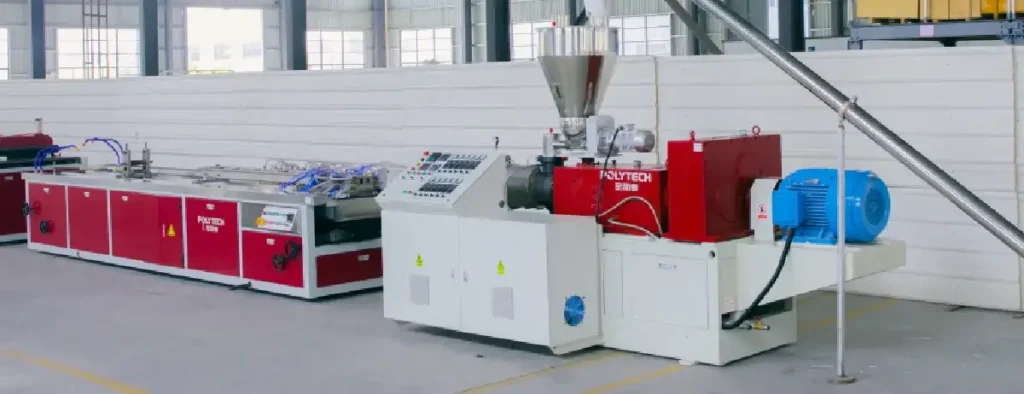
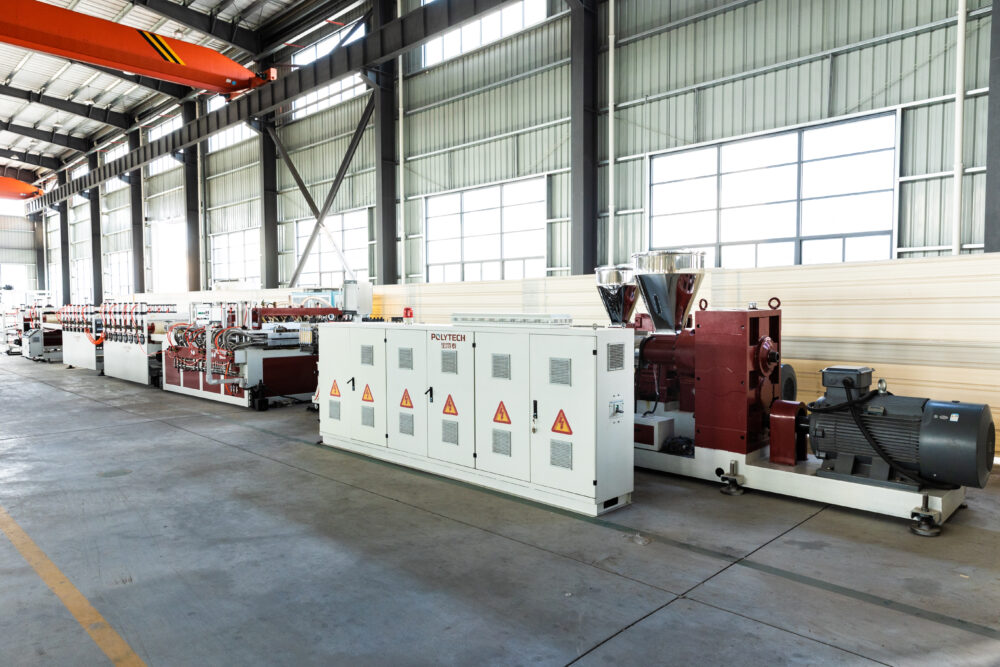
A POLYTECH plastic formwork extrusion line. This high-precision machinery extrudes and forms PP hollow formwork panels, delivering consistent quality at industrial scale. POLYTECH’s advanced extrusion technology ensures uniform panel dimensions, smooth surfaces, and efficient production for construction formwork suppliers.
Precision, Durability, and Turnkey Support: Construction clients value machinery that can deliver precise products with minimal downtime. POLYTECH’s formwork extrusion lines are built with heavy-duty components and intelligent controls, resulting in durable machines that run continuously with minimal maintenance. Features like automatic screen changers (for filtering out impurities without stopping production) and multi-point thickness control guarantee that each panel meets exact specifications This level of precision is critical because even small deviations in panel thickness or flatness could affect the assembly of formwork and the quality of the poured concrete. By investing in technology that tightly regulates temperature, pressure, and extrusion speed, POLYTECH ensures its clients can produce formwork panels of consistent high quality batch after batch.
Moreover, POLYTECH Middle East distinguishes itself by offering end-to-end support to customers adopting its extrusion solutions. With an integrated team and network in the region, POLYTECH provides services such as installation, training, and technical consulting to get factories up and running smoothly They can assist with workshop layout, formulation of plastic materials (e.g. optimizing the PP or PVC blends for strength and cost), and ongoing maintenance support The company’s philosophy of “Excellent quality, perfect as one” underlines a turnkey approach – delivering not just a machine, but a complete solution that ensures clients achieve the promised efficiency and product performance from day one. Over the years, POLYTECH has executed numerous turnkey projects and has partnered with over 500 companies worldwide, reflecting the trust it has built through reliable technology and service excellence.
In summary, POLYTECH Middle East is at the forefront of the plastic formwork revolution. By combining deep industry experience, cutting-edge extrusion machinery, and comprehensive client support, POLYTECH enables construction firms and material manufacturers to embrace plastic formwork with confidence. Its PP Hollow Formwork extrusion lines and PVC Foam Board lines deliver the precision, durability, and scalable output that industrial B2B customers require to stay competitive and meet the growing demand for high-quality, reusable formwork panels. With plastic formwork poised to play a major role in greener and more efficient construction, companies like POLYTECH are driving the innovation needed to make this transition feasible and profitable worldwide.
Conclusion
Plastic formwork represents a significant advancement in construction methodology – offering a sustainable, efficient, and cost-effective alternative to traditional wood and metal forms. Technically sophisticated plastic panels (PP hollow or PVC foam) provide excellent reusability, weather resistance, and structural performance, which translate to smoother construction processes and high-quality concrete finishes. The advantages over plywood (dramatically longer life, consistent quality, no rot) and over steel/aluminum (lighter weight, lower handling costs) make plastic formwork an attractive solution for projects of all scales. Additionally, the environmental benefits – from saving timber and reducing waste to enabling recycling – align with the construction industry’s push toward sustainability and circular economy practices
Crucially, the rise of plastic formwork is supported by companies like POLYTECH MIDDLE EAST, whose leadership in extrusion technology has made it possible to manufacture these advanced panels reliably and economically. With decades of experience and a global footprint, POLYTECH provides the machines and expertise that turn raw polymer into high-performance formwork panels at scale. Their innovation in PP hollow formwork lines (now in the 5th generation) and PVC panel production ensures that builders and formwork suppliers have access to top-quality equipment that delivers on precision and efficiency. By investing in such technology, stakeholders in the construction sector can reap the benefits of plastic formwork – achieving faster construction cycles, lower long-term costs, and a greener footprint – all while maintaining the structural integrity and safety that projects demand.
In conclusion, plastic formwork is not just a trend but a transformative development in construction, and POLYTECH’s role as a pioneer in this field underscores how technology and experience combine to drive the industry forward. As more companies adopt plastic formwork for its clear advantages, the construction landscape will continue to shift towards more innovative, durable, and environmentally conscious practices, building a future where quality and sustainability go hand in hand.