

Plastic manufacturing is a broad field encompassing various processes to shape raw polymers into finished products. From everyday consumer goods to specialized industrial components, plastics are formed through techniques like injection molding, blow molding, and extrusion. Each process has unique advantages and produces different types of plastic items. This article provides a comprehensive overview of plastic manufacturing processes (with a focus on extrusion), common plastic products and their applications, the machinery and systems involved (extrusion lines, extruders, molds, downstream equipment, etc.), and how POLYTECH Middle East serves as a regional partner in delivering advanced plastic manufacturing equipment and services. The goal is to offer an informative, professional guide for a B2B audience, highlighting the technology and capabilities without the fluff of marketing jargon or SEO gimmicks.
Major Plastic Manufacturing Processes
Plastic parts can be made using several primary manufacturing methods. Here we introduce the most widely used processes – injection molding, blow molding, and plastic extrusion – and how they differ:
Injection Molding (Discrete Parts)
Injection molding is a process where melted plastic is injected under high pressure into a metal mold cavity, then cooled to solidify into the desired shape. This method produces individual discrete parts with complex three-dimensional geometries (for example, bottle caps, automotive interior panels, or appliance housings). Injection molding is ideal for high-volume production of identical items with excellent repeatability and fine detail. The key components are an injection molding machine (with an injection unit and a clamping unit) and the precision-engineered mold which forms the part. Once the mold is filled and the part cools, the mold opens and ejects the finished piece. Injection molding is valued for its ability to produce precise, intricate components quickly, but it requires significant up-front mold fabrication costs.
Blow Molding (Hollow Objects)
Blow molding is a plastic forming process used to create hollow objects such as bottles, containers, tanks, and other hollow shapes. In blow molding, a heated plastic parison (a tube-like piece of molten plastic) is placed in a mold and then inflated with air pressure so that it expands and conforms to the mold’s walls. Once the plastic cools and hardens, the mold is opened and the hollow product is released. This technique is commonly used for making packaging bottles (e.g. for water, soda, detergents), fuel tanks, and other hollow containers. Variations of blow molding include extrusion blow molding (where the parison is extruded and then blown) and injection blow molding (where a preform is injection-molded first, then blown into its final shape). Blow molding allows efficient mass production of uniform hollow plastic items with thin walls.
Plastic Extrusion (Continuous Profiles and Sheets)
Plastic extrusion is a continuous manufacturing process in which raw plastic material (usually pellets or granules) is melted and pushed through a shaped die to form a continuous profile of a fixed cross-section. Unlike molding processes that produce individual parts, extrusion creates a continuous length of product that can be cut or coiled as needed. This makes extrusion ideal for items with consistent cross-sections, such as pipes, tubing, sheets, films, cables, and profiles (e.g. window frame sections). In an extrusion machine (called an extruder), a screw rotates inside a heated barrel, melting and conveying the plastic forward. The molten plastic exits through a die opening that imparts the desired shape (for instance, a circular die for making pipe, a flat slit die for sheets, or a complex profile die for window frames). As the hot extrudate emerges, it is cooled (often by air or water) to solidify the shape, and then continuously pulled by downstream equipment until it can be cut to length or rolled for packaging. Extrusion is highly efficient for high-volume production of long products – it offers continuous output, minimal waste, and excellent consistency in dimensions. Many everyday plastics – from drinking straws and PVC pipes to plastic films and wire insulation – are made by extrusion.
(In summary, injection molding and blow molding are used for discrete and hollow products respectively, while extrusion produces continuous lengths of material. These processes often complement each other in the plastics industry, depending on the product requirements.)
Common Plastic Products and Industrial Applications
Plastics appear in virtually every industry, and different manufacturing processes produce different categories of products. Below are some common types of plastic products and their industrial applications, with an emphasis on those made via extrusion (continuous products) as well as a nod to other processes where relevant:
Construction Industry – Pipes, Profiles, and Panels
The construction industry heavily uses extruded plastic products for infrastructure and building materials. Notable examples include PVC and HDPE pipes for water supply, plumbing and drainage systems, electrical conduit pipes, and cable ducting – these are typically made by pipe extrusion lines. uPVC window and door profiles (rigid frames for windows/doors) are extruded in continuous lengths and cut to size, offering durable, weather-resistant alternatives to wood or metal frames. Other construction-related extruded items are siding and cladding panels, vinyl flooring planks, decking boards, and roofing sheets (such as corrugated PVC or polycarbonate panels for roofs and skylights). These materials are popular because they are lightweight, corrosion-proof, and easy to install, often reducing maintenance compared to traditional materials. For example, using vinyl siding or uPVC window frames improves a building’s weather resistance and thermal insulation while lowering upkeep needs. Injection-molded parts also appear in construction (like plastic hardware or fittings), but extrusion dominates long components like pipes and profiles. POLYTECH’s extrusion lines enable manufacturers to produce these construction components with consistent quality and in high volumes, ensuring that builders and contractors have reliable standardized products that meet building codes and performance standards.
Packaging Industry – Films, Sheets, and Containers
Plastics are indispensable in the packaging industry, with extrusion and molding both playing key roles. Plastic films used for bags, shrink wrap, and food packaging are made by film extrusion (often using a blown film process, which is a type of extrusion where a tubular film is inflated). These thin films of polyethylene (PE) or polypropylene (PP) are produced in rolls and later converted into bags or wrapping material. Similarly, plastic sheets of materials like PET, PP, or PS are extruded and then thermoformed into trays, cups, lids, and blister packs for packaging foods and consumer goods. Extrusion provides the uniform thin-gauge sheets and films needed for consistent thermoforming results. For example, high-output blown film extrusion lines can continuously produce rolls of LDPE film for packaging, while sheet extrusion lines create the flat plastic sheets that will be molded into clamshell packages or disposable cups. POLYTECH Middle East’s extrusion equipment supports packaging manufacturers by delivering precise control over film/sheet thickness and surface quality, which is crucial for downstream sealing, printing, or forming operations. In addition to extruded films and sheets, the packaging sector also uses injection-molded containers and caps (for rigid tubs, lids, etc.) and blow-molded bottles (for beverages, detergents, etc.). Thus, an integrated packaging plant might extrude plastic film for flexible packaging while injection molding caps and blow molding bottles – each process contributing to the final packaged product line. Overall, extrusion technology provides the speed and consistency required for modern high-volume packaging production.
Automotive Industry – Seals, Hoses, and Profiles
The automotive sector relies on a multitude of plastic components, many of which are produced by extrusion. For instance, cars and trucks contain numerous extruded seals and profiles – such as the weatherstripping around doors and windows (often made of extruded EPDM rubber or PVC), plastic tubing for fuel lines and fluid transfer, convoluted cable conduits and wire insulation, as well as decorative trim strips and protective edge guards on interiors. These parts are well-suited to extrusion because they are long, continuous pieces that can be cut to length as needed for each vehicle. An extruded door seal profile, for example, can be produced in coils and then cut into segments to fit each door frame, providing a fast and economical way to manufacture these critical sealing components. Extrusion allows tight tolerances and continuous production, ensuring that each seal or hose has consistent dimensions and material properties. Automotive plastics must often withstand heat, chemicals, and mechanical stress – extruders can be equipped to process specialty polymers (or rubber blends) that meet these requirements, producing parts with the necessary flexibility or rigidity. POLYTECH’s extrusion machines can manufacture automotive profiles with the precision and material consistency required for safety and performance (e.g. fuel tubing that resists gasoline, or rubber seals that retain elasticity in cold weather). By using extruded components, automotive OEMs benefit from lighter weight parts (replacing metal or heavier materials) and efficient assembly (extruded pieces can be designed to snap or fit perfectly, reducing assembly time). Of course, other plastic manufacturing processes are also prominent in automotive: injection molding is used for larger 3D parts like bumpers, dashboards, and interior panels, while blow molding is used for items like windshield washer fluid tanks or fuel tanks. Each process provides what it’s best at – extrusion for long flexible parts and profiles, injection for complex shapes, and blow molding for hollow shapes – collectively enabling the modern automobile to be built with a high content of plastic parts.
Furniture and Consumer Goods – Panels, Profiles, and More
Extruded plastics find broad use in furniture, home goods, and consumer products as well. Plastic panels and boards are used in cabinetry and furniture – for example, PVC foam boards (made by a foam extrusion line) serve as lightweight, water-resistant panels for kitchen cabinets, bathroom furniture, and outdoor signage. These boards can replace traditional wood in many applications, offering resistance to moisture and rot (useful for outdoor or damp environments) while being easier to clean. Extruded edge banding strips (thin plastic strips, often ABS or PVC) are produced in continuous rolls and later applied to cover the exposed edges of particleboard furniture, giving a smooth finished look to tables, shelves, or cabinets. In the home, curtain tracks and picture frame moldings are often long plastic profiles made by extrusion. Everyday consumer items like garden hoses (PVC or rubber hose extrusions), drip irrigation tubing for agriculture, straws, cable ties, and even certain toy parts (like flexible tubing or rods) are extruded. For instance, a manufacturer can use a POLYTECH extrusion line to produce hundreds of kilometers of drip irrigation tubing with precise diameters and emitter spacing, which helps save water in agriculture. Consumers benefit from these extruded products as they are generally cost-effective, lightweight, and customizable in color or texture. It’s also common for injection molding to be used alongside extrusion in consumer goods manufacturing – e.g. an office chair might have extruded plastic tubing for the frame and injection-molded joints or fittings that connect pieces together. POLYTECH Middle East’s equipment allows manufacturers in the furniture and consumer goods sector to create custom profiles and panels in large volumes, with consistent quality. Whether it’s a decorative PVC trim profile for furniture or the flexible hose for a vacuum cleaner, extrusion machines provide the throughput and reliability needed to supply global consumer markets.
(Across these industries and more, plastic manufacturing processes provide the versatility to produce everything from tiny precision parts to large structural components. Extrusion in particular underpins a vast range of products by delivering continuous profiles and materials that improve construction durability, enable efficient packaging, enhance vehicle performance, and add convenience or aesthetics to daily life.)
Machinery and Systems in Plastic Manufacturing
Producing plastic products at an industrial scale requires specialized machinery and systems. Each manufacturing process has its own core equipment – for example, injection molding uses injection presses and steel molds, blow molding uses blow mold machines and air pressure systems, and extrusion relies on extruders and coordinated downstream equipment. Below, we focus on the machinery used in plastic extrusion, as it involves not just a single machine but an entire extrusion line composed of multiple integrated components. We’ll also touch on the role of molds and tooling in both extrusion and molding processes, and highlight how these systems come together in a production line.
Extrusion Lines and Extruders
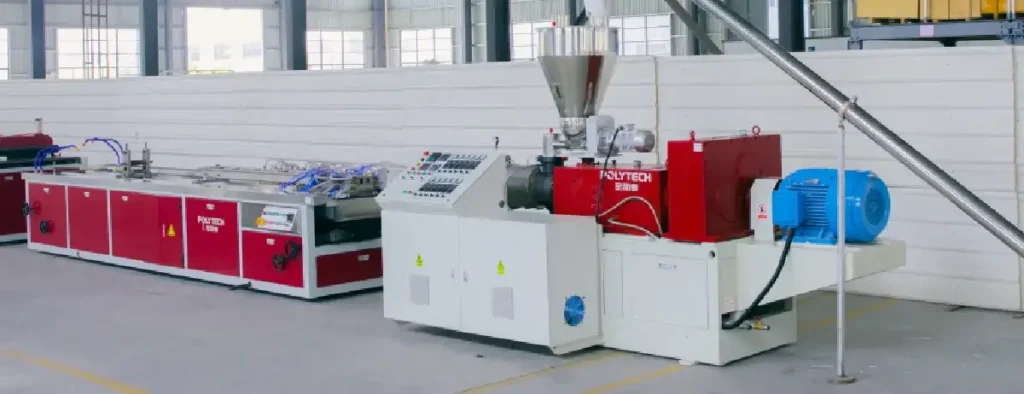
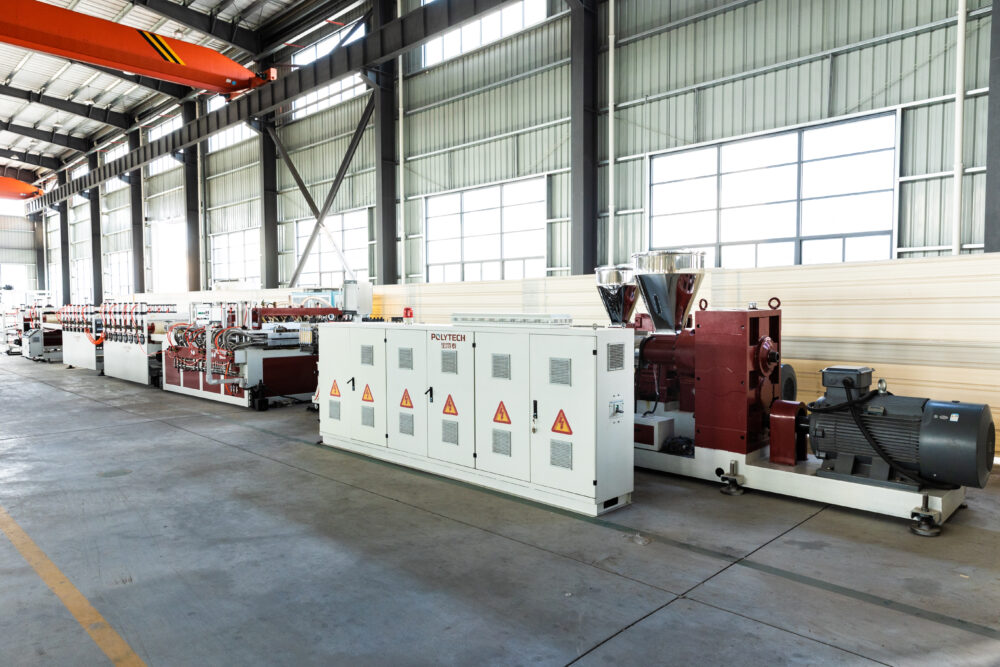
An example of an extrusion line by POLYTECH Middle East: a twin-screw extruder (right, in red) feeds molten polymer into a sheet die and roller system to produce plastic roofing sheets. The integrated line includes material hoppers, an extrusion barrel, and downstream cooling/calibrating rollers.
In an extrusion-based production, the primary machinery is the extrusion line – a turnkey system that takes in raw material at one end and outputs a finished continuous product at the other end. A full extrusion line typically consists of several key components working in unison:
- Feeding system: This usually includes a hopper and automatic feeders (or loaders) that supply plastic pellets or powder into the extruder at a controlled rate. In some cases, a material mixing unit (for blending additives or colorants) is used upstream to ensure a homogeneous feed.
- Extruder: The extruder is the heart of the line – a machine comprising a motor-driven screw rotating inside a heated barrel. As the screw turns, it melts the plastic and pushes it forward. Extruders come in different sizes and types, mainly single-screw and twin-screw designs, which we discuss shortly. The extruder’s job is to generate a steady, well-mixed melt of plastic at the correct temperature and pressure, ready to be shaped by the die.
- Die and Tooling: At the end of the extruder, the molten plastic is forced through a shaping die (a piece of precision tooling that has an opening in the shape of the final product’s cross-section). This die is often accompanied by calibration tools or molds right after it, especially for profiles and pipes, to size and cool the new shape so it holds its form. We will discuss tooling in more detail in the next subsection.
- Calibration and Cooling equipment: As the continuous shape exits the die, it is still hot and soft. Cooling tanks (for pipes and profiles) or cooling rollers (for sheets and films) are positioned immediately downstream to gradually cool and solidify the product without distortion. For example, a PVC pipe extrusion line uses a vacuum calibration tank filled with water; the vacuum holds the soft pipe against a sizing sleeve to ensure it hardens to the exact diameter. A sheet line might have a series of chilled metal rolls that press and cool the sheet to the desired thickness.
- Haul-off (Puller): To maintain continuous movement, a haul-off unit pulls the extruded product through the line at a controlled speed. This is typically a motorized belt or caterpillar track that grips the product. Synchronizing the haul-off speed with the extruder screw speed is critical – too fast and the product would stretch and thin out; too slow and it could buckle or accumulate. A steady haul-off ensures the extrudate retains uniform dimensions.
- Cutting or winding unit: Since extrusion produces an endless product, it must be either cut into lengths or wound onto rolls at the end of the line, depending on the product type. Pipe, profile, and rod extrusion lines often have an automatic cutter (saw or knife) that periodically cuts the product to standard lengths (e.g. 3m or 6m pipes, or window profile segments). For thin items like film, plastic strapping, or small flexible profiles, a winder coils the product continuously onto spools instead of cutting. Modern cutters and winders are usually servo-controlled and synchronized with the line so that cuts occur at the right intervals and coils are neat.
All these elements together make up a complete extrusion line. POLYTECH Middle East designs and supplies full extrusion lines that integrate all necessary components from material feeding through extrusion, calibration, haul-off, and cutting, delivering a turnkey system optimized for the target product. By fine-tuning each part of the line – selecting the appropriate extruder size, screw design, die tooling, cooling length, etc. – the line is able to achieve high throughput, consistent product quality, and efficient operation for its specific application. For example, a POLYTECH PVC pipe extrusion line will include a twin-screw extruder (for PVC), a multi-head pipe die (if making multiple small pipes in parallel), a vacuum cooling tank, a dual-belt haul-off, and a planetary cutter – all coordinated to produce pipes at the desired diameter and wall thickness continuously. In contrast, a plastic sheet extrusion line from POLYTECH might use a single-screw extruder with a flat T-die, a three-roll calendaring stack for cooling/flattening, and a shear-cutting unit for sheet lengths. In all cases, automation and control systems (PLC-based controls) monitor the line, adjusting heaters, screw speed, and puller speed to maintain stable processing conditions. This level of integration allows manufacturers to ramp up production quickly and reliably, knowing that each component of the line is matched and tuned for the product at hand.
Extruder Types – Single vs. Twin Screw: The extruder itself comes in different configurations. Single-screw extruders use one screw and are the most common, known for their simplicity and general-purpose capability. They work well for melting and pumping polymers that don’t require heavy compounding – for example, PE and PP materials for pipes, films, or simple profiles can be run on single-screw extruders efficiently. Twin-screw extruders, on the other hand, have two intermeshing screws (either co-rotating or counter-rotating, arranged in parallel or in a conical intersecting shape) and excel at mixing and compounding tasks. Twin-screw designs are often used for formulation-intensive plastics like PVC (which is typically processed as a powder blend and needs thorough mixing and precise temperature control) or filled compounds like wood-plastic composites. POLYTECH offers both single and twin-screw extruders to suit different materials and applications. For instance, PVC extrusion almost always employs twin-screw extruders (often in a conical twin-screw configuration) because PVC is heat-sensitive and processed as a dry blend – the twin-screw provides better control and gentle mixing to avoid degrading the polymer POLYTECH’s conical twin-screw extruders are optimized for PVC profiles and pipes, generating high output pressure at lower screw speeds, which is ideal for maintaining quality in uPVC window profiles, pipe extrusion, and WPC products.
Single-screw extruders, by contrast, are cost-effective workhorses for tasks like polyethylene pipe extrusion or polypropylene sheet extrusion, where intensive mixing is not as critical. Both types are engineered by POLYTECH with robust barrels and screws, precise temperature zone control, and automatic pressure regulation, ensuring a stable melt flow and consistent product dimensions. In summary, the choice of extruder depends on the material and product requirements: single-screw machines for straightforward melting and high throughput, twin-screw machines for demanding compounding and sensitive materials.
Screws and Barrels: Within any extruder, the screw and barrel are core components that determine performance. The screw is a helical shaft that conveys and mixes the plastic, and the barrel is the surrounding heated cylinder. A well-designed screw has sections for feeding solids, compressing and melting the polymer, and metering/pumping the melt out to the die. The barrel contains heating elements and temperature sensors to keep the plastic at the right melt temperature as it travels. POLYTECH pays special attention to screw and barrel design, offering customized configurations to match each customer’s material and product needs. For example, a screw for a high-density polyethylene (HDPE) pipe extruder might have a deep channel feed section to take in pellets, and a gradual compression to melt the waxy HDPE efficiently, whereas a conical twin-screw for PVC will have a different geometry to ensure gentle gelation of PVC powder and incorporation of additives. The materials of construction are also crucial: POLYTECH’s screws and barrels are made from hardened, wear-resistant steel alloys (often with bimetallic linings) to withstand the abrasive fillers and high temperatures encountered in extrusion. Over time, screws and barrels do wear down, especially when processing filled or reinforced plastics, but POLYTECH’s designs maximize their lifespan and the company’s local spare parts support in the Middle East ensures replacements or refurbishments are available to minimize downtime. The screw and barrel as a pair govern the extrusion’s throughput, mixing quality, and stability – so having the right design means efficient melting, uniform blending of additives, and a steady output with minimal energy waste. (POLYTECH also supplies screws and barrels as spare parts or upgrades for existing machines, covering standard sizes like 51/105, 65/132, 80/156 mm conical twin-screw sets commonly used in the industry.)
Molds and Extrusion Tooling
Whether in extrusion or molding processes, tooling is what gives the plastic product its shape. In injection or blow molding, the term “mold” refers to the metal cavity (or cavities) that form the shape of the part – these molds are typically made of steel and precision-machined to have the negative shape of the final product. Molten plastic is injected or blown into the mold, filling it completely, and when it cools we get a solid object conforming to that cavity. Injection molds can be quite complex (with multiple parts, moving sections for undercuts, cooling channels, etc.), and they are a critical part of the injection molding system. Blow molds similarly shape the outside of a hollow part as air pushes the material outward.
In extrusion, instead of a closed mold cavity, we use a die and associated tooling to shape the continuously flowing plastic. The extrusion die is essentially a specialized steel profile opening: as the molten plastic is forced through, it takes on the cross-sectional shape of that opening. For example, a pipe die has a central mandrel creating a ring-shaped gap for the plastic to flow around – producing a hollow pipe. A sheet die (T-die) has a long flat slit for making sheets. A profile die has a more intricate cut-out matching the profile’s geometry (such as the multi-chamber shape of a window frame profile). Immediately after the die, extrusion lines often use calibrators or sizing plates – these can be thought of as simple molds that hold the extruded shape at the correct dimensions until it cools enough to be self-supporting. For a pipe, the calibrator might be a short round sleeve, and a vacuum tank right after helps suck the pipe outward against that sleeve to fix its diameter. For a complex profile, a series of calibrator blocks might be used to gently shape and cool the multiple walls of the profile to exact measurements.
POLYTECH Middle East provides a comprehensive range of extrusion toolings and moulds tailored to different products and industry standards. High-quality tooling is essential because it directly impacts the accuracy, surface finish, and consistency of the extruded product. For instance, POLYTECH offers pipe extrusion dies equipped with adjustable sizing sleeves and vacuum calibration tanks to ensure pipes come out with precise diameters and roundness. For flat products like boards and sheets, POLYTECH supplies flat T-dies along with polishing/cooling roller systems or calibration frames that ensure the sheet’s thickness and flatness are uniform. For complex profiles (e.g., uPVC window frames, multi-hollow panels, siding panels), POLYTECH delivers custom profile dies and calibrator sets that can include multi-stage calibration and even co-extrusion setups. Co-extrusion dies allow multiple layers or materials to be merged (such as applying a thin cap layer of UV-resistant polymer onto a base layer profile in one extrusion pass). In POLYTECH’s lineup, you can find examples like profile molds for window frames, ceiling panel and wall cladding dies, pipe dies, and wood-plastic composite profile dies, each engineered for durability and easy setup on the production line.
The materials used for extrusion dies and molds are high-grade tool steels, often polished to a mirror finish on flow surfaces to reduce friction. Design features like flow channels and breaker plates inside the die help distribute the molten plastic evenly before it exits, preventing areas of stress or uneven flow. POLYTECH’s tooling designs also often integrate cooling channels or vacuum assist where needed to rapidly solidify the extrudate in the correct form. By using precision-engineered tooling, manufacturers can achieve tight tolerances and smooth surfaces on profiles right out of the extrusion line, minimizing any need for post-extrusion machining or finishing. In summary, molds and tooling in plastic manufacturing are what turn the shapeless melt into a useful object or profile – be it an injection mold for a phone case or an extrusion die for a pipe. POLYTECH’s expertise in custom extrusion dies and calibrators ensures clients get exactly the shape and dimensions they require with each product.
Downstream and Auxiliary Equipment
Producing a finished plastic product involves more than just the primary forming machine (extruder or molding press). A variety of auxiliary equipment supports the process, handling everything from material preparation to cooling to final handling of the product. In extrusion lines especially, downstream equipment beyond the extruder is crucial to achieving a stable, automated process. Let’s outline some of the key auxiliary systems commonly used in plastic extrusion (many of which also have analogues in molding operations):
- Material Handling & Mixing: Upstream of the extruder, plastic raw materials need to be stored, conveyed, and sometimes premixed. Hopper loaders or vacuum conveyors move pellets from storage bins into the extruder’s hopper. Mixers and blenders (such as high-speed turbomixers for PVC compounds or gravimetric batch blenders for multiple components) are used to combine resin with additives like color masterbatch, stabilizers, or filler powders. Proper mixing ensures a homogeneous feed, which leads to consistent melting and product color. POLYTECH offers feeding and mixing units (e.g., automatic dosing systems, PVC dry blend mixers) as part of their equipment range, so that the extruder is continuously supplied with well-mixed material. For example, a gravimetric feeder might continuously dispense precise ratios of virgin polymer, regrind, and color additive into the extruder, maintaining product consistency.
- Calibration & Cooling: As mentioned earlier, devices like vacuum calibration tables, water cooling baths, and cooling rolls are placed right after the extrusion die to support and solidify the product. These are critical downstream units – without proper cooling, the hot extruded plastic could warp or sag, losing the desired shape. POLYTECH’s downstream cooling systems are designed to match the product needs: a long water tank with adjustable vacuum for a pipe line, or a series of stainless steel cooling rolls for a sheet line. They are also synchronized with the extruder speed (the cooling rate and pulling speed go hand-in-hand to achieve correct dimensions). Temperature control units (chillers) may be used to maintain the water or roll temperature at an optimal setpoint for consistent cooling.
- Haul-Off (Puller): The haul-off machine (or caterpillar puller) is an indispensable part of extrusion lines, as it ensures the continuous movement of the product through the line. POLYTECH’s haul-off units come in various designs (belt haul-offs, caterpillar tracks, or roller pullers) chosen based on the product (e.g., a wide sheet might use multiple rollers across its width, while a small tube might use belt pullers). They are equipped with speed control and sometimes an encoder feedback to precisely match the extrusion output. A well-calibrated haul-off prevents stretching or compression of the product, thereby maintaining a uniform cross-section and smooth surface along its entire length.
- Cutting & Take-off: Downstream cutting saws or knives automatically cut rigid extruded products to the required lengths. POLYTECH supplies cutting units that are often servo-driven to synchronize the blade travel with the moving product, enabling a clean, square cut without cracking or deforming the plastic. For instance, a PVC profile line might have a fly-knife cutter that moves with the profile for a split second to make the cut, then returns to make the next cut, all timed with the extrusion speed. If the product is not meant to be cut (like flexible hose or film), winding units take up the output. POLYTECH’s winders can handle products like tubing, cable, or film, winding them onto spools or rolls uniformly. Additional take-off equipment can include conveyors or stacking tables that collect the cut pieces and arrange them for packing.
- Vacuum Pumps, Air Compressors, and Other Utilities: Auxiliary utilities support the above equipment. Vacuum pumps provide the suction in calibration tanks (vital for pipe/profile accuracy) – POLYTECH offers vacuum pump units in different power ratings (e.g. 2.2 kW, 5.5 kW) to ensure a stable vacuum for any given line. Air compressors might be needed for pneumatic cutters or for powering air jets in certain calibration systems. Melt filters (screen changers) can be installed before the die to remove contaminants from recycled material melts. Static mixers or gear pumps might be used for very critical extrusion processes to stabilize output. Dosing units can add color or foaming agents into the melt stream. Even in injection molding cells, you find auxiliaries like mold temperature controllers (to heat/cool the mold), robotic part removers, and granulators to recycle sprues – but for extrusion, the focus is on continuous handling of product.
By providing a complete set of these downstream and auxiliary units along with the main extruder, POLYTECH Middle East acts as a one-stop supplier for fully functional extrusion lines. Every component – from the hopper feeder at the start to the cutter or coiler at the end – is designed to work in harmony as part of the overall system. This turnkey approach means a manufacturer does not have to source pieces from multiple suppliers and attempt to integrate them; instead, they receive an optimized, unified line with all parts synchronized by a central control system. The result is a smooth production workflow where raw material goes in and finished product comes out continuously with minimal manual intervention. Such integrated lines improve efficiency, reduce the risk of compatibility issues, and simplify the installation and startup of new production capacity.
POLYTECH Middle East – Regional Capabilities and Services
Having reviewed the processes, products, and machinery in plastic manufacturing, it’s worth highlighting how POLYTECH Middle East supports plastic manufacturers as a regional equipment provider. POLYTECH Middle East is the Middle East extension of POLYTECH Plastic Machinery Co., Ltd., a global player in plastic extrusion technology. Established in 2023 as an expansion of the parent company’s activities, POLYTECH Middle East is based in Istanbul and provides localized sales, support, and services for customers across the Middle East region. This means manufacturers in the region have direct access to advanced extrusion machinery and expertise, backed by a company with over 25 years of experience in the plastics equipment industry.
Product Portfolio: POLYTECH Middle East specializes in plastic extrusion equipment and complete extrusion lines. Their offerings cover:
- Full Extrusion Lines for a variety of end products – for example, turnkey lines for ASA/PVC roofing sheets, PVC/PE pipes, SPC and WPC flooring, PP hollow formwork panels, PVC foam boards, PC/PMMA sheets, PVC granulation (pelletizing) lines, drip irrigation tube lines, uPVC window profile lines, and more. Each line is delivered as a tailored solution with all necessary components.
- Extruders and Components – including single-screw extruders (in different diameters and lengths for polyolefins, etc.) and twin-screw extruders (both conical and parallel types for PVC and compounding needs). They also provide the core screws and barrels as individual offerings or replacements, as well as specialized gearboxes and drives for extruders.
- Extrusion Tooling and Molds – custom-designed dies, calibrators, moulds, and downstream jigs for producing pipes, profiles, sheets, and films of various sizes. Whether a client needs a new profile die for a unique product shape or a high-speed multi-strand pipe die to boost output, POLYTECH can supply the precise tooling required.
- Auxiliary Equipment and Spare Parts – POLYTECH Middle East’s catalog also includes auxiliary machines like mixers, feeders, vacuum pumps, haul-off units, cutters, coilers, temperature control units, and even raw material handling systems. In addition, they maintain an inventory of spare parts (heating elements, controllers, gear units, etc.) and wear parts (screws, barrels, seals) so that customers can get replacements quickly when needed. Notably, POLYTECH also provides some plastic raw materials (such as ASA and PVC resins) to customers, reflecting a one-stop approach from materials to machinery.
Turnkey Project Services: One of POLYTECH Middle East’s key strengths is acting as a turnkey project partner for setting up or expanding plastic manufacturing lines. Rather than just selling machines, they offer end-to-end support that includes:
- Custom Engineering and Consultation: POLYTECH’s engineering team works closely with clients to design solutions tailored to their product goals. They consider factors like polymer type, formulation, desired output rate, and product specifications to recommend the optimal equipment configuration. This might mean customizing screw designs, designing a unique die for a new profile shape, or advising on plant layout. The result is a bespoke extrusion line or equipment set that is fine-tuned to the customer’s requirements, rather than a one-size-fits-all machine.
- Installation and Training: After equipment procurement, POLYTECH handles on-site installation and commissioning of the machines. Their technical team will guide the setup of the extrusion line, including alignment of machines, connection of utilities (electrical, water, air), and initial test runs. They often assist with workshop design – advising how to arrange machines for efficient workflow and safety. Once the line is installed, POLYTECH provides comprehensive training for the customer’s operators and maintenance staff. Training can be conducted at POLYTECH’s own facilities (to see similar lines in operation) or at the customer’s factory during commissioning. This ensures that the local team is confident in running the line, performing product changeovers, and handling routine maintenance, which is crucial for a successful start-up.
- After-Sales Support and Maintenance: POLYTECH Middle East prides itself on strong after-sales service. Customers benefit from having a regional support hub that can respond quickly to service requests. The company offers a standard 12-month warranty on new machines, during which any issues are addressed. But beyond that, POLYTECH provides lifetime technical support – meaning even years down the line, they can supply spare parts, upgrades, or repair services as needed. With a local spare parts stock and technical personnel in the Middle East, downtime for clients can be minimized. Whether it’s replacing a worn screw, troubleshooting an electrical fault, or optimizing process settings for a new material, POLYTECH acts as a long-term partner to keep the production lines running smoothly. This level of ongoing support is a major advantage for manufacturers who may not have in-house expertise on every aspect of the extrusion equipment.
Experience and Track Record: The backing of POLYTECH’s global experience is another advantage of working with POLYTECH Middle East. The parent company (based in China) has over 25 years of experience and has delivered equipment to over 100 countries worldwide, earning multiple national patents for its innovations. This extensive track record means the technology is proven and continually improved with feedback from diverse markets. By 2025, POLYTECH Middle East has successfully executed projects and collaborations with over 500 international companies, demonstrating trust and reliability in their solutions. Moreover, POLYTECH adheres to international quality standards (in design, manufacturing, and safety compliance), ensuring that their machines meet the expectations of modern factories in terms of performance and durability. The company’s motto, “Excellent quality, perfect as one,” underlines a commitment to delivering integrated, high-quality systems. For Middle Eastern customers, having a partner that combines global expertise with local presence is invaluable – it means state-of-the-art machinery is available along with culturally and regionally attuned support.
In summary, POLYTECH Middle East offers more than just machines – it provides complete solutions for plastic manufacturing, from planning and customization to installation and lifetime service. This empowers plastics producers in the region to adopt cutting-edge extrusion technology and produce world-class plastic products with confidence. Whether a company needs a new PVC pipe production line, an upgrade to their extrusion tooling, or technical training for their staff, POLYTECH Middle East has the capability and experience to deliver. By bridging the gap between advanced manufacturing technology and on-the-ground support, POLYTECH Middle East has established itself as a valuable partner in the growth of the region’s plastics industry.
Conclusion
Plastic manufacturing is a diverse field, encompassing multiple processes to meet the vast array of product demands in modern life. Injection molding and blow molding produce discrete and hollow items ranging from precision engineered parts to everyday bottles. Extrusion stands out for its ability to continuously produce lengths of material with uniform profiles – fueling industries like construction, packaging, automotive, and consumer goods with an endless supply of pipes, films, profiles, and panels. Achieving success in any of these processes requires not only an understanding of the materials and techniques but also the right machinery and support systems. We’ve seen that an extrusion line is a complex orchestra of extruder, die, calibrators, cooling, haul-off, and cutting equipment, all of which must be finely tuned to deliver quality output. Companies like POLYTECH Middle East play a pivotal role in this landscape by providing the advanced equipment and technical support needed to establish and maintain efficient production lines. With a full spectrum of extrusion solutions, custom engineering, and turnkey services, POLYTECH Middle East enables manufacturers to focus on innovation and production, rather than worrying about machinery limitations. The result is a thriving manufacturing operation that can produce high-quality plastic products reliably and cost-effectively. As the demand for plastic components continues across industries, having such reliable technology partners and a solid grasp of manufacturing processes will be key for any business aiming to excel in the plastics sector.