

Plastic machines are the backbone of modern manufacturing, encompassing the equipment that transforms raw polymers into finished plastic products. These machines – including extrusion lines, extruders, moulds, and auxiliary devices – enable high-volume production of plastic pipes, sheets, profiles, films, and more. POLYTECH Middle East is a specialist in this field, providing advanced plastic extrusion equipment and turnkey production lines for a wide range of applications.
From full extrusion lines to high-performance extruders, precision screws and barrels, custom extrusion toolings and moulds, and all necessary auxiliary equipment, Polytech offers end-to-end solutions to meet the needs of today’s plastic product manufacturers These plastic machines play a pivotal role across industries – from construction and packaging to automotive and furniture – by efficiently turning raw plastic materials into the durable components that power our world.
Full Extrusion Lines: Turnkey Production Systems
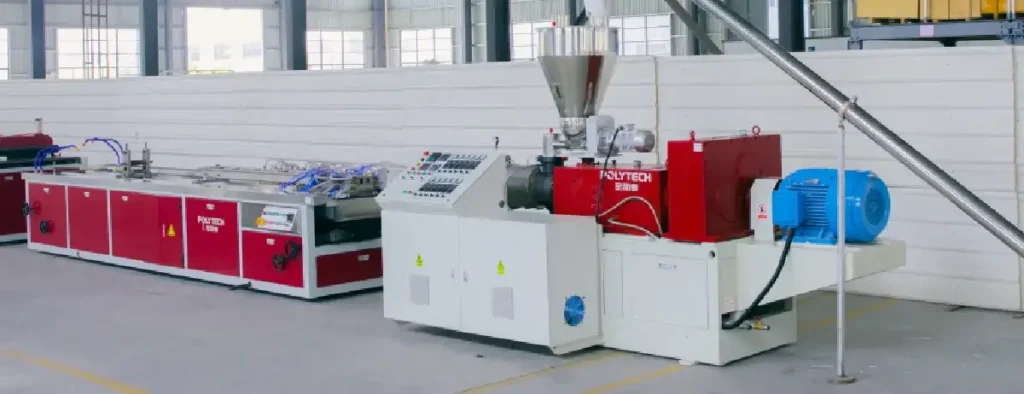
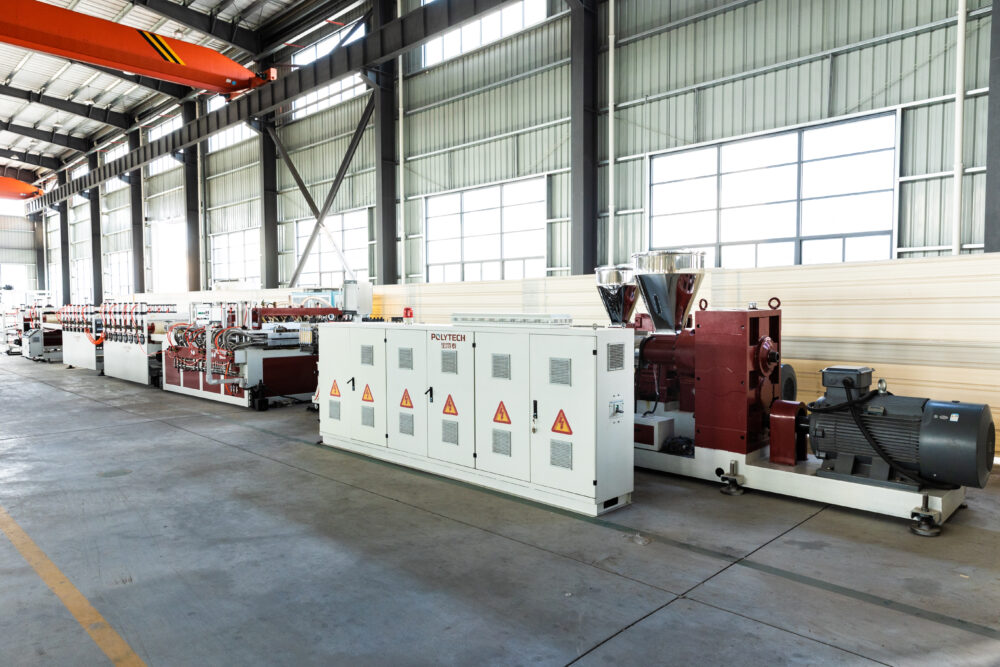
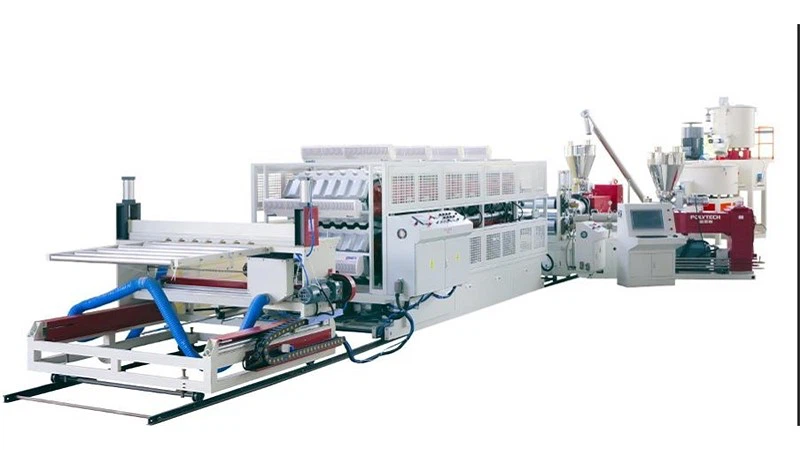
POLYTECH Middle East designs and supplies Full Extrusion Lines that integrate all the machinery needed to produce specific plastic products from raw material input to finished output. A full extrusion line typically includes an extruder, material feeding system, die mold, calibration and cooling units, a haul-off (puller), and a cutting or winding unit, all synchronized for continuous production. Each line is optimized for a particular end product, ensuring high throughput, consistent quality, and efficient operation. Notable examples of Polytech’s full lines include:
A complete line for manufacturing lightweight, durable PVC foam boards. These boards have a high strength-to-weight ratio and are used in signage, furniture, and construction. The line precisely controls foam extrusion to produce boards with smooth surfaces and uniform thickness, using components like specialized T-dies, vacuum calibration tables, and multi-station cutters for high-quality output.
A turnkey system for producing corrugated PVC sheets, synthetic roof tiles, and flat panels for roofing. This line extrudes heated PVC through a shaped die to form weather-resistant, UV-stable roofing sheets. Key units include the extruder (often with co-extrusion for multi-layer sheets), forming molds or rollers to create profiles (waves or tile patterns), cooling sections, and cutting tools. The result is lightweight roofing panels with excellent durability for various building types.
A specialized extrusion line for manufacturing rigid uPVC profiles such as window and door frames. It typically features a conical twin-screw extruder optimized for PVC, followed by a precision profile die and vacuum calibrator that shape the molten PVC into the multi-chamber profile design. Downstream, calibration tables, haul-off units, and automatic cutters work in tandem to produce accurate, low-maintenance uPVC profiles in continuous lengths, ready for use in energy-efficient windows and doors.
A full line for producing PP/HDPE hollow formwork panels, which are reusable plastic molds for concrete in construction. This extrusion line yields strong but lightweight panels that replace traditional plywood formwork. The system includes a high-capacity twin-screw extruder to mix plastic with any fiber fillers, a flat sheet die for hollow panels, calibration/cooling units to maintain panel shape, and cutting stations. The resulting formwork panels are dimensionally stable, water-resistant, and can be reused many times, greatly improving construction efficiency.
A compounding and pelletizing line that converts raw or recycled plastic into uniform granules (pellets) for reuse in manufacturing. Polytech’s granulation lines (often based on twin-screw extruders) mix PVC resin with additives, then extrude the molten compound through a pelletizing die. A cutter chops the extrudate into pellets, which are cooled and collected. These granulation lines enable high-capacity production of plastic compounds, allowing manufacturers to recycle scrap or prepare custom polymer blends in-house. (For instance, Polytech offers complete PVC granulation systems for making feedstock pellets for new extrusion processes
Each POLYTECH full extrusion line is delivered as a turnkey solution – from material handling through extrusion and downstream automation – all engineered to work together seamlessly. By customizing each line’s screw design, extrusion tooling, and downstream equipment, Polytech ensures optimal melt quality, dimensional precision, and productivity for the specific product being made. This integrated approach allows manufacturers to ramp up production quickly with confidence in the consistency and quality of the output.
Extruders: Single-Screw and Twin-Screw Extrusion Machines
At the heart of every extrusion line is the extruder – the machine that melts and pushes the plastic material through a die to form a continuous shape. Polytech Middle East provides both single-screw extruders and twin-screw extruders, each suited to different materials and applications
These extruders use one rotating screw inside a heated barrel to continuously melt and extrude the polymer. They are the most common and straightforward type of extruder, valued for their simplicity, reliability, and high output for general-purpose use Single-screw machines are ideal for plastics like polyethylene (PE) and polypropylene (PP) that do not require intensive mixing. For example, many pipe, tubing, and film extrusion processes use single-screw extruders to achieve excellent throughput with relatively low operating cost. Polytech’s single-screw extruders are engineered for efficient melting and stable pressure, making them workhorses for tasks like PE/PP pipe extrusion and sheet film production.
These extruders have two intermeshing screws (which can be configured as co-rotating or counter-rotating, and either parallel or conical in arrangement) working together to process the plastic. Twin-screw extruders excel at mixing and compounding – they impart more shear and better blending of additives or fillers into the molten polymer This makes them the preferred choice for formulations that are heat-sensitive or highly filled. PVC extrusion, for instance, almost always uses twin-screw extruders, since PVC is often fed as a dry blend powder and requires thorough, gentle mixing and precise temperature control to avoid degradation. POLYTECH offers advanced twin-screw extruders, including conical twin-screw models optimized for PVC. The conical design generates high pressure at lower screw speeds, which is ideal for producing consistent uPVC profiles, pipes, and WPC (wood-plastic composite) products with minimal thermal stress. Twin-screw extruders are more complex and higher in cost than single-screw machines, but they deliver superior control over material homogenization, devolatilization, and output stability – essential for high-quality, specialty plastics.
All Polytech extruders are built with robust screw and barrel assemblies (often bimetallic for wear resistance), precise temperature zones, and automated control systems to maintain stable processing conditions. Whether a project calls for a simple single-screw extruder or a high-performance twin-screw extruder, Polytech can provide the right solution tailored to the material and product requirements, ensuring consistent melt quality and throughput for downstream forming
Screws and Barrels: The Core of Extrusion Performance
Within any extruder, the screw and barrel are the critical components that directly affect melting efficiency, mixing quality, and output rate. Polytech Middle East places special emphasis on these core parts, offering custom-designed screws and barrels to match each application. The screw, a helical metal shaft, rotates inside the barrel, which is a precision-engineered heated cylinder. As the screw turns, it conveys raw plastic forward, generating pressure and frictional heat that melts the material. A well-designed screw has sections for feeding, compressing, and metering the plastic melt, ensuring the polymer is uniformly melted and mixed by the time it reaches the end of the barrel The barrel, for its part, must withstand high temperatures and pressures; it is equipped with heating elements and sensors to maintain the optimal melt temperature profile throughout the process
Polytech’s screws and barrels are fabricated from hardened, wear-resistant steel alloys to endure the abrasive and high-heat conditions of extrusion. This durability prolongs the service life of the extruder and minimizes maintenance downtime. Moreover, Polytech can tailor the screw geometry (length, flight depth and pitch, mixing elements, etc.) and barrel configuration to the customer’s material and product. For example, they provide conical twin-screw barrel systems specifically for PVC and WPC extrusion, which ensure excellent output pressure and thorough compounding in a compact form factor. High-performance screw/barrel sets yield multiple benefits: efficient throughput, consistent melt quality, and reduced energy consumption, all of which translate to better product quality and lower operating cost. When these components do eventually wear out after years of production, Polytech’s local support in the Middle East ensures that replacement screws and barrels or refurbishment services are readily available, keeping the production lines running smoothly.
(POLYTECH also supplies screws and barrels as spare parts or upgrades for existing plastic machines. Their catalog covers common sizes like 51/105, 65/132, 80/156 conical twin-screw sets, among others, each designed for specific output ranges
Extrusion Toolings and Moulds: Precision Dies for Every Profile
Downstream of the extruder, the molten plastic must be shaped into the desired product form – be it a pipe, sheet, profile, or panel. This is accomplished by extrusion toolings and moulds, which are the custom dies, molds, and calibrators that give the plastic its final cross-sectional shape and dimensions. POLYTECH Middle East provides a comprehensive range of Extrusion Toolings and Moulds to suit different products and industry standards. These tooling sets are meticulously engineered for each application, because the design of the die and its associated calibration tools directly determines the accuracy and finish of the extruded product
For example, to produce plastic pipes, POLYTECH offers pipe dies with a circular profile and adjustable sizing sleeves; immediately after the die, a vacuum calibration tank cools and sets the pipe’s diameter with high precision. For flat sheets or boards, they provide flat T-dies along with calibration rollers or plates that ensure the extruded sheet solidifies to the correct thickness and flatness. For complex profiles like window frames or multi-hollow panels, POLYTECH delivers specialized profile tooling (dies and calibrator blocks) that create intricate cross-sections with multiple hollows or chambers. These may include multi-strand dies to extrude several small profiles in parallel, or co-extrusion dies that combine multiple materials/layers in one profile (such as a UV-resistant cap layer on a base material). In Polytech’s lineup you can find, for instance, profile extrusion molds for uPVC window frames, panel tooling for WPC or PVC foam panels, pipe moulds, ceiling panel and wall cladding dies, and even co-extrusion tooling for multilayer products – each designed for high precision, durability, and easy setup on the production line.
High-quality extrusion tooling is essential to achieving tight tolerances and a smooth surface finish on the extruded product. POLYTECH’s moulds are made from hardened tool steels and polished to reduce friction, helping the hot plastic flow evenly. Additionally, the company’s tooling designs often incorporate vacuum assist or cooling channels (especially for profiles and pipes) to rapidly solidify the product without warping.
By using the right tooling, manufacturers can reliably produce complex shapes – from hollow PVC profiles with internal webs, to multi-wall polycarbonate sheets or decorative panel profiles – with minimal scrap and post-processing. Polytech’s expertise in custom extrusion dies and calibrators ensures that clients get the exact product dimensions and quality they require, whether it’s a simple panel or a highly intricate profile
Auxiliary Equipment and Downstream Units
Producing a finished plastic product via extrusion involves more than just the extruder and die. Polytech Middle East delivers all the necessary auxiliary equipment and downstream units to complete the extrusion line, ensuring a smooth and automated production process. This includes both upstream auxiliaries (for material preparation) and downstream equipment (for cooling, handling, and finishing the extrudate):
Upstream equipment like mixers, loaders, and feeders are crucial for preparing the raw plastic formulation and feeding it steadily into the extruder. Polytech can provide high-speed PVC mixing units, gravimetric feeders, and hopper loaders that keep the extruder supplied with a homogeneous blend of resin, additives, and fillers. Proper mixing and feeding lead to better melt consistency and color uniformity in the final product. (Polytech’s Machines and Spare Parts range includes items like mixer blades and twin-screw feeders to upgrade these systems.)
As the hot plastic exits the die, it needs to be cooled and calibrated to the exact size and shape. Polytech offers water cooling baths, vacuum calibration tables, and cooling rolls depending on the product. For example, vacuum calibrators are used for pipes and profiles – the soft extrudate is pulled through a water-cooled chamber where a slight vacuum is applied to hold it against the calibrator walls, ensuring the profile hardens to precise dimensions. Similarly, a wide sheet extrusion line might use a series of chilled rolls (calender stack) to cool a plastic sheet while keeping it flat and smooth. Proper cooling is vital to prevent warping or dimensional inaccuracies, and Polytech’s downstream cooling units are synchronized with the extrusion speed to guarantee consistent quality
The haul-off unit continuously pulls the extruded product downstream at a controlled speed. This is typically a caterpillar track or belt system that grips the profile or pipe. Polytech’s pullers are designed to be synchronized with the extruder speed so that the product is neither stretched nor sagging. A steady haul-off is critical for maintaining a uniform cross-section and smooth surface along the entire length of the extrusion. For instance, in a profile line, the haul-off works in tandem with the calibrator to support the profile until it’s fully cooled. Even for soft tubing or cables, haul-off belts guide the product to the cutter or coiler without causing deformation.
Most extrusion lines include an automatic cutter or saw at the end to cut the continuous extruded product into the desired length (e.g. 6-meter pipes, window profile lengths, boards, etc.). Polytech provides cutting units with servo-controlled knives or saw blades that are synchronized to the line speed, ensuring clean, square cuts without damaging the product
- . For products like film or small flexible profiles that are wound up, motorized winders or coilers are used instead of cutters
- . Additionally, downstream stacking tables or conveyors may be included to collect cut pieces or to convey them to the next operation. All these units are integrated with the line’s PLC control so that each cut or coil is made with precision at the right interval.
Supporting equipment such as vacuum pumps (for vacuum tanks), air compressors (for pneumatic cutters or co-extrusion feeding), and temperature control units (chillers or mold temperature controllers) are also part of Polytech’s offerings. For example, robust vacuum pumps ensure stable vacuum in calibrators for pipe extrusion, directly impacting the dimensional accuracy of pipes. Polytech can supply various pump sizes (e.g. 2.2 kW, 5.5 kW vacuum pumps listed in their catalog) to match the line requirements
. Other auxiliary systems might include melt filters (screen changers), dosing units for color masterbatch, and edge trim recyclers for sheet lines – all aimed at improving line efficiency and product quality.
By providing a complete set of downstream and auxiliary units along with the main extruder, POLYTECH Middle East acts as a one-stop supplier for fully functional extrusion lines. Every component, from the loader at the start to the cutter at the end, is designed to work in harmony. This level of integration means manufacturers can rely on a smooth production workflow: the raw material is properly prepared, the extrusion is precise, the product is cooled and handled gently, and the final output is cut or rolled exactly to specification
. The comprehensive nature of Polytech’s equipment supply eliminates the hassle of piecing together components from different sources and ensures that clients get a turnkey system that is optimized for their specific production needs.
Applications of Plastic Machines Across Industries
One reason plastic machines are so indispensable is their versatile applications across many industries. Extrusion technology, in particular, produces an enormous variety of plastic parts and materials used in everyday products and critical infrastructure. Polytech’s extrusion lines and machines are utilized in numerous sectors, including:
The construction industry heavily uses extruded plastic products. uPVC pipes for plumbing and drainage, electrical conduits, window and door profiles, siding and cladding panels, decking boards, and roofing sheets are all produced by extrusion. These materials are popular in building applications for their durability, corrosion resistance, and light weight compared to traditional materials. For instance, using uPVC window frames and vinyl siding improves weather resistance and reduces maintenance in buildings. Polytech’s machines enable construction suppliers to mass-produce these components with consistent quality, ensuring builders have reliable, standardized products that meet building codes.
Many packaging materials are made by plastic extrusion. This includes plastic films (for bags, wraps, shrink film) and thin sheets that are later thermoformed into containers like food trays, cups, and blister packs. High-output blown film lines (a type of extrusion) can produce rolls of LDPE/HDPE film for packaging, while sheet extrusion lines make PP, PET, or PS sheets that packaging companies form into clamshells and lids. Polytech’s extrusion equipment supports the packaging industry by delivering the uniform thin-gauge films and sheets required for fast production of packaging with minimal waste. The machines maintain precise thickness control and surface finish, which is crucial for downstream sealing and printing of packaging materials.
The automotive sector uses a multitude of extruded plastic and rubber parts. Examples include weather seals for doors and windows (often made of extruded EPDM rubber or PVC profiles), plastic tubing for fuel lines and under-the-hood applications, cable insulation and conduits, dashboard trim strips, and protective edge guards. Extrusion allows long continuous pieces like door seals or wiring channels to be produced efficiently and then cut to the lengths needed for each vehicle model. Polytech’s machines can produce these automotive profiles with the tight tolerances and material properties required – such as flexibility, heat resistance, and precision fit. By using extruded components, car manufacturers benefit from lighter weight parts and faster assembly (e.g., snapping in a pre-formed plastic seal is quicker than assembling multiple pieces). The consistency provided by extrusion machines ensures each part performs reliably for safety and longevity in vehicles.
Extruded plastics also find broad use in furniture design and everyday consumer products. PVC foam boards and profiles serve as lightweight, water-resistant panels in cabinetry, office furniture, and outdoor furniture, replacing heavier wood or metal componentspolytechme.compolytechme.com. ABS or PVC edge banding – the thin strip that covers the exposed edges of particleboard furniture – is made by continuous profile extrusion and then applied to tables, shelves, and cabinets for a clean finishpolytechme.com. Curtain tracks, picture frame moldings, plastic tubing for garden hoses, and even toys and sports equipment often come from extrusion processes. In appliances, extruded profiles might form refrigerator door gaskets or vacuum cleaner hose. The furniture and consumer goods industries value extruded parts for their combination of light weight, design flexibility, and cost-effectiveness. With extrusion machines like those from Polytech, manufacturers can produce custom colors, textures, and shapes in large volumes – for example, creating a decorative PVC profile that becomes the trim on furniture, or making hundreds of kilometers of drip irrigation tubing for agriculture. The ability to consistently extrude these items ensures consumers get products that fit together well and have a high-quality appearance.
In summary, plastic extrusion machines underpin a vast range of industrial and consumer applications, delivering products that improve construction durability, preserve and package goods, enhance vehicle performance, and add convenience or aesthetics to daily life. POLYTECH Middle East’s equipment, by covering the needs of these diverse industries, has become an integral part of the supply chain – enabling local manufacturers to produce world-class plastic products for regional markets and beyond
Polytech Middle East – Turnkey Extrusion Partner Advantages
Beyond the hardware itself, Polytech Middle East distinguishes itself through its turnkey project capabilities and customer-centric support services. Choosing Polytech as a supplier of plastic machines means gaining a partner that will guide you through every step – from initial design to long-term production success. Here are key strengths that make Polytech Middle East a preferred turnkey supplier:
POLYTECH excels at custom designing extrusion lines and equipment configurations to meet each client’s specific product requirements. Their engineering team evaluates factors like the polymer type, desired output capacity, and product dimensions to recommend the ideal machinery setup. Everything is tailored – for instance, selecting the right extruder size and screw design, or developing a unique profile die – so that the delivered system produces exactly what the customer envisioned. This consultative approach ensures that manufacturers get bespoke machines optimized for their raw materials and end-use application, rather than one-size-fits-all equipment.
As a full turnkey provider, Polytech handles on-site installation, commissioning, and training to get the new extrusion line up and running smoothly. Their technicians assist in workshop layout planning (placement of each machine for efficient workflow) and supervise the assembly and alignment of the equipment in the customer’s facility. They then perform test runs and calibration to guarantee the line meets performance specs. Importantly, Polytech also provides operator training programs– either at Polytech’s factory or at the customer’s site – to teach local staff how to safely operate the machines, perform process adjustments, and carry out routine maintenance. This hands-on training empowers the customer’s team to achieve optimal results from day one. By covering installation and training, Polytech ensures a seamless startup and that the client can confidently run the new production line.
Polytech Middle East backs its machinery with robust after-sales support to keep the production lines productive. Customers benefit from readily available spare parts, timely maintenance service, and technical assistance whenever needed. The company typically provides a 12-month warranty on new machines and continues to support the equipment throughout its lifecycle, far beyond the warranty period. Because Polytech has a local presence in the Middle East, clients can expect faster response times for service calls and parts delivery. Whether it’s replacing a worn screw, updating a control system, or answering a process question, Polytech acts as a long-term partner, not just a one-time vendor. This commitment to after-sales support helps customers minimize downtime and extend the lifespan of their investment.
With over 25 years of experience in plastics machinery and a parent company that has exported production lines to more than 100 countries, Polytech brings a proven track record of quality and innovation. The company holds multiple national patents and adheres to international standards, reflecting in the exceptional performance and reliability of its machines. Polytech’s equipment has been adopted by manufacturers worldwide, giving it a wealth of real-world feedback to continuously improve its designs. In the Middle East region, Polytech’s established operations (based in Istanbul) and growing list of successful installations make it a trusted name. This depth of experience means customers can have confidence in the machines’ engineering integrity and in Polytech’s ability to deliver on promises. Few suppliers offer the combination of global engineering excellence and local market knowledge that POLYTECH Middle East does
True to their motto “Excellent quality, perfect as one”, Polytech is fully committed to turn-key project delivery for its clientspolytechme.com. This means they don’t just sell equipment – they partner in the customer’s entire project lifecycle. Polytech can advise on raw material selection and formulation (leveraging their compounding know-how), help with product development and prototyping, and even provide market insights or business consultation for new ventures. The goal is to ensure that the customer’s extrusion line is not only installed and running, but also producing a product that is competitive in the market. By providing such end-to-end support – from initial planning and one-key turnkey project service to ongoing improvements – Polytech acts as a single-source solution provider. This approach simplifies the process for manufacturers, because they have one expert partner to turn to for any need, thereby reducing risk and accelerating time-to-market for new plastic products.
In conclusion, plastic machines form an indispensable part of modern manufacturing, enabling everything from the pipes in our homes to the packaging that preserves our food. Polytech Middle East, through its range of extrusion lines, extruders, and auxiliary equipment, plays a key role in delivering these technologies to manufacturers with a focus on quality, efficiency, and support. By offering turnkey extrusion solutions – complete with custom design, installation, and lifelong service – Polytech empowers businesses in the Middle East and beyond to innovate and scale in the plastics industry. Whether a company is looking to produce construction materials, consumer goods, or any plastic product in between, Polytech’s expertise as a full-spectrum partner ensures they have the right machines and the know-how to succeed. With advanced plastic machines and a reliable partner at hand, manufacturers can confidently meet the demands of today’s market and drive sustainable growth through modern extrusion technology.