

Plastic extrusion is one of the most widely used manufacturing processes in the plastics industry, yet it remains unfamiliar to many outside the field. From pipes and profiles to films and sheets, countless everyday products are created using this versatile technique. But what exactly is plastic extrusion, how does it work, and why is it so essential to modern manufacturing?
In this article, we’ll break down the fundamentals of plastic extrusion lines in simple terms — covering the process, the types of materials used, key applications across various industries, and what makes it such a cost-effective and scalable solution. Whether you’re a curious beginner, a student, or a manufacturing professional exploring new technologies, this guide will provide a clear overview of how plastic extrusion shapes the world around us.
🔹 Section 1: Plastic Extrusion Basics and General Knowledge
What is Plastic Extrusion?
Plastic extrusion is a continuous manufacturing process in which raw plastic materials — usually in the form of granules or pellets — are melted and formed into a desired shape using a die. The resulting product can be a solid or hollow profile, a sheet, a film, or even coated wire and cables. Unlike molding processes that create discrete parts, extrusion is ideal for producing long, continuous items with consistent cross-sections.
How Does the Plastic Extrusion Process Work?
The plastic extrusion process typically follows these key steps:
- Feeding: Plastic pellets or granules are fed into a hopper located above the extruder.
- Melting: The material is conveyed through a heated barrel by a rotating screw, where it gradually melts due to friction and external heat.
- Forming: The molten plastic is pushed through a precision-shaped die, giving it the desired profile or form.
- Cooling: The extruded shape is cooled — usually by air or water baths — to solidify and maintain dimensional accuracy.
- Cutting or Rolling: Depending on the product type, it is either cut to length or rolled for packaging.
Why is Plastic Extrusion Important?
Plastic extrusion is a foundational technology in manufacturing because it offers:
- High efficiency: Continuous production with minimal material waste.
- Versatility: Suitable for a wide range of thermoplastics and product types.
- Cost-effectiveness: Ideal for mass production of consistent, high-quality products.
- Scalability: Easy to scale up for industrial-level outputs.
From construction materials to medical tubing and packaging films, plastic extrusion plays a vital role in countless industries around the world.
🔹 Section 2: Machinery and Technology
Types of Plastic Extrusion Machines
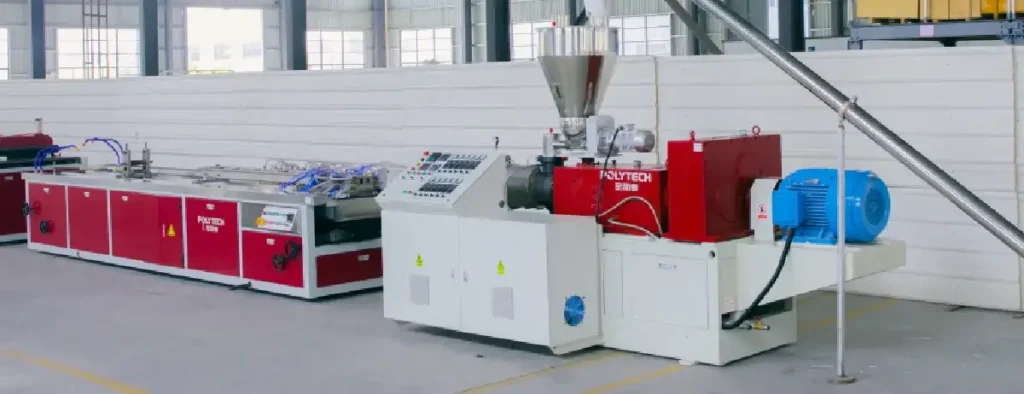
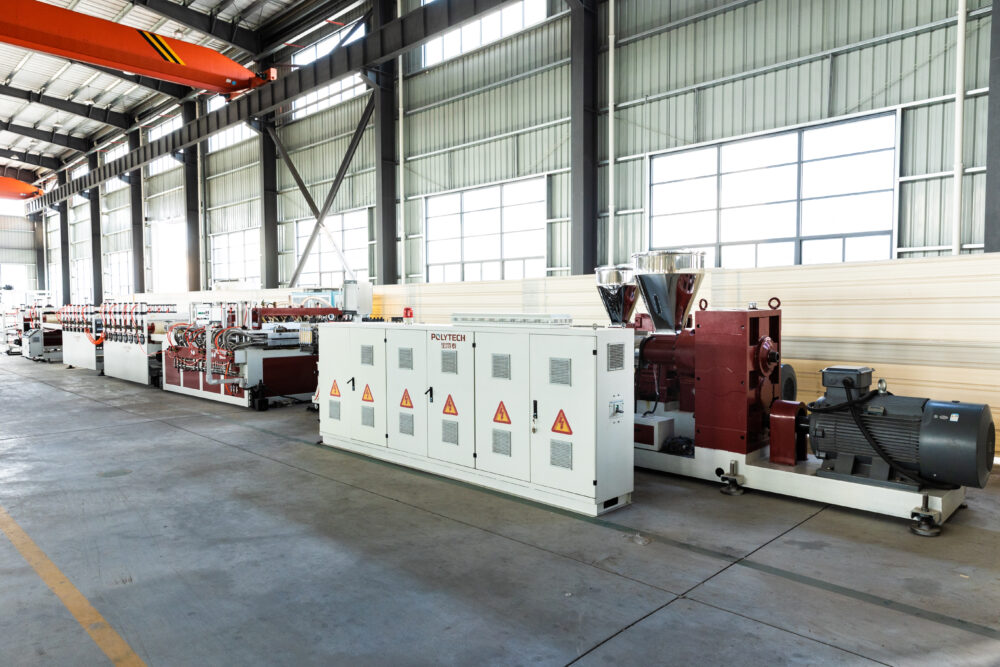
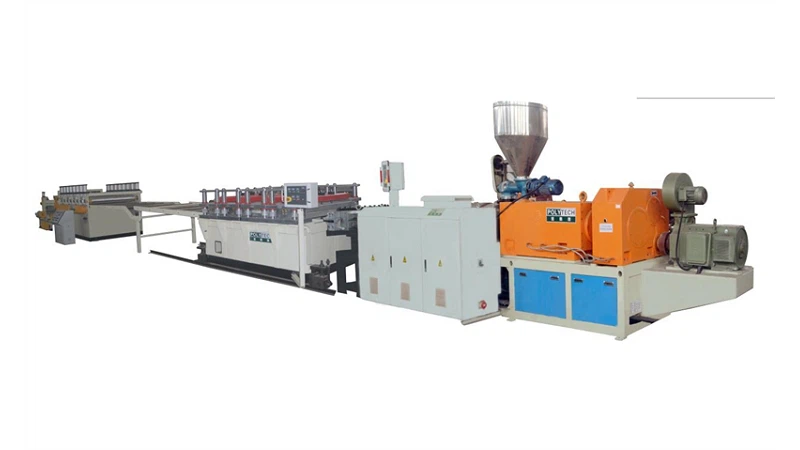
Plastic extrusion systems come in different configurations depending on the type of product being manufactured. The most common types include:
- Single-Screw Extruders:
Ideal for simple applications like tubing, films, and profiles. These are widely used for materials such as PE and PP. - Twin-Screw Extruders (Conical and Parallel):
Used for more complex formulations such as PVC compounds or filled materials. They provide better mixing, melting, and output control — making them a popular choice in industrial production. - Co-Extrusion Lines:
Allow multiple materials or colors to be extruded simultaneously into a single product (e.g., layered sheets or profiles with inner and outer layers).
How Polytech Middle East Excels in Extrusion Machinery
Polytech Middle East, a regional extension of China-based POLYTECH Plastic Machinery Co., Ltd, specializes in advanced extrusion solutions tailored to Middle Eastern industries. Their machines are designed for both high performance and energy efficiency, offering:
- Complete extrusion lines for ASA PVC roofing sheets, PP hollow formwork, and PVC granulation.
- Custom screw and barrel systems, including conical twin-screw barrels that ensure excellent output and processing consistency.
- Integrated control systems for real-time monitoring and production optimization.
- Robust support services, including machine installation, technical training, and maintenance assistance.
Choosing the Right Machine for Your Application
When selecting an extrusion machine, several factors should be considered:
- Type of material (e.g., PVC, ASA, PP)
- Desired output capacity
- Final product specifications
- Energy consumption and maintenance needs
Polytech’s team of engineers provides tailored consultations to help clients choose the right solution — whether you’re launching a new factory or expanding an existing production line.
🔹 Section 3: Materials and Inputs
Common Materials Used in Plastic Extrusion
The plastic extrusion process supports a wide range of thermoplastic materials, each selected based on the product’s function, environment, and physical properties. Some of the most commonly used materials include:
- PVC (Polyvinyl Chloride):
Highly versatile, cost-effective, and resistant to weathering. Used for pipes, profiles, cables, and roofing sheets. - ASA (Acrylonitrile Styrene Acrylate):
Offers superior UV and chemical resistance. Often used in outdoor applications like roofing and façade panels. - PP (Polypropylene):
Lightweight, flexible, and suitable for food packaging, medical products, and hollow formwork systems. - PE (Polyethylene):
Known for its toughness and flexibility, commonly used in tubing, films, and insulation.
Plastic Granules: The Raw Material of Precision
Extrusion begins with plastic granules or pellets, which are processed and melted into shape. These granules can be pure resin or custom-blended formulations that include:
- Fillers for added strength or fire resistance
- Color masterbatches for custom colors
- Additives such as UV stabilizers, anti-static agents, or lubricants
Polytech Middle East offers not only the machines but also the knowledge and support to help clients choose the right raw material formulation for each application — ensuring product quality, durability, and efficiency.
The Importance of Material Quality in Extrusion
Using high-quality materials in extrusion leads to:
- Better product consistency and surface finish
- Reduced machine wear and maintenance
- Higher production efficiency
- Improved recyclability and sustainability
With over 25 years of expertise, Polytech ensures that its machines are optimized to handle both standard and complex material formulations — including recycled compounds and specialty blends.
🔹 Section 4: Services and Market Solutions
Tailored Extrusion Solutions for the Middle East
The plastic manufacturing landscape in the Middle East is rapidly evolving, driven by infrastructure development, packaging demands, and a growing interest in localized production. Polytech Middle East is uniquely positioned to serve this market by delivering customized plastic extrusion solutions that align with regional needs.
Key market sectors served include:
- Construction: Roofing sheets, window profiles, and pipe systems
- Agriculture: Irrigation tubes and protective films
- Packaging: Food-grade sheets and films
- Industrial manufacturing: Cable coatings, boards, and technical profiles
End-to-End Support: From Design to Delivery
Polytech offers comprehensive turnkey project solutions, guiding clients through every step of the production journey:
- Workshop Layout & Planning:
Designing factory floors and machine placement for maximum efficiency. - Machine Installation & Commissioning:
On-site supervision, alignment, testing, and operational setup. - Operator Training Programs:
Providing technical training to local teams for safe and effective use of the machinery. - After-Sales Technical Support:
Ongoing consultation, maintenance assistance, and spare parts availability — all backed by a 12-month warranty. - Marketing & Business Consultation:
Helping clients align their production capabilities with regional market demands.
Why Polytech is a Strategic Partner for Regional Growth
With a strong presence in Istanbul and a proven track record across the Middle East, Polytech Middle East empowers manufacturers to:
- Launch new product lines quickly
- Reduce operational costs through energy-efficient machinery
- Meet international quality standards
- Scale production to match market demand
By combining global engineering excellence with localized service, Polytech continues to support sustainable industrial growth throughout the region.
🔹 Section 5: Innovation and Sustainability
Driving Innovation in Plastic Extrusion
As the demand for high-performance plastic products grows, so does the need for smarter and more efficient manufacturing solutions. Polytech Middle East, in collaboration with its parent company in China, continues to invest in research and development to bring cutting-edge technologies to the plastic extrusion market.
Key areas of innovation include:
- Advanced control systems for precision temperature and pressure regulation
- High-output screw designs for better melt homogenization and material flow
- Multi-layer co-extrusion technology for complex product structures
- Integration with Industry 4.0 tools, including remote diagnostics and production analytics
These innovations allow manufacturers to boost quality, reduce downtime, and stay ahead of evolving market demands.
Committing to Sustainable Manufacturing
Sustainability is no longer optional — it’s a competitive necessity. Polytech supports greener plastic production through:
- Energy-Efficient Extrusion Machines:
Designed to minimize electricity consumption without compromising performance. - Recyclable Material Compatibility:
Polytech machines are capable of processing post-consumer recycled (PCR) materials and blends — ideal for companies looking to reduce plastic waste. - Emission Control and Safety Systems:
Built-in filtration and ventilation components help ensure cleaner and safer working environments. - Process Optimization:
Real-time monitoring and automation reduce material waste and improve output efficiency.
Looking Ahead: Smart & Sustainable Extrusion
Polytech’s innovation roadmap includes:
- Development of AI-assisted extrusion lines that auto-adjust based on product specs
- Integration of solar-powered machine modules
- Expansion into bioplastic-compatible systems
With a future-forward mindset, Polytech Middle East is not only meeting today’s challenges — it’s actively shaping the next generation of plastic extrusion technology.