

Introduction to PVC Factories
A PVC factory is an industrial facility that manufactures products from polyvinyl chloride (PVC), one of the most widely used thermoplastic materials in modern manufacturing. PVC is valued for its versatility, durability, chemical resistance, and ability to be formulated into rigid or flexible products. These characteristics make it suitable for applications across construction, infrastructure, electrical systems, packaging, furniture, and industrial manufacturing.
PVC factories use specialized processing technologies to transform PVC resin and other formulation ingredients into finished products with specific dimensions, mechanical properties, colors, and surface characteristics. Depending on the factory’s production capabilities, its product range may include pipes, fittings, window and door profiles, wall panels, cable conduits, flooring materials, and flexible tubing.
Among the manufacturing technologies used in PVC processing, extrusion plays a particularly important role. PVC extrusion machines continuously process the prepared material and force it through a die to produce pipes, profiles, sheets, and other products with consistent cross-sectional shapes.
Establishing an efficient PVC factory requires careful planning of raw materials, production equipment, processing conditions, quality control, and market requirements. Understanding these factors helps manufacturers select suitable machinery and develop a production system that meets the technical and commercial demands of their target industries.
What Does a PVC Factory Produce?
A PVC factory can manufacture a wide range of products depending on the equipment installed, the PVC formulation used, and the intended market. Different products require specific processing conditions, tooling configurations, and downstream equipment.
PVC Pipes and Fittings
PVC pipes are among the most common products manufactured in PVC factories. They are widely used in drainage systems, wastewater networks, irrigation, electrical cable protection, and other applications where the selected PVC formulation meets the required operating conditions.
PVC pipe manufacturing involves processing PVC compound through an extrusion system equipped with a specially designed pipe die. The extruded pipe is then calibrated, cooled, pulled through the production line, and cut to the required length.
Depending on the application, manufacturers may produce pipes with different diameters, wall thicknesses, pressure ratings, and connection systems. Quality control is essential to ensure dimensional accuracy and compliance with the relevant product standards.
PVC fittings, such as elbows, tees, and connectors, are typically manufactured using separate processes, including injection molding or other suitable forming methods. They are often supplied alongside extruded pipes to create complete piping systems.
PVC Window and Door Profiles
PVC profiles are widely used in window and door manufacturing because they can be designed with multiple internal chambers, reinforcement spaces, and specialized connection features.
A PVC profile extrusion line uses a profile die to produce the required cross-sectional geometry. Calibration and cooling systems maintain dimensional accuracy while the haul-off unit controls product movement through the line.
Manufacturers can produce profiles in different shapes, sizes, and colors according to architectural requirements. The design may incorporate chambers that contribute to thermal insulation and structural performance, depending on the complete window or door system.
PVC Wall and Ceiling Panels
PVC wall and ceiling panels are commonly used in interior finishing and decorative applications. These products are available in different thicknesses, widths, colors, and surface designs.
A PVC panel production line typically includes an extrusion machine, a panel die, calibration equipment, cooling systems, a haul-off unit, and cutting equipment. Depending on the product design, downstream processes may include surface printing, lamination, or other finishing operations.
The lightweight nature of many PVC panels and their ease of installation make them suitable for residential, commercial, and selected industrial interiors.
PVC Cable Conduits and Electrical Profiles
PVC is widely used in electrical installations because suitable formulations can provide electrical insulation, dimensional stability, and resistance to moisture and various environmental conditions.
PVC factories manufacture cable conduits, protective tubes, trunking systems, and other electrical profiles using specialized extrusion equipment. The final product must meet the applicable requirements for its intended electrical and installation environment.
Flexible PVC Tubes and Hoses
Flexible PVC products are manufactured using formulations containing suitable plasticizers and other additives. These formulations allow manufacturers to produce products with different levels of flexibility, hardness, and resistance to environmental conditions.
Applications may include selected industrial hoses, tubing, protective coverings, and flexible components. The appropriate formulation depends on factors such as the transported material, operating temperature, pressure, and required service life.
How Does a PVC Factory Work?
The manufacturing process in a PVC factory depends on the product being produced. However, PVC extrusion operations generally involve raw material preparation, compound feeding, extrusion, forming, cooling, cutting, and quality inspection.
1. Raw Material Preparation
The first stage involves preparing the PVC material and the ingredients required for the product formulation.
PVC resin is commonly combined with stabilizers, lubricants, processing aids, pigments, impact modifiers, and fillers, depending on the required product characteristics. Flexible PVC formulations may also contain plasticizers.
Each ingredient serves a specific purpose. Stabilizers help protect the material during processing, lubricants influence processing behavior, pigments provide color, and impact modifiers can improve impact performance when appropriately selected.
PVC formulations must be designed carefully because the composition affects processing stability, mechanical properties, appearance, and long-term product performance.
2. Mixing and Compounding
After material selection, the PVC resin and required additives are blended to produce a uniform formulation. Depending on the manufacturing system, this may involve high-speed mixing, cooling mixers, or other compounding equipment.
Consistent mixing helps distribute additives throughout the formulation and supports stable processing during extrusion.
Some factories purchase ready-to-process PVC compounds from specialized suppliers, while others prepare their own formulations. The choice depends on production scale, technical capabilities, product requirements, and quality control procedures.
3. Feeding and Extrusion
The prepared PVC compound is fed into an extrusion machine, where the screw conveys and processes the material inside a heated barrel.
PVC processing requires careful control of temperature, screw speed, residence time, and material flow because the polymer can undergo thermal degradation if exposed to unsuitable processing conditions.
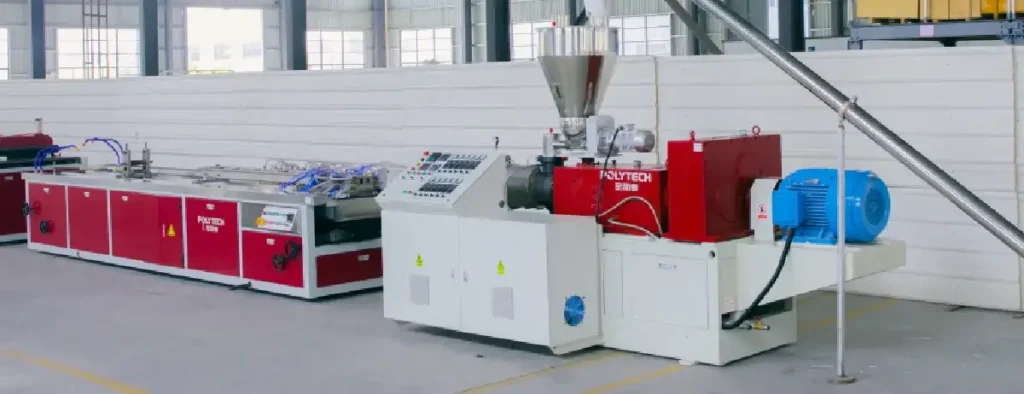
Twin-screw extruders, particularly conical and parallel designs, are widely used in PVC processing because they can provide suitable conveying, mixing, and processing characteristics for different formulations.
The selection of an extrusion machine depends on the product type, required output, material formulation, and production line configuration.
4. Product Forming Through a Die
Once the PVC material reaches the required processing condition, it passes through a die that determines the product’s cross-sectional shape.
Pipe dies are used for PVC pipe production, while specialized profile dies are required for window frames, door profiles, cable conduits, and decorative components. Flat dies may be used for suitable PVC sheet products.
Die design affects material distribution, dimensional consistency, surface quality, and production stability. Proper adjustment of the die and processing parameters is essential for achieving the required product dimensions.
5. Calibration and Cooling
After leaving the die, the extruded PVC product must be calibrated and cooled to maintain its intended shape and dimensions.
Pipe production lines commonly use vacuum calibration systems and cooling tanks. Profile production lines may use vacuum calibration tables, cooling units, and specialized sizing tools.
Cooling efficiency influences production speed, dimensional stability, and the risk of deformation. The system must be designed according to the product geometry, wall thickness, material formulation, and required output.
6. Haul-Off and Cutting
A haul-off unit pulls the extruded product through the production line at a controlled speed. Stable synchronization between extrusion output and haul-off speed is important for maintaining consistent dimensions.
The product is then cut to the required length using an appropriate cutting system. PVC pipes are typically cut into standardized lengths, while profiles and panels are processed according to customer specifications.
Depending on the product, additional operations may include printing, socketing, drilling, surface finishing, or packaging.
7. Quality Control and Final Inspection
Quality control is essential for ensuring that PVC products meet the required technical specifications.
Common inspection procedures include dimensional measurements, wall thickness checks, surface inspection, and evaluation of relevant mechanical properties. Pipe manufacturers may also perform tests related to pressure performance, impact resistance, or other requirements specified by the applicable standards.
For profiles and panels, quality checks may include dimensional accuracy, color consistency, surface quality, and mechanical performance.
Consistent inspection helps manufacturers identify production problems early and reduce the likelihood of defective products reaching customers.
Essential Equipment for a PVC Factory
Selecting the correct equipment is one of the most important decisions when establishing or expanding a PVC manufacturing facility. The required machinery depends on the intended product range and production capacity.
PVC Extrusion Machine
The extrusion machine is the core processing unit in many PVC factories. It processes the PVC compound and delivers the material to the forming die.
Conical twin-screw extruders and parallel twin-screw extruders are widely used in PVC applications. Their suitability depends on the formulation, required output, product type, and operating conditions.
A properly selected extruder helps maintain stable material flow and consistent product quality while supporting the required production rate.
PVC Pipe Extrusion Line
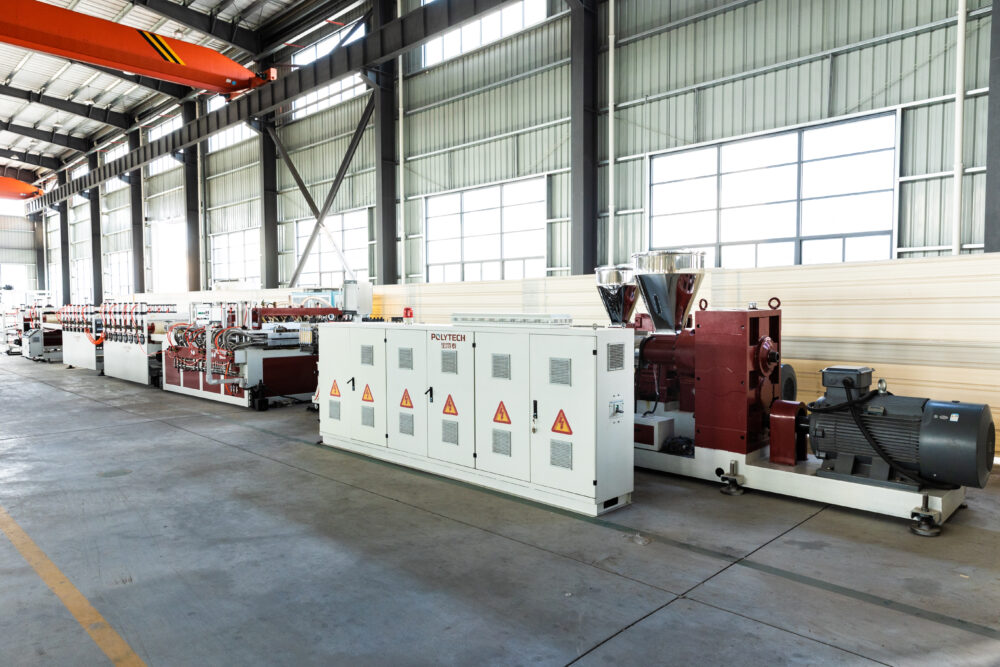
A PVC pipe extrusion line is designed specifically for manufacturing plastic pipes. It generally includes an extruder, pipe die, vacuum calibration tank, cooling tanks, haul-off unit, cutting machine, and product handling equipment.
The line configuration depends on pipe diameter, wall thickness, material formulation, and required production capacity.
Some production lines also include equipment for automatic pipe socketing, marking, and packaging, depending on the final product requirements.
PVC Profile Extrusion Line
A PVC profile extrusion line is used to manufacture window profiles, door frames, cable conduits, decorative trims, and other products with customized cross-sectional shapes.
The main equipment includes an extruder, profile die, calibration table, cooling system, haul-off unit, and cutting machine.
Because profile geometries can be complex, die design and calibration tooling play an important role in maintaining dimensional accuracy and product consistency.
PVC Sheet and Panel Production Line
PVC sheet and panel lines are designed to manufacture flat products with specified widths, thicknesses, and surface characteristics.
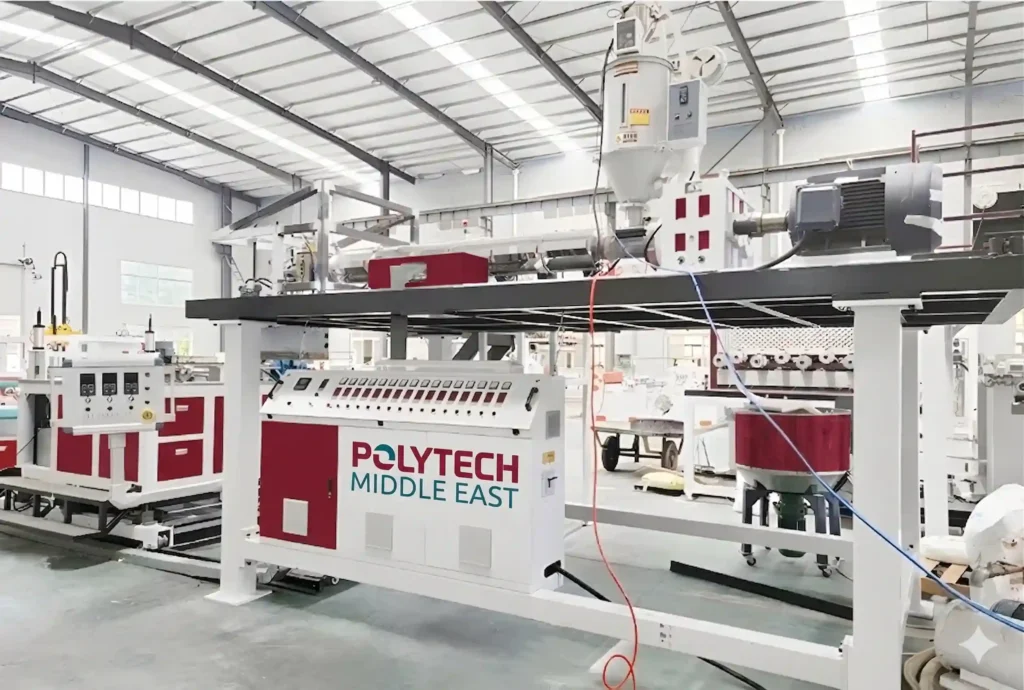
Depending on the product design, the equipment may include a suitable extruder, flat die, calibration rollers, cooling system, haul-off unit, and cutting equipment.
Additional finishing units may be installed when the product requires printing, lamination, embossing, or decorative surface treatments.
Mixing and Feeding Equipment
Mixing and feeding equipment supports consistent material preparation and delivery to the extrusion process.
A typical PVC production facility may use high-speed mixers, cooling mixers, storage silos, dosing systems, and automatic feeding equipment. The required configuration depends on whether the factory produces its own PVC compound or purchases prepared material.
Reliable feeding and formulation control help reduce processing variations and support consistent production quality.
Auxiliary Equipment
Auxiliary equipment supports the main production line and helps maintain efficient operation. Depending on the factory, this may include industrial chillers, air compressors, material loaders, dust collection systems, recycling equipment, and automatic handling systems.
The correct selection of auxiliary equipment is important because insufficient cooling capacity, unstable material feeding, or other utility limitations can restrict the performance of the main extrusion line.
Types of PVC Used in Manufacturing
PVC can be formulated to produce materials with different levels of rigidity, flexibility, and performance characteristics.
Rigid PVC (uPVC)
Unplasticized PVC, commonly known as uPVC, is formulated without the addition of plasticizers intended to make the material flexible. It is widely used for pipes, window and door profiles, cable conduits, and other rigid products.
Rigid PVC products can provide useful stiffness, chemical resistance, and durability when correctly formulated and used within their design limits.
Flexible PVC
Flexible PVC contains plasticizers that modify the material’s flexibility and softness. The amount and type of plasticizer influence hardness, flexibility, processing behavior, and other properties.
Flexible PVC is used in selected tubing, hoses, cable insulation, protective coverings, and other applications that require a softer material.
Modified PVC Compounds
Some PVC products require specialized formulations to improve particular characteristics, such as impact performance, weather resistance, processing stability, or surface appearance.
These formulations may incorporate impact modifiers, stabilizers, pigments, fillers, and other additives selected for the intended application.
The formulation must be compatible with the processing equipment and the product’s required performance specifications.
Applications of PVC Factory Products
PVC products are used across a wide range of industries because their properties can be adapted through formulation and product design.
Construction and Infrastructure
Construction is one of the largest application areas for PVC products. PVC pipes, window profiles, door systems, wall panels, and cable conduits are widely used in residential, commercial, and infrastructure projects.
The suitability of each product depends on its formulation, design, installation conditions, and applicable standards.
Water Supply and Drainage
PVC piping systems are used in drainage, wastewater, and selected water distribution applications. Their performance depends on pipe design, pressure rating where applicable, jointing method, and compatibility with the operating environment.
Manufacturers must ensure that products meet the relevant requirements for their intended service.
Electrical Systems
PVC conduits, cable protection products, and suitable insulation compounds are used in electrical installations. These products help protect cables and support organized installation systems.
Material selection must consider the electrical, thermal, mechanical, and fire-performance requirements applicable to the product.
Furniture and Interior Decoration
PVC profiles, decorative panels, trims, and selected surface products are used in furniture manufacturing and interior finishing.
Extrusion allows manufacturers to produce customized shapes and surface designs while maintaining consistent dimensions throughout production.
Industrial Applications
PVC products are also used in selected chemical-handling systems, protective components, industrial profiles, and equipment installations.
The chemical resistance and operating limits of each PVC formulation must be evaluated before selecting it for a particular industrial environment.
Advantages of Establishing a PVC Factory
A properly planned PVC factory can provide several manufacturing and commercial advantages. Actual performance depends on equipment selection, production management, market conditions, and product quality requirements.
Wide product range: PVC processing technology supports the production of pipes, profiles, panels, conduits, tubing, and other products through different extrusion and forming systems.
Material versatility: PVC formulations can be adapted to produce rigid or flexible products with different characteristics.
Continuous manufacturing: Extrusion supports continuous production of pipes, profiles, sheets, and other products, making it suitable for industrial manufacturing.
Product customization: Manufacturers can adjust product dimensions, colors, formulations, and cross-sectional designs according to customer specifications and equipment capabilities.
Automation opportunities: Automatic feeding, cutting, handling, and inspection systems can improve production consistency and reduce repetitive manual operations.
Industrial market opportunities: PVC products serve construction, infrastructure, electrical installations, furniture, and other sectors, allowing factories to target different customer groups according to their production capabilities.
Factors to Consider When Setting Up a PVC Factory
Establishing a PVC factory requires careful evaluation of technical, operational, and commercial factors before purchasing machinery or preparing the production facility.
Product Selection and Market Demand
The first step is to identify the products the factory intends to manufacture. PVC pipes, window profiles, wall panels, and flexible tubing require different equipment configurations and may serve different markets.
Manufacturers should evaluate customer requirements, competition, applicable standards, expected sales volume, and the availability of raw materials before deciding on the product range.
Production Capacity
The required production capacity influences the size and configuration of the extrusion machines, dies, cooling systems, and downstream equipment.
Manufacturers should consider not only nominal machine output but also product dimensions, material formulation, operating hours, changeover requirements, and expected downtime.
Machinery and Automation
Equipment selection should be based on the intended product and its required quality specifications. Important considerations include extruder design, screw configuration, die technology, calibration systems, cutting equipment, and automation level.
The production line should operate as an integrated system, with sufficient capacity at each stage to prevent bottlenecks.
Raw Material Supply
PVC resin and additives represent important operating inputs. Reliable suppliers, consistent material quality, and appropriate storage conditions help maintain stable production.
The factory must also establish procedures for controlling formulations and managing raw materials to reduce variation between production batches.
Factory Layout and Utilities
A PVC factory requires suitable space for raw material storage, mixing, extrusion, cooling, finished product handling, and maintenance.
Electrical supply, cooling water, ventilation, and other utilities must meet the requirements of the installed equipment. The facility should also include appropriate safety measures, dust control where needed, and effective management of processing waste.
Quality Control and Maintenance
A quality management system should define product specifications, inspection procedures, and corrective actions when defects occur.
Preventive maintenance is equally important. Regular inspection of screws, barrels, dies, calibration tools, rollers, cutting systems, and auxiliary equipment helps maintain stable production and reduce unexpected downtime.
Production Costs and Efficiency
Operating costs may include raw materials, electricity, labor, maintenance, packaging, transportation, and waste management.
Manufacturers should evaluate these costs alongside expected production capacity and market demand. Effective process control and material management can improve efficiency and help reduce avoidable losses.
Quality and Environmental Considerations in PVC Manufacturing
Quality and environmental management are important parts of modern PVC production. Manufacturers must control processing conditions, manage material waste, and ensure that finished products meet the relevant safety and performance requirements.
PVC processing requires appropriate temperature control because excessive heat or prolonged exposure to unsuitable conditions can cause material degradation. Proper equipment settings, maintenance, and operator training help reduce this risk.
Production waste should be collected and managed according to its composition and condition. Suitable clean production scrap may be reprocessed when the material properties, formulation, and product requirements permit it. Reprocessing procedures must be controlled to avoid compromising finished product quality.
Factories should also evaluate dust control, ventilation, energy consumption, and the safe handling of raw materials and additives. The specific measures required depend on the manufacturing process, equipment configuration, local regulations, and the type of products being produced.
A structured quality and environmental management approach helps manufacturers improve operational consistency and maintain responsible production practices.
Conclusion
A PVC factory is a specialized manufacturing facility that transforms polyvinyl chloride resin and formulated compounds into products used in construction, infrastructure, electrical systems, furniture, and industrial applications.
The production process depends on selecting suitable raw materials, preparing consistent formulations, using the correct extrusion equipment, and maintaining effective forming, cooling, and quality control systems.
From PVC pipe extrusion lines to profile and panel manufacturing equipment, each production system must be configured according to the intended product dimensions, material properties, output requirements, and applicable standards.
For businesses planning to establish or expand a PVC manufacturing facility, understanding the production process and evaluating the complete equipment configuration are essential steps toward achieving reliable product quality, efficient operations, and long-term manufacturing performance.