

Introduction
A PP Sheet Extrusion Line is an advanced plastic processing system designed to manufacture high-quality polypropylene sheets with consistent thickness, excellent surface finish, and precise dimensions. Polypropylene (PP) is widely used because of its lightweight structure, chemical resistance, moisture resistance, and good mechanical performance.
Modern PP sheet extrusion lines integrate material feeding, extrusion, sheet forming, cooling, calibration, cutting, and stacking systems into one continuous production process. This configuration allows manufacturers to achieve stable output, high productivity, and consistent product quality for a wide range of industrial applications.
What Is a PP Sheet Extrusion Line?
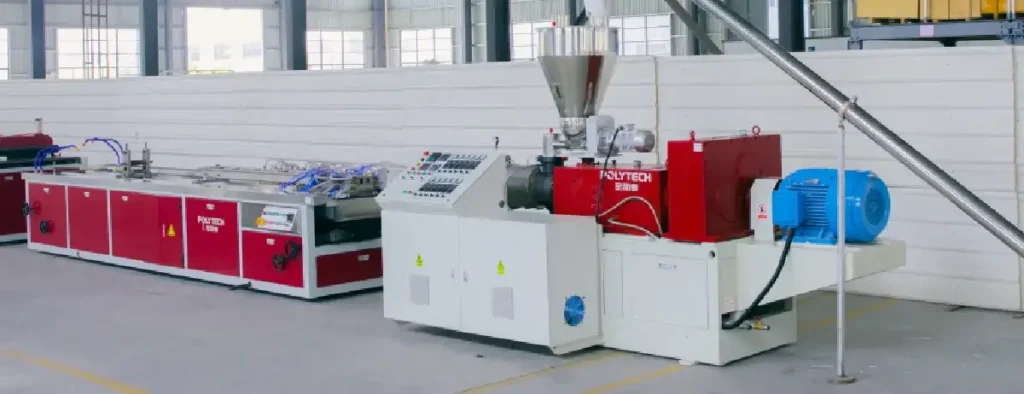
A PP sheet extrusion line is a complete production system that transforms polypropylene raw material into continuous plastic sheets. The PP material is fed into an extruder, where it is heated, melted, mixed, and homogenized before being pushed through a flat sheet die.
After leaving the die, the molten sheet passes through a cooling and calibration system. Rollers control the sheet thickness and surface quality while removing heat from the material. The finished sheet is then trimmed, cut, stacked, or wound according to the required production format.
The process can be configured to manufacture sheets with different thicknesses, widths, surface finishes, and performance characteristics.
How Does a PP Sheet Extrusion Line Work?
The PP sheet extrusion process consists of several coordinated stages.
1. Raw Material Feeding
Polypropylene pellets are supplied to the extrusion system through a hopper or automatic feeding unit. Accurate feeding helps maintain a stable production rate and consistent material flow.
2. Melting and Plasticization
Inside the extruder, the PP material moves through the screw and barrel while controlled heat and mechanical shear transform it into a homogeneous molten polymer.
3. Melt Homogenization
The extrusion system ensures that the polymer melt has a uniform temperature and composition before it reaches the die.
4. Sheet Forming
The molten PP is pushed through a specially designed flat die that determines the initial width and thickness of the sheet.
5. Cooling and Calibration
The hot sheet enters a roller or cooling system where its temperature, thickness, flatness, and surface characteristics are stabilized.
6. Cutting and Stacking
After cooling and trimming, the finished sheets can be cut to the required dimensions and automatically stacked for storage and transportation.
Main Components of a PP Sheet Extrusion Line
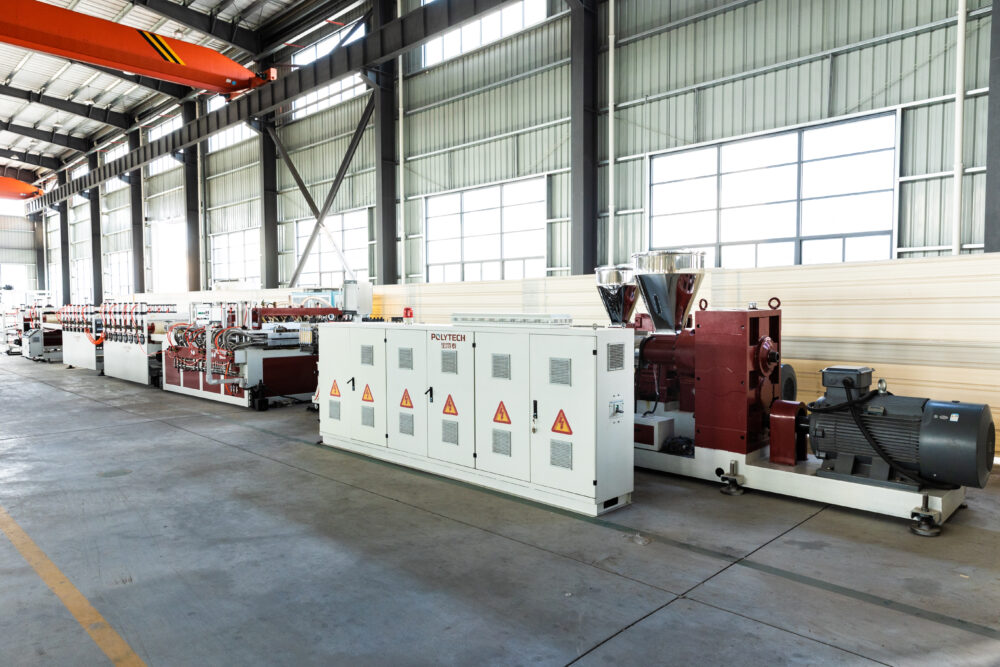
A complete PP sheet extrusion system normally consists of several integrated machines.
Feeding System
Provides a controlled and continuous supply of polypropylene material to the extruder.
Extruder
The main processing unit responsible for melting, plasticizing, mixing, and conveying the PP material.
Screw and Barrel
The screw transports and homogenizes the polymer, while the barrel provides controlled heating and processing conditions.
Flat Sheet Die
Forms the molten polypropylene into a wide, continuous sheet with the required dimensions.
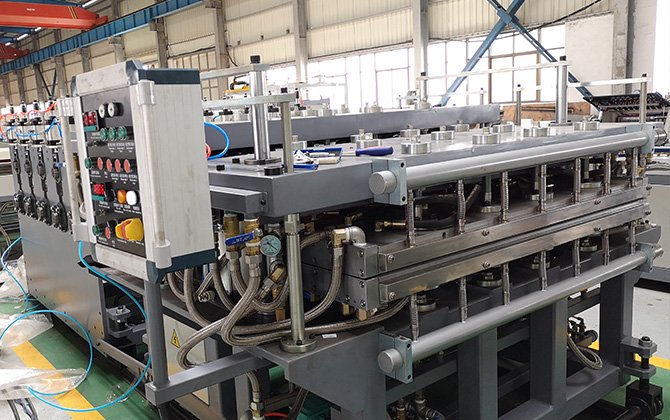
Three-Roll Calender or Cooling Unit
Controls sheet thickness, surface quality, flatness, and cooling after extrusion.
Edge Trimming System
Removes excess material from the sheet edges to achieve accurate width and clean edges.
Haul-Off System
Controls the movement and production speed of the sheet throughout the downstream section.
Cutting and Stacking Unit
Cuts the finished PP sheet into specific lengths and arranges the products for convenient handling.
PLC and HMI Control System
Allows operators to monitor and adjust important parameters such as temperature, speed, pressure, and production output.
Key Features of PP Sheet Extrusion Lines
Modern PP sheet extrusion lines are designed to provide efficient and stable production.
Key features include:
- High production capacity.
- Continuous sheet production.
- Precise thickness control.
- Stable extrusion pressure.
- Accurate temperature regulation.
- Excellent surface quality.
- Automated production control.
- Efficient cooling and calibration.
- Flexible sheet dimensions.
- Low material waste.
- Easy operation and monitoring.
These features make PP sheet extrusion lines suitable for both high-volume manufacturing and specialized sheet production.
Benefits of PP Sheet Extrusion
1. High Production Efficiency
Continuous extrusion allows manufacturers to produce large quantities of polypropylene sheets with minimal production interruptions.
2. Excellent Dimensional Accuracy
Advanced die and calibration systems provide precise control over sheet thickness, width, and flatness.
3. Superior Chemical Resistance
PP sheets offer good resistance to many chemicals, acids, and alkaline substances, making them suitable for demanding industrial environments.
4. Lightweight Products
The relatively low density of polypropylene allows manufacturers to produce lightweight sheets that are easier to handle and transport.
5. Good Moisture Resistance
Polypropylene has low moisture absorption, making PP sheets suitable for applications exposed to humidity and water.
6. Cost-Effective Production
Efficient material processing and continuous manufacturing can help reduce production costs and material waste.
7. Flexible Product Design
PP sheets can be manufactured in different thicknesses, widths, colors, and surface finishes according to application requirements.
Materials Used in PP Sheet Extrusion
The primary raw material is polypropylene, but different PP grades and formulations can be selected according to the required product performance.
Production may also involve:
- Virgin polypropylene.
- Recycled polypropylene.
- PP compounds.
- Color masterbatch.
- Mineral fillers.
- Processing additives.
- UV stabilizers.
- Other performance modifiers.
Material selection should be based on the required mechanical properties, processing characteristics, appearance, and intended application.
Applications of PP Sheets
PP sheets manufactured using extrusion technology are used across numerous industries.
Packaging Industry
PP sheets can be used for reusable packaging, protective packaging, containers, and thermoforming applications.
Chemical Industry
Their chemical resistance makes polypropylene sheets suitable for tanks, protective linings, industrial containers, and processing equipment components.
Construction Industry
PP sheets can be used for protective panels, insulation-related components, temporary protection, and specialized construction products.
Automotive Industry
Extruded PP sheets are used in selected interior components, protective parts, lightweight structures, and technical applications.
Advertising and Display
PP sheets can be processed into signs, display boards, promotional products, and lightweight visual materials.
Industrial Manufacturing
Applications include machine protection, separators, industrial trays, covers, and fabricated plastic components.
Quality Control in PP Sheet Production
Quality control is essential for maintaining consistent sheet performance throughout the production process.
Important quality checks include:
- Raw material inspection.
- Melt temperature monitoring.
- Extrusion pressure monitoring.
- Sheet thickness measurement.
- Width and dimensional inspection.
- Flatness evaluation.
- Surface quality inspection.
- Color consistency testing.
- Mechanical property testing.
- Final product inspection.
Accurate monitoring helps reduce production defects and ensures that the finished PP sheets meet the required specifications.
Factors Affecting PP Sheet Quality
Several production parameters can directly influence the final quality of polypropylene sheets.
Extrusion Temperature
The temperature profile must be properly controlled to achieve stable melting and processing without unnecessary thermal stress.
Screw Speed
Screw speed affects material output, mixing, melt temperature, and overall production stability.
Die Gap
Accurate die adjustment is important for achieving uniform sheet thickness across the entire width.
Cooling Conditions
Proper cooling helps control shrinkage, flatness, surface quality, and dimensional stability.
Line Speed
The relationship between extrusion output and haul-off speed directly affects the final sheet thickness.
Maintaining the correct balance between these parameters is essential for producing consistent PP sheets.
Choosing the Right PP Sheet Extrusion Line
Selecting the appropriate production line depends on the required product specifications and manufacturing capacity.
Important considerations include:
- Required sheet width.
- Sheet thickness range.
- Production output.
- PP material grade.
- Required surface finish.
- Automation level.
- Cooling requirements.
- Cutting and stacking configuration.
- Available production space.
- Future production expansion.
A properly configured line can provide reliable production performance while allowing manufacturers to adapt to changing market requirements.
Automation and Energy Efficiency
Modern PP sheet extrusion lines increasingly use automated control systems to improve production stability and reduce operator intervention. PLC and HMI systems can monitor temperatures, pressures, motor speeds, cooling conditions, and other critical parameters in real time.
Energy-efficient motors, optimized heating systems, improved cooling technology, and automated process control can also help reduce energy consumption while maintaining high production output.
Conclusion
A PP Sheet Extrusion Line provides an efficient and flexible solution for manufacturing high-quality polypropylene sheets. By integrating advanced extrusion, flat die technology, cooling, calibration, trimming, cutting, and automated control systems, manufacturers can achieve consistent dimensions, excellent surface quality, and high production efficiency.
With its combination of lightweight properties, chemical resistance, moisture resistance, durability, and processing flexibility, polypropylene remains an important material for sheet manufacturing. As demand for efficient and versatile plastic solutions continues to grow, modern PP sheet extrusion lines offer manufacturers a reliable technology for producing high-quality sheets across a wide range of industrial applications.