

Introduction
Polypropylene extrusion is a widely used plastic manufacturing process for producing continuous products with consistent dimensions, excellent surface quality, and reliable performance. Polypropylene (PP) is a versatile thermoplastic valued for its low density, chemical resistance, moisture resistance, mechanical strength, and good processing characteristics.
The combination of polypropylene’s material properties and modern extrusion technology makes PP extrusion suitable for manufacturing sheets, profiles, tubes, films, pipes, and customized plastic components. With appropriate process control, manufacturers can achieve stable output, efficient material utilization, and consistent product quality.
What Is Polypropylene Extrusion?
Polypropylene extrusion is a continuous manufacturing process in which polypropylene resin is heated, melted, homogenized, and forced through a specially designed die to create a product with a specific cross-sectional shape.
The extrusion process can be adapted to different PP grades and product requirements. Depending on the application, polypropylene can be processed into rigid profiles, flexible products, sheets, tubes, films, and other continuous forms.
One of the major advantages of PP extrusion is its ability to produce large quantities of plastic products with repeatable dimensions and consistent properties.
Polypropylene Material Properties
Polypropylene is a semi-crystalline thermoplastic that offers a useful balance between performance, weight, and processing efficiency.
Important properties of polypropylene include:
- Low material density.
- Good mechanical strength.
- Excellent chemical resistance.
- Low moisture absorption.
- Good fatigue resistance.
- Good electrical insulation properties.
- High resistance to many acids and alkalis.
- Good processing characteristics.
- Excellent balance between rigidity and flexibility.
- Good recyclability when properly collected and processed.
These properties make PP suitable for numerous industrial and commercial extrusion applications.
Polypropylene Extrusion Process
The PP extrusion process involves several carefully controlled stages.
1. Material Feeding
Polypropylene pellets or other prepared feedstock are introduced into the extrusion system through a hopper and feeding unit. Accurate feeding helps maintain a stable production rate.
2. Melting and Plasticization
The polypropylene enters the screw and barrel assembly, where controlled heat and mechanical shear gradually melt and homogenize the material.
3. Mixing and Melt Homogenization
The screw design and processing conditions help create a uniform melt. When additives, colorants, fillers, or other components are required, appropriate mixing is essential for achieving consistent dispersion.
4. Die Forming
The molten polypropylene is conveyed toward the extrusion die. The die determines the shape and dimensions of the final product.
5. Cooling and Calibration
After leaving the die, the product is cooled and, where required, calibrated to stabilize its dimensions and surface quality.
6. Haul-Off and Finishing
A haul-off unit controls product movement through the line. Depending on the application, the final product may then be cut, stacked, wound, or prepared for additional processing.
Main Equipment Used in PP Extrusion
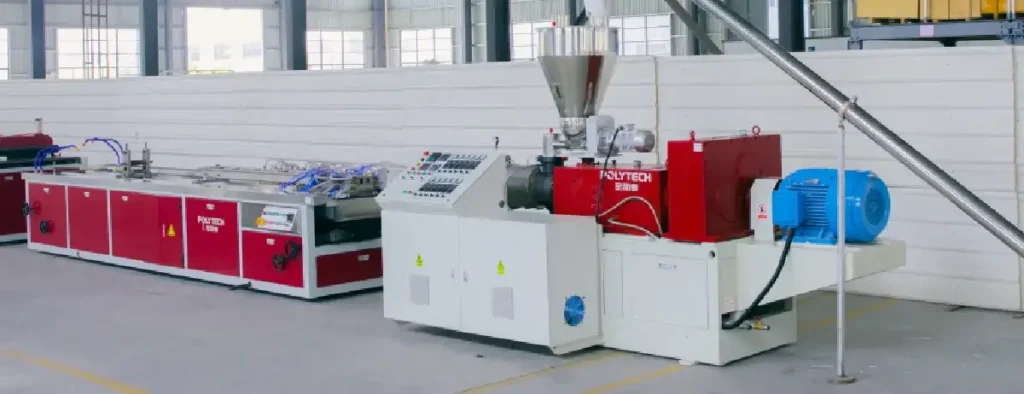
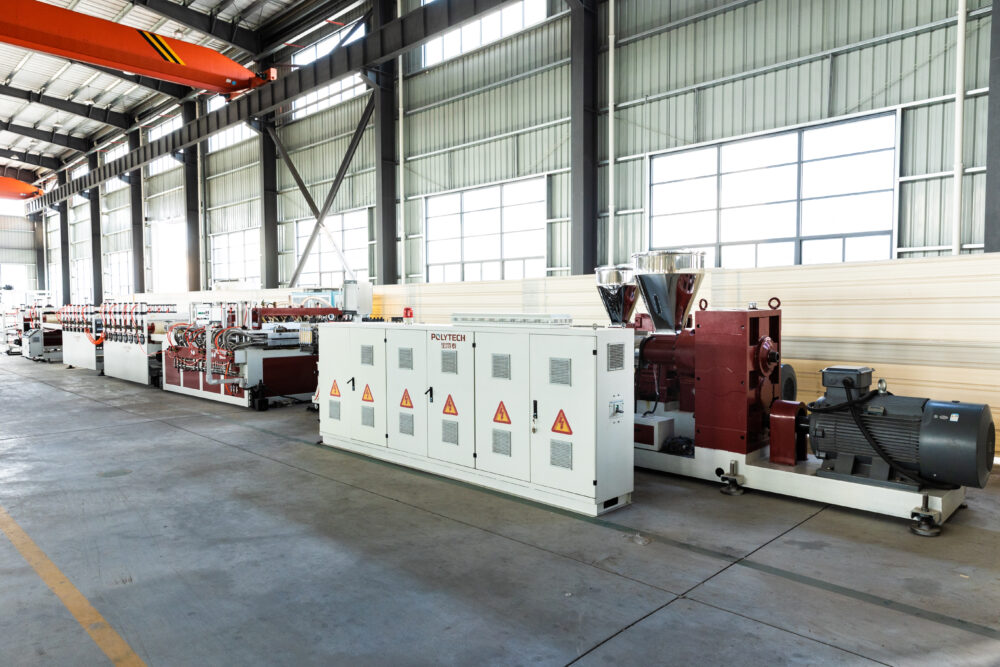
A polypropylene extrusion line normally integrates several machines and auxiliary systems.
Feeding System
Provides a controlled supply of PP material to the extruder.
Extruder
The main processing unit responsible for melting, conveying, and homogenizing polypropylene.
Screw and Barrel
The screw conveys and plasticizes the polymer while the barrel provides controlled heating and processing conditions.
Die
Shapes the molten PP into the required product geometry.
Calibration and Cooling System
Controls product dimensions and removes heat after extrusion.
Haul-Off Unit
Maintains controlled product speed and helps stabilize production.
Cutting or Winding Equipment
Finishes the product according to its final format, whether cut lengths or continuous rolls.
Control System
PLC and HMI systems allow operators to monitor and adjust critical process parameters such as temperature, speed, pressure, and output.
Key Features of Polypropylene Extrusion
Modern PP extrusion systems can provide a combination of production efficiency, process stability, and product consistency.
Key features include:
- Continuous production capability.
- High material processing efficiency.
- Accurate temperature control.
- Stable melt pressure.
- Consistent extrusion output.
- Precise product dimensions.
- Automated production monitoring.
- Flexible product configurations.
- Efficient material utilization.
- Compatibility with different PP formulations.
These features make polypropylene extrusion suitable for both high-volume manufacturing and specialized product development.
Benefits of Polypropylene Extrusion
1. High Production Efficiency
The continuous nature of extrusion allows manufacturers to produce large quantities of PP products with stable output and reduced production interruptions.
2. Excellent Chemical Resistance
Polypropylene performs well in applications where products may come into contact with many chemicals, acids, alkalis, and industrial substances.
3. Lightweight Products
PP has a relatively low density, allowing manufacturers to produce lightweight components without sacrificing useful mechanical performance.
4. Low Moisture Absorption
Polypropylene’s low moisture absorption makes it suitable for humid environments and applications where water resistance is important.
5. Good Mechanical Performance
PP products can provide a useful combination of stiffness, toughness, fatigue resistance, and dimensional stability.
6. Cost-Effective Manufacturing
Efficient processing, low material density, and continuous production can contribute to competitive manufacturing costs.
7. Design Flexibility
Extrusion technology allows polypropylene to be manufactured into a wide variety of shapes, sizes, and profiles.
PP Compounding for Extrusion
Polypropylene can also be modified through compounding to achieve specific performance characteristics. During compounding, PP may be combined with additives, fillers, reinforcements, pigments, or impact modifiers according to the intended application.
Common objectives of PP compounding include:
- Increasing stiffness.
- Improving impact performance.
- Enhancing thermal stability.
- Improving UV resistance.
- Adding specific colors.
- Increasing dimensional stability.
- Modifying processing behavior.
- Improving selected mechanical properties.
Twin-screw extrusion systems are commonly used when intensive mixing and controlled dispersion are required for compounded polypropylene formulations.
Applications of Polypropylene Extrusion
Polypropylene extrusion is used across many industrial sectors.
Packaging Applications
PP can be extruded into sheets, films, and other packaging-related products used in a wide range of applications.
Construction Applications
Extruded polypropylene can be used for profiles, protective components, technical products, and specialized construction materials.
Automotive Applications
PP extrusion supports the production of lightweight technical components, protective profiles, tubing, and other automotive-related products.
Electrical Applications
Polypropylene’s electrical insulation characteristics make it useful for selected cable management, insulation, and electrical components.
Industrial Applications
PP extrusion is used for pipes, profiles, sheets, tubes, protective components, and customized technical products.
Consumer Products
Extruded polypropylene can be found in household products, storage solutions, furniture components, and various everyday plastic products.
Quality Control in Polypropylene Extrusion
Consistent quality control is essential for maintaining stable PP extrusion performance. Manufacturers typically monitor both material properties and production parameters throughout the process.
Important quality checks can include:
- Raw material inspection.
- Material moisture control where required.
- Melt temperature monitoring.
- Melt pressure monitoring.
- Extrusion output measurement.
- Product thickness and dimensional inspection.
- Surface quality evaluation.
- Mechanical property testing.
- Final product inspection.
Accurate process monitoring helps reduce defects, improve production stability, and maintain consistent product specifications.
Factors Affecting PP Extrusion Performance
Several factors can influence the quality and efficiency of polypropylene extrusion.
Material Grade
Different PP grades have different melt flow characteristics and mechanical properties. The selected grade should match the product and processing requirements.
Screw Design
Screw geometry affects melting, mixing, conveying, pressure generation, and overall extrusion stability.
Temperature Profile
Appropriate temperature settings are essential for achieving efficient melting without unnecessarily exposing the polymer to excessive thermal conditions.
Extrusion Speed
Screw speed and line speed must be balanced to maintain stable output and the required product dimensions.
Cooling Conditions
Proper cooling is important for dimensional stability, surface quality, and final product performance.
Die Design
The die must be properly designed for the desired product geometry and material flow characteristics.
Sustainability and Polypropylene Extrusion
Polypropylene is an important material in the development of more resource-efficient plastic products. Its relatively low density can help reduce material usage in certain applications, while properly collected PP products can be mechanically recycled into secondary materials.
Modern extrusion systems can also be designed to improve energy efficiency, reduce production scrap, and process recycled polypropylene where the material quality and application requirements allow it.
These approaches can help manufacturers improve material utilization and support more sustainable plastic production.
Choosing a Polypropylene Extrusion System
Selecting the appropriate PP extrusion equipment requires careful consideration of the product and production requirements.
Important factors include:
- Product type and dimensions.
- Required production capacity.
- PP grade and melt flow characteristics.
- Screw configuration.
- Die design.
- Cooling requirements.
- Level of automation.
- Energy efficiency.
- Quality control requirements.
- Future production expansion.
A properly configured extrusion system can provide stable production, consistent product quality, and efficient long-term operation.
Conclusion
Polypropylene extrusion is a highly versatile manufacturing process that enables the efficient production of continuous plastic products with consistent quality and precise dimensions. The excellent chemical resistance, lightweight nature, low moisture absorption, and useful mechanical properties of polypropylene make it suitable for a broad range of industrial applications.
By combining the right PP material grade with appropriate screw design, temperature control, die technology, cooling systems, and automation, manufacturers can achieve reliable extrusion performance and high production efficiency. As demand for lightweight, durable, recyclable, and cost-effective plastic solutions continues to grow, polypropylene extrusion remains an important technology in modern plastic manufacturing.