

Introduction
The plastic sheet extrusion line is a cornerstone of modern plastic manufacturing, enabling continuous and large-scale production of flat, uniform plastic sheets that serve a wide range of applications — from packaging and construction to automotive and consumer goods. This process combines precision engineering, high-temperature polymer processing, and automated control systems to transform raw plastic pellets into consistent, high-quality sheets ready for further conversion or forming.
In a typical plastic sheet extrusion line, thermoplastic materials such as PET, PP, PS, or PVC are fed into an extruder, where they are melted and mixed under controlled conditions. The molten polymer is then forced through a flat die that shapes it into a thin film or sheet, which is subsequently cooled, calibrated, and rolled or cut according to the product’s intended dimensions. Every stage of the line — from feeding and temperature regulation to cooling and winding — plays a vital role in ensuring the sheet’s final quality and uniform thickness.
With advancements in automation, digital monitoring, and energy-efficient drive systems, today’s extrusion lines deliver faster production speeds, reduced material waste, and improved sustainability. Manufacturers can now achieve tighter tolerances, better surface finishes, and more consistent mechanical properties — meeting the increasing global demand for lightweight, durable, and recyclable plastic sheet products.
In essence, the plastic sheet extrusion line represents more than just a production system; it’s a sophisticated integration of material science, mechanical design, and process control that drives innovation across multiple industries
What Is a Plastic Sheet Extrusion Line?
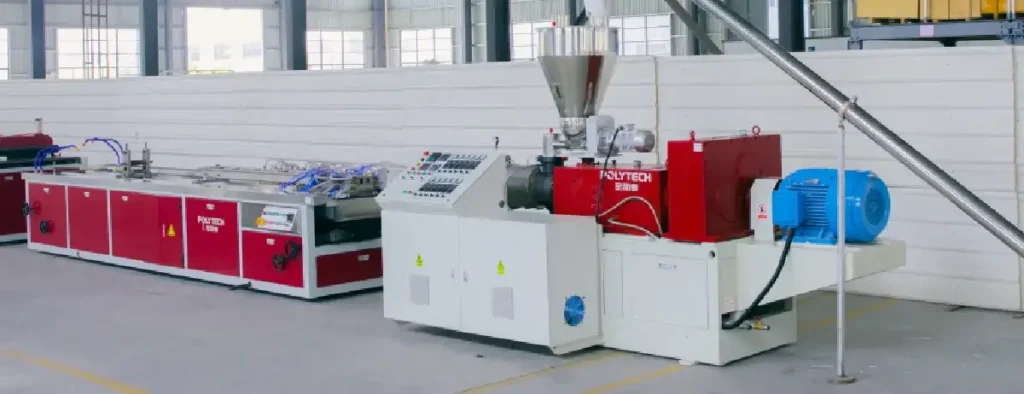
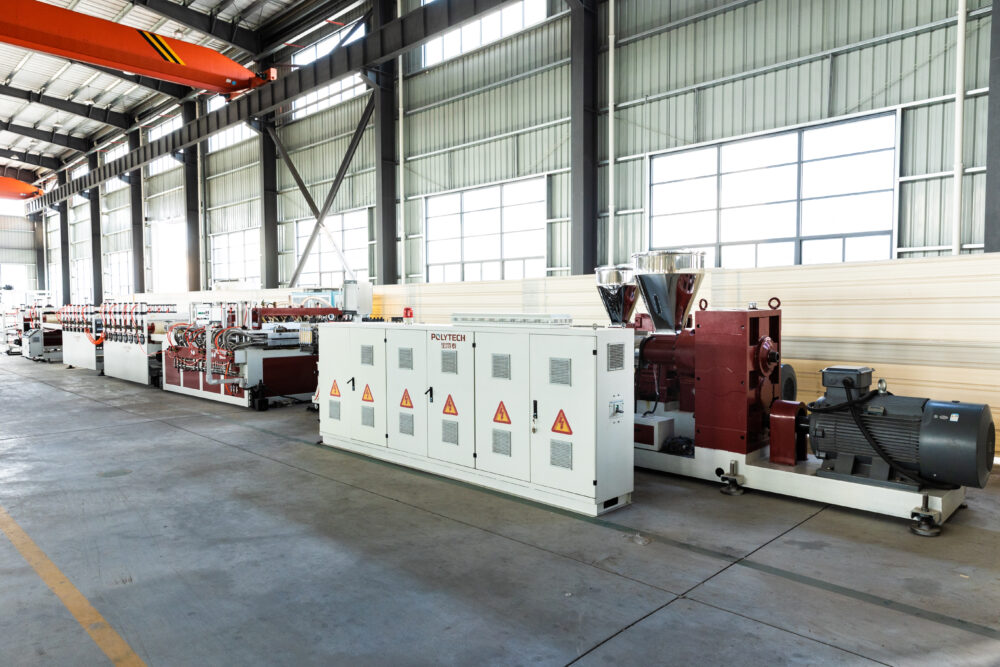
A plastic sheet extrusion line is a complete manufacturing system designed to convert raw plastic materials into continuous sheets with controlled thickness and surface finish. It typically includes several main components: an extruder, a flat die, a polishing or chill roll stack, a haul-off unit, and a winding or cutting section. Each part of the line works in harmony to ensure precision, efficiency, and product consistency.
The process begins when plastic pellets are fed into the extruder, where they are melted by a rotating screw under controlled temperature zones. The molten plastic is then pushed through a flat die, which evenly distributes the melt across its width to form a thin, continuous sheet. The sheet passes through chill rolls or a polishing stack, which cool and smooth the surface, improving its clarity, gloss, and thickness uniformity.
After cooling, the sheet moves to the haul-off unit, which controls the speed and tension of the process, followed by a winder or cutter that collects or trims the sheet according to production requirements. Advanced plastic sheet extrusion lines may also include inline measurement systems that monitor thickness, temperature, and surface quality in real time, allowing automatic adjustments for optimal output.
Because of its flexibility, the plastic sheet extrusion line can produce sheets from various thermoplastic materials, including polypropylene (PP), polystyrene (PS), polycarbonate (PC), polyethylene terephthalate (PET), and polyvinyl chloride (PVC). This versatility makes it a preferred choice for industries that demand customized sheet properties — such as food packaging, construction panels, thermoformed products, and signage.
How the Plastic Sheet Extrusion Process Works
The plastic sheet extrusion process involves a carefully controlled sequence of steps that transform solid polymer pellets into high-quality sheets. A well-designed plastic sheet extrusion line ensures that every stage—from melting to cooling—is optimized for precision, consistency, and energy efficiency.
The process starts when plastic resin—usually in the form of pellets, granules, or flakes—is loaded into a hopper. From there, the material enters the extruder barrel, which contains one or more rotating screws.
As the screw turns, it pushes the resin forward through zones of increasing temperature. Heaters placed along the barrel melt the plastic gradually, while mechanical shear generated by the screw’s rotation ensures a uniform melt.
Different polymers require specific temperature profiles: for example, PET may need a gradual rise to around 280°C, while PP or PE melts at lower ranges between 160°C and 220°C.
To enhance the properties of the plastic sheet, manufacturers may introduce additives—such as stabilizers to prevent degradation, color masterbatches for pigmentation, or UV inhibitors for outdoor applications. Precise dosing and blending at this stage determine the overall quality of the final product.
In advanced plastic sheet extrusion lines, automatic gravimetric feeders ensure consistent material input, minimizing waste and maintaining precise layer compositions in co-extrusion setups.
Once the plastic has melted into a homogeneous fluid, it passes through a screen changer or melt filter. This component removes any impurities or solid particles that could create surface defects or weaken the sheet structure.
After filtration, the melt enters the extrusion die, a critical part of the plastic sheet extrusion line that determines sheet width and thickness. The most common die designs include T-dies and coat-hanger dies, which distribute the molten polymer evenly across the entire width of the sheet.
Uniform flow distribution is essential to avoid problems such as thickness variation or surface waviness. High-end dies are often equipped with lip adjustment systems or thermal control zones, allowing operators to fine-tune the melt flow in real time.
When the molten sheet exits the die, it immediately enters the calendering unit, also known as the chill roll stack. This part of the extrusion line typically consists of three or more polished steel rolls arranged in a vertical or inclined configuration.
The top roll captures the hot sheet and defines its surface texture (smooth, matte, or embossed). The middle roll fine-tunes the thickness, while the bottom roll ensures uniform cooling and surface flatness.
The temperature and pressure applied at this stage are critical—if cooling is too rapid, internal stresses may form; if too slow, the sheet could warp or lose surface definition. To counter this, rolls are temperature-controlled by circulating chilled or heated fluids, maintaining consistent sheet properties across the entire width.
In co-extrusion lines, where multiple materials are layered together, the calendering system helps bond these layers seamlessly, producing multi-layer plastic sheets with unique mechanical or barrier properties.
Once cooled, the plastic sheet moves toward the haul-off system, which uses a pair of synchronized rollers to maintain steady tension and pull the sheet at a controlled rate. Line speed is precisely calibrated to ensure that the sheet thickness remains consistent from start to finish.
Next, the sheet is directed to the cutting or winding station. Depending on the application, it can be wound into large rolls for continuous processing or cut into standard-size panels for storage and shipment.
Cutting systems may include rotary knives, guillotine cutters, or laser cutters for high-precision trimming. Edge trimming units also remove uneven margins, ensuring the final product meets exact dimensional standards.
In a modern plastic sheet extrusion line, quality assurance is fully integrated throughout the process. Advanced sensors continuously measure sheet thickness using non-contact gauges, while infrared cameras monitor surface temperature.
Automated feedback systems adjust screw speed, die lips, or roll pressure to correct deviations instantly—helping maintain dimensional accuracy within microns.
Operators also inspect surface clarity, gloss, color uniformity, and mechanical strength. Many production lines use statistical process control (SPC) software to track real-time data, allowing predictive maintenance and higher yield efficiency.
After inspection, the finished sheets are packaged and labeled according to material grade, batch number, and customer specifications.
Each stage of the plastic sheet extrusion line plays a vital role in ensuring that the final product meets strict industrial standards. By combining precise temperature control, advanced die design, and automated quality monitoring, extrusion lines deliver high-performance plastic sheets used in packaging, construction, automotive, and countless other sectors.
Applications and Advantages of Plastic Sheet Extrusion
The plastic sheet extrusion line is one of the most important systems in modern plastic manufacturing, offering unmatched flexibility and performance across many industries. By converting raw materials into durable and lightweight sheets, this process supports a wide variety of end products used in everyday life and high-end applications alike.
Plastic sheets produced through the plastic sheet extrusion line are widely used in construction and industrial environments. Materials such as PVC, ABS, PETG, and polycarbonate are formed into wall panels, roofing sheets, protective barriers, and insulation layers.
Their corrosion resistance, lightweight structure, and ease of installation make them a popular alternative to metal or glass. In addition, extruded sheets can be thermoformed or machined to create parts for HVAC systems, clean rooms, and machine guards.
For outdoor applications, UV-stabilized sheets are favored because they maintain color and strength under sunlight exposure, ensuring long-term reliability in harsh weather conditions.
The packaging sector heavily depends on plastic sheet extrusion due to its cost efficiency and ability to produce sheets with controlled barrier properties. PET, HIPS, and PP sheets are used for food trays, blister packs, and containers that combine clarity with hygiene.
In consumer goods, extruded sheets serve as the base material for stationery, displays, lighting diffusers, and decorative panels. With co-extrusion technology, manufacturers can combine multiple polymers in one process, achieving improved appearance and performance—such as glossy finishes or scratch-resistant surfaces.
The plastic sheet extrusion line plays a major role in the automotive sector by producing interior and exterior components that meet strict mechanical and thermal standards. Sheets made from ABS, PMMA, or polycarbonate are used for dashboards, trims, luggage compartments, and protective panels.
These sheets are lightweight yet strong, contributing to vehicle weight reduction and improved fuel efficiency. Additionally, their ability to be thermoformed into complex shapes gives manufacturers freedom in design and style, while still maintaining cost-effective mass production.
Hygienic environments such as hospitals, laboratories, and pharmaceutical plants rely on extruded plastic sheets for easy-to-clean surfaces and precise dimensional control. PVC and PETG sheets, produced through high-purity extrusion lines, are ideal for sterile packaging, medical device covers, and wall cladding in contamination-sensitive areas.
The extrusion process ensures consistent thickness and smooth surfaces, which are crucial for preventing bacterial growth and enabling effective sterilization.
Modern plastic sheet extrusion lines are designed with energy efficiency and sustainability in mind. They allow for recycling of post-industrial and post-consumer materials, reducing waste and production costs.
The ability to precisely control thickness and output minimizes raw material use without compromising strength or quality. Furthermore, innovations like closed-loop cooling systems, energy-efficient motors, and smart process controls help manufacturers reduce carbon footprints and operational expenses.
By adopting advanced extrusion technologies, companies can meet global environmental standards while maintaining competitive pricing and high-quality performance.
From packaging to construction and automotive manufacturing, the plastic sheet extrusion stands as a cornerstone of industrial innovation. It offers an efficient, sustainable, and highly adaptable solution for producing materials that shape our modern world. With continuous improvements in automation and materials science, plastic sheet extrusion will continue to play a central role in the evolution of the plastics industry.
Quality Control & Future Trends in Plastic Sheet Extrusion
Maintaining consistent quality is at the core of every successful sheet extrusion operation. Modern production lines integrate precise monitoring, automated adjustments, and strict testing protocols to ensure that every sheet meets international standards for thickness, surface finish, and durability.
Raw Material Selection and Testing
Quality begins long before extrusion starts. The performance of the final sheet depends heavily on the purity and properties of the raw polymers. Manufacturers test the melt flow index (MFI), moisture content, and thermal stability of materials to guarantee uniform melting behavior. Using high-grade additives, stabilizers, and pigments ensures clarity, UV resistance, and mechanical strength.
In-Line Monitoring and Control Systems
During the extrusion process, advanced sensors and PLC-based systems continuously track temperature, screw pressure, and output rate. Real-time data allows operators to detect fluctuations instantly and make immediate corrections. These controls minimize waste and maintain uniform sheet thickness across the entire roll width.
Dimensional Accuracy and Surface Inspection
Laser and ultrasonic gauges are commonly used to measure sheet thickness with micron-level precision. Automated vision systems scan for surface imperfections such as streaks, air bubbles, or uneven gloss. This continuous inspection helps ensure that only flawless sheets move forward to packaging or secondary processing.
Mechanical and Environmental Testing
Post-extrusion testing includes tensile strength, impact resistance, and flexibility evaluations. Sheets designed for outdoor use undergo accelerated UV and weathering tests to assess long-term stability. These quality checks guarantee reliable performance under real-world conditions.
Future Trends and Innovations
The future of sheet extrusion is driven by automation, energy efficiency, and sustainability. Factories are adopting AI-driven control systems that optimize energy use and predict maintenance needs. Additionally, the development of bio-based and recycled polymers is reshaping how manufacturers approach environmental responsibility. Enhanced die designs, faster cooling technologies, and digital twins are also transforming production speed and accuracy.
As the industry evolves, plastic sheet extrusion continues to play a vital role in building stronger, lighter, and more sustainable products for global markets.
Applications of Plastic Sheet Extrusion in Different Industries
The versatility of plastic sheet extrusion makes it one of the most widely used manufacturing methods across numerous industries. From packaging to construction and automotive, extruded sheets offer durability, design flexibility, and cost efficiency that meet diverse functional needs.
Packaging Industry
In packaging, extruded plastic sheets serve as the base material for thermoforming trays, containers, and lids. Polymers such as PET, PP, and PS are commonly used because they combine transparency, toughness, and recyclability. The ability to control sheet thickness ensures uniformity in forming processes and consistent product quality. Advanced extrusion lines also allow multi-layer configurations that improve barrier properties for food and pharmaceutical applications.
Construction and Building Materials
Plastic sheets are increasingly used in construction due to their light weight, weather resistance, and thermal insulation properties. PVC and HDPE sheets are applied in wall cladding, waterproof membranes, and roofing systems. Transparent sheets made from PMMA or polycarbonate are ideal for skylights, greenhouses, and architectural glazing, offering high optical clarity and impact resistance. The precision achieved in extrusion ensures that these sheets maintain dimensional stability under varying environmental conditions.
Automotive and Transportation
The automotive industry uses extruded sheets for interior panels, dashboard components, and underbody protection. Polypropylene and ABS sheets are especially valued for their balance of strength, flexibility, and surface finish. The consistent thickness and surface uniformity achieved through extrusion allow for efficient thermoforming and painting, reducing manufacturing time and cost.
Electrical and Industrial Applications
In industrial environments, extruded plastic sheets act as insulators, machine guards, and chemical-resistant liners. Their dielectric strength and corrosion resistance make them suitable replacements for metal in certain electrical and mechanical systems. Custom formulations can also include anti-static or flame-retardant additives for enhanced performance.
Consumer Goods and Display Products
From signage and furniture to appliances and protective covers, extruded sheets provide design freedom and aesthetic appeal. Manufacturers can achieve specific colors, textures, and gloss levels while maintaining durability and light weight. Polycarbonate and acrylic sheets are popular in advertising displays and retail fixtures for their visual clarity and strength.
Conclusion & Call to Action
Plastic sheet extrusion has become an essential technology in modern manufacturing, providing the foundation for countless applications in packaging, construction, automotive, and beyond. Its ability to produce consistent, durable, and customizable materials has made it a cornerstone of industrial innovation.
As extrusion machinery continues to evolve—with smarter controls, better materials, and more energy-efficient systems—the future of plastic sheet manufacturing promises even greater precision and sustainability. Manufacturers that invest in advanced extrusion solutions can achieve faster production, lower waste, and superior product performance.
For businesses aiming to stay ahead in today’s competitive market, adopting modern extrusion technologies isn’t just an upgrade—it’s a necessity. By choosing reliable extrusion systems and maintaining strict quality control, companies can ensure long-term success and deliver high-value products that meet the demands of global industries.