

Introduction
Plastic extrusion equipment plays a key role in modern manufacturing, especially for industries that rely on large-scale, continuous production of sheets, pipes, profiles, films, and pellets. This equipment takes raw polymer materials, melts them, and shapes them into consistent and high-quality end products — all within one streamlined process. Because extrusion is efficient, flexible, and highly scalable, businesses across packaging, construction, automotive, and consumer goods depend on it as a primary production method.
The strength of plastic extrusion equipment lies in its ability to operate continuously without frequent stoppage, which helps factories achieve higher output and stable quality. Many production lines now run with advanced automation, smart control systems, and energy-efficient heaters that reduce waste and support long-term operational savings. With the right equipment, manufacturers can switch between product sizes, material types, wall thicknesses, and surface finishes with minimal changeover time — a major advantage in competitive markets.
As demand for plastic products continues to grow, extrusion machines are evolving with better melt control, stronger cooling systems, and more precise die designs. These upgrades improve accuracy during shaping and help factories maintain high consistency in both dimension and finish. The result is smooth production, faster turnaround, and plastic products built to meet industrial standards.
Types of Plastic Extrusion Equipment
Plastic extrusion equipment comes in several configurations, each designed to produce specific forms, thicknesses, and material properties. Understanding these machine types helps manufacturers choose the right setup for their operations, product requirements, and production scale.
Single-Screw Extruders
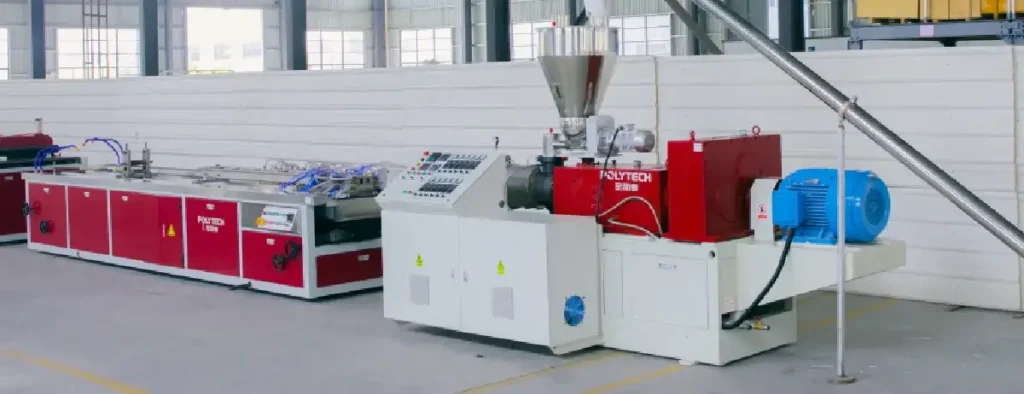
Single-screw extruders are among the most widely used systems in the extrusion industry. They operate with one rotating screw inside a heated barrel, pushing raw plastic forward as it melts and forms into a continuous profile. These machines are ideal for standard products like pipes, profiles, and granules because of their simple structure and reliable output. Many factories prefer them for their cost efficiency and ease of maintenance.
Twin-Screw Extruders
Twin-screw extruders offer higher mixing performance and more stable material flow compared to single-screw units. Manufacturers rely on them for advanced material processing, especially when working with additives, fillers, and color blending. Twin-screw machines can be either co-rotating or counter-rotating, depending on the required output and material characteristics. This makes them suitable for high-precision tasks like masterbatch production, PVC compounding, and engineered plastics.
Sheet & Film Extrusion Lines
Sheet and film extrusion lines are designed for wide-format products, including thermoforming sheets, packaging films, and multi-layer rolls. They operate with a flat die system that delivers consistent thickness control, followed by chill rollers to ensure smooth surface quality. These lines suit industries that need lightweight yet durable materials for packaging, food trays, automotive interiors, and construction panels.
Pipe & Profile Extrusion Machines
Pipe and profile extrusion machines are built to produce shapes with specific cross-sections, such as water pipes, cable ducts, window frames, and decorative profiles. They support a wide range of polymer materials like PVC, PE, PP, and ABS. With the right calibration system, manufacturers achieve high dimensional accuracy and excellent surface finish — which is essential in construction and infrastructure applications.
Pelletizing Extrusion Systems
Pelletizing equipment converts plastic waste or raw resin into uniform pellets, making it a key step in recycling and compounding operations. These systems often include a die-face cutter or strand pelletizer to produce consistent granules used later in injection molding, film blowing, or sheet extrusion. As recycling demand increases worldwide, pelletizing extrusion lines are becoming more valuable and widely adopted.
Key Components & How They Work
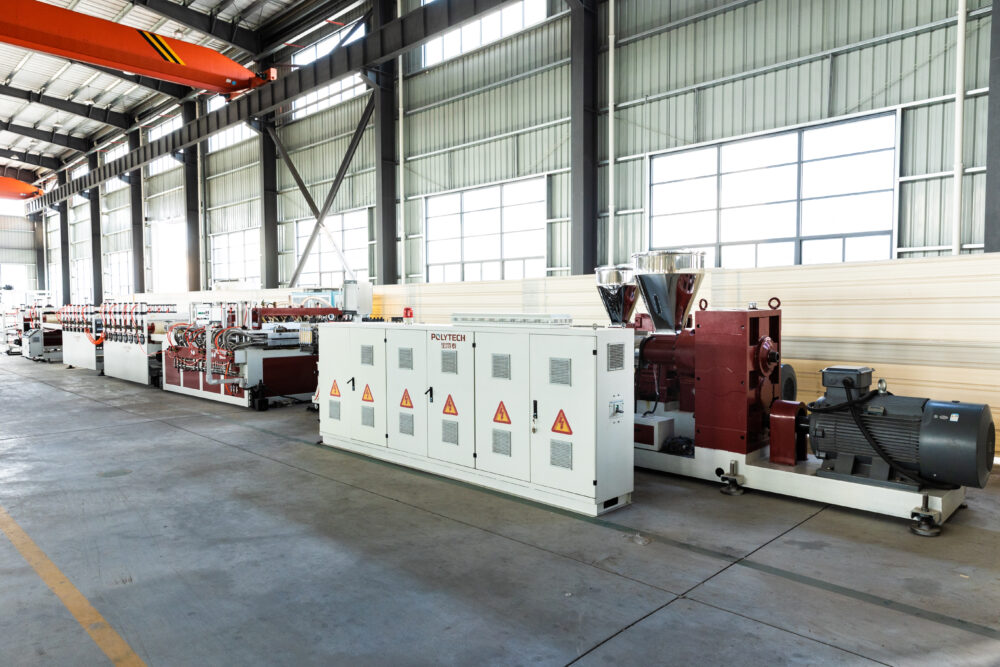
A high-performance plastic extrusion equipment line relies on multiple critical components, each contributing to smooth, precise, and efficient production. Understanding these parts helps manufacturers optimize output, reduce waste, and maintain consistent quality.
The feeding system introduces raw polymer materials into the extruder.
- It can be gravimetric or volumetric, ensuring precise dosing and continuous material supply.
- Proper feeding prevents blockages, maintains consistent melt, and improves overall extrusion quality.
The extruder is the heart of the system.
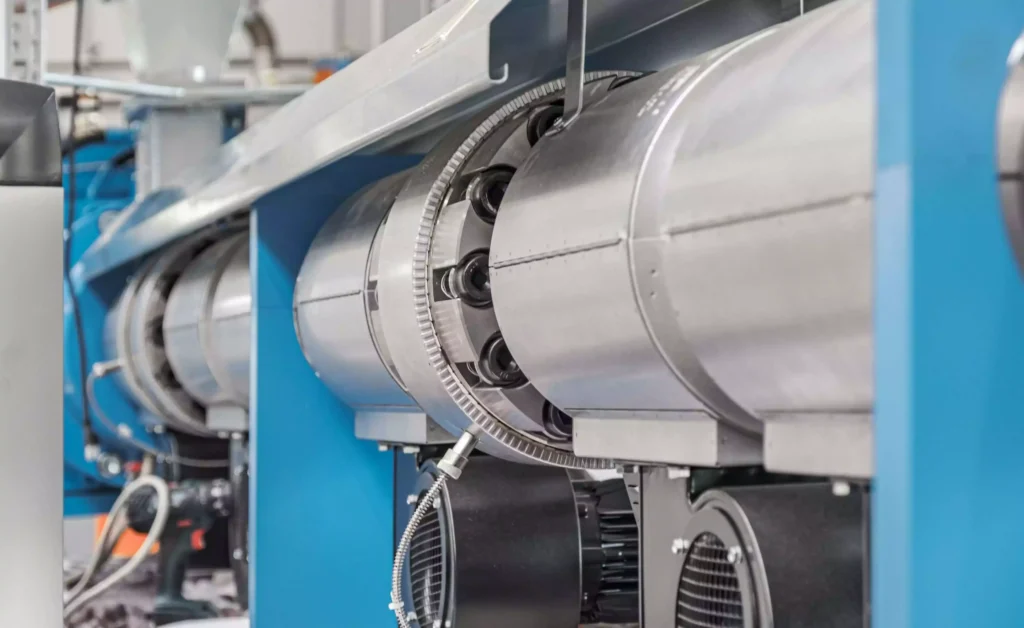
- A rotating screw pushes material forward while melting it through friction and external heaters.
- Single-screw extruders provide simple, reliable operation for standard products, while twin-screw extruders enhance mixing and processing of complex compounds or recycled materials.
- Temperature zones along the barrel allow fine-tuning for different polymers, ensuring proper plasticization without degradation.
The die head shapes molten plastic into the desired product form — sheets, films, pipes, or profiles.
- Precision-engineered dies ensure uniform thickness, smooth surfaces, and minimal dimensional variation.
- Adjustable die lips enable quick thickness changes, making the equipment versatile for multiple applications.
After shaping, the hot plastic passes through a cooling section with water or air chillers and calibration rollers.
- This step stabilizes dimensions, prevents warping, and ensures surface smoothness.
- In pipe or profile lines, vacuum calibration tanks help maintain consistent wall thickness.
The haul-off system pulls the extruded product at a controlled speed through the line.
- Rubber belts or caterpillar pullers maintain even tension, which is crucial for dimensional accuracy.
- Speed can be adjusted according to material type, thickness, and line output.
Depending on the product, cutting units trim sheets, pipes, or profiles to length.
- Pelletizing units create uniform granules for recycled or compounded material.
- These optional modules increase versatility and allow factories to produce ready-to-use material for other extrusion or molding processes.
Modern plastic extrusion equipment often includes:
- Inline thickness or diameter measurement systems
- Edge trimming units
- Printing, embossing, or coating modules
- Programmable logic controllers (PLC) and data logging for process monitoring
These auxiliary systems improve efficiency, reduce manual handling, and maintain high-quality standards across production batches.
Advantages of Plastic Extrusion Equipment
Plastic extrusion equipment offers powerful advantages that make it one of the most preferred production technologies in the global plastic manufacturing sector. With high efficiency, flexibility in material selection, and the ability to run continuously, extrusion becomes an ideal solution for companies aiming to scale production while maintaining consistent quality and cost control.
High Production Speed & Continuous Output
One of the greatest strengths of plastic extrusion equipment is its ability to operate without frequent interruption.
Continuous feeding, melting, and shaping allow manufacturers to produce long profiles, sheets, pipes, and film rolls with minimal downtime. This high-speed workflow enables factories to meet large production demands in shorter timeframes — a key benefit for commercial and industrial supply markets.
Cost-Efficiency in Large-Scale Manufacturing
Extrusion is highly economical because it reduces waste and makes efficient use of raw material.
- Melt control systems help maintain stable flow and reduce scrap.
- Energy-efficient heaters and cooling systems lower power consumption.
- Automated feeding and cutting reduce labor involvement and improve productivity.
When scaled, these small savings accumulate into major long-term operating cost reductions.
Flexibility in Material & Product Variations
Plastic extrusion equipment supports a wide range of polymers including PVC, PE, PP, PET, ABS, EVA, and engineering plastics.
This flexibility allows manufacturers to produce different product types on the same line with minor adjustments. Operators can easily change color, thickness, width, and surface texture — catering to diverse markets such as packaging, construction, automotive components, and consumer goods.
Uniform Product Quality & Dimensional Accuracy
With advanced barrel heating zones, die design, and controlled cooling, extrusion machines deliver highly consistent output.
- Thickness variation remains minimal.
- Surface finish stays smooth and defect-free.
- Dimensional tolerance is tighter compared to many other forming methods.
Stable product quality strengthens customer confidence and reduces rejection rates during inspection.
Suitable for Recycling & Sustainable Production
One major advantage of plastic extrusion equipment is its compatibility with recycled polymer.
Factories can reprocess scrap materials, convert plastic waste into granules, and feed them back into the extrusion line. This reduces environmental impact and supports circular manufacturing — something highly demanded in today’s global sustainability push.
Easy Integration With Automation & Add-On Units
Extrusion lines accept multiple add-ons such as embossing units, corona treaters, edge trimmers, lamination stations, screen changers, and automated winding systems.
The ability to expand and customize the line makes extrusion future-proof — giving factories room to grow without replacing core machinery.
Applications of Plastic Extrusion Equipment
Plastic extrusion equipment serves as a backbone for many industrial sectors because it can transform raw polymer into a wide variety of finished products — each tailored for specific performance requirements. Its ability to produce continuous lengths, controlled thickness, and stable mechanical properties makes it a global choice for mass production.
Packaging & Consumer Goods Manufacturing
Extrusion plays a crucial role in the packaging industry, supplying materials for food containers, disposable products, shopping bags, films, and thermoforming sheets.
These products need clarity, strength, and low weight, which extrusion delivers reliably. Many daily-use items — from storage boxes to household accessories — also come from extrusion-based processes due to their durability and customizable design.
Construction & Infrastructure Solutions
PVC pipes, window profiles, cable conduits, wall cladding, and roofing sheets are among the most common construction products made using plastic extrusion equipment.
Manufacturers prefer extrusion here because it achieves accurate dimensions and high resistance to corrosion, weather, and chemical exposure. This helps construction companies maintain quality standards over long-term usage.
Automotive Parts & Interior Components
The automotive industry depends on plastic extrusion to produce trim profiles, dashboard films, sealing strips, and lightweight structural components.
Extruded plastics reduce vehicle weight, lower fuel consumption, and improve interior finish — making them an attractive alternative to heavier materials like metal.
Agriculture & Irrigation Systems
Extrusion equipment produces LDPE irrigation hoses, drip lines, greenhouse films, and multi-layer agricultural sheets.
These products help farmers regulate water distribution, protect crops, and increase productivity. The long, continuous nature of extruded tubing makes it ideal for irrigation networks that cover large land areas.
Recycling & Plastic Pellet Regeneration
Plastic extrusion equipment is essential in recycling plants where waste materials are melted and converted into uniform pellets for reuse.
This application supports circular production and reduces environmental impact, helping industries move toward sustainability targets. Recycled pellets later enter new processes like film blowing, injection molding, or sheet extrusion.
Electrical & Industrial Insulation Products
Cable insulation, protective coverings, tubing, and industrial sleeves are also manufactured using extrusion technology.
These products require precise dielectric strength and uniform wall thickness — qualities extrusion machines deliver effectively.
Conclusion
Plastic extrusion equipment stands as one of the most reliable and productive technologies in modern manufacturing. Its ability to process different polymers, operate continuously, and produce consistent output makes it a core choice for industries ranging from packaging and infrastructure to automotive, agriculture, and recycling. With the right setup — including efficient feeding, controlled melting, precision dies, and smart automation — manufacturers can achieve high-quality products at scale while maintaining cost efficiency.
As global demand for plastic products continues to increase, extrusion systems are evolving with better energy management, enhanced process control, and more intelligent automation. This shift opens the door for higher productivity, reduced waste, and more sustainable industrial production. Companies that invest in advanced extrusion equipment today will be better positioned for market growth, quality improvement, and long-term competitiveness.