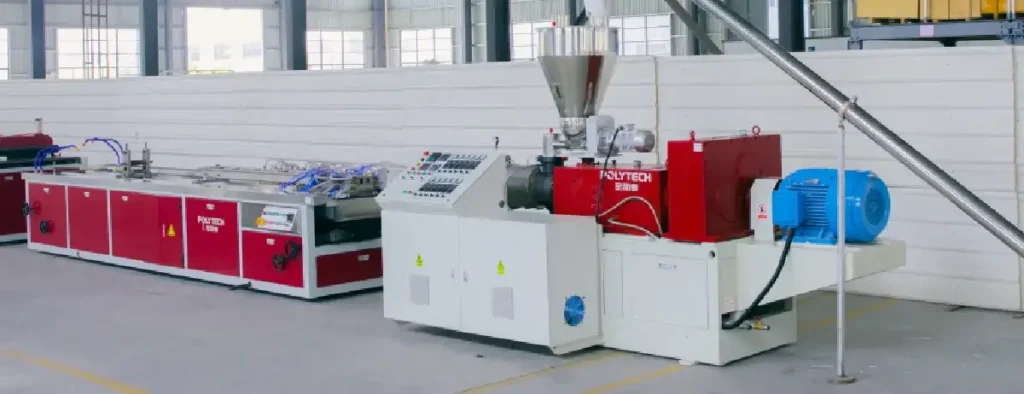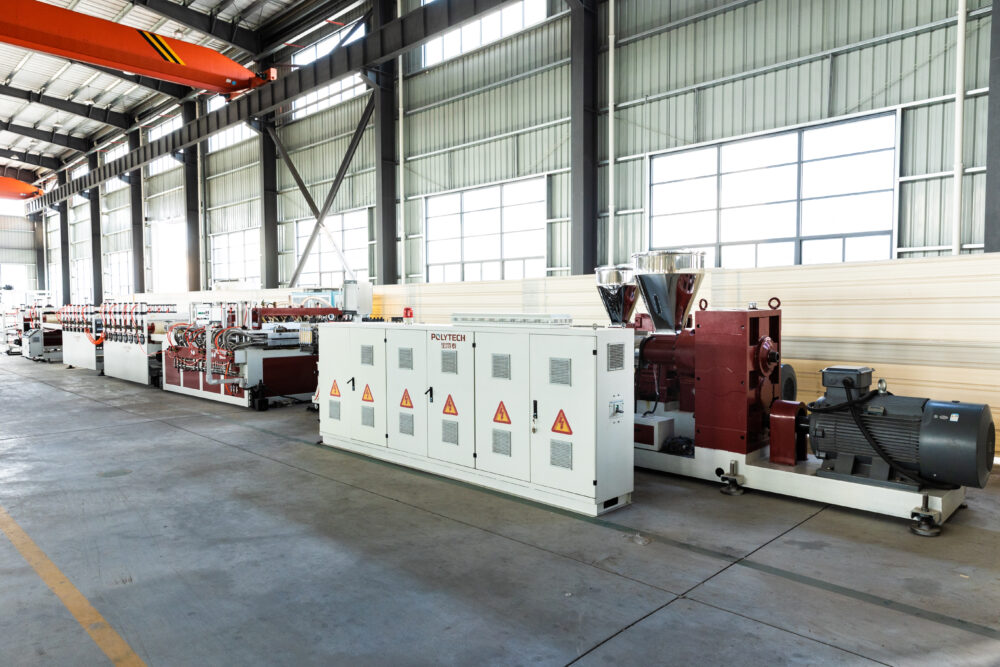


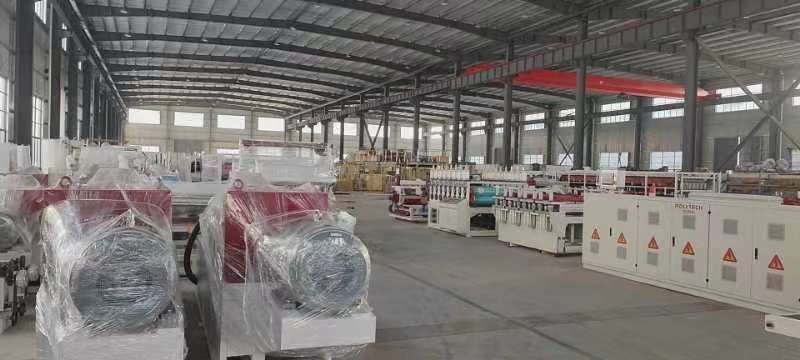
Extrusion equipment is the backbone of plastic manufacturing when it comes to producing continuous products like pipes, profiles, sheets, and films. In an extrusion process, raw plastic material (pellets or powder) is melted and pushed through a shaped opening (a die) to form a continuous product with a constant cross-section. The various machines – from the extruder itself to downstream cooling and cutting units – work together to turn raw material into finished products continuously. This makes extrusion highly efficient for high-volume production.
In the sections below, we’ll explore the core components of extrusion equipment, the types of machines used for different plastic products (PVC pipes, foam boards, uPVC profiles, roofing sheets, WPC composites, etc.), compare key machine configurations, discuss common materials processed, and provide guidance on selecting the right extrusion setup.
Core Components of Extrusion Equipment
Extrusion systems consist of several primary components, each playing a crucial role in converting raw plastic into finished goods. The key extrusion equipment components include the extruder (with its screw and barrel), the die and tooling, various downstream units for cooling and handling, and the control system. Understanding each of these elements is important to optimize performance and product quality.
Extruders: Single-Screw vs. Twin-Screw
The extruder is the heart of an extrusion line. It contains a motor-driven screw rotating inside a heated barrel, continuously melting and pumping the plastic forward. Extruders come in two main designs:
A single-screw extruder uses one screw to convey and melt the polymer. These machines are widely used for polymers like polyethylene (PE) and polypropylene (PP). They are relatively simple, cost-effective, and capable of high output. Single-screw extruders are ideal when the material doesn’t require intensive mixing or when processing granules with additives that are already well-blended.
Twin-screw extruders have two screws (either co-rotating or counter-rotating, in parallel or conical configuration) working together. They excel at mixing and are often chosen for formulations that need thorough compounding or for materials supplied as powder. For example, processing PVC or wood-plastic composite typically requires a twin-screw extruder to ensure uniform melt and prevent overheating. Often, conical twin screw barrels are used in twin-screw extruders for PVC to achieve high pressure and stable output in a compact design. Twin-screw machines are more complex and usually higher in cost, but they offer superior control over material shear and temperature, resulting in better consistency for difficult-to-process plastics.
Screws and Barrels in the Extruder
Inside the extruder, the screw and barrel are the critical parts that actually melt and move the plastic. The screw’s geometry (flight depth, length, pitch) is tailored to the material and process, and it works in tandem with the barrel, which is a precision metal cylinder with heating elements. Together, the screw and barrel build pressure and generate frictional heat to transform solid plastic into a homogeneous melt. High-performance screws and barrels for extrusion are made of hardened, wear-resistant steel to withstand the abrasive, high-temperature environment. Over time, these components can wear and may require refurbishment or replacement to maintain efficiency. A well-designed screw/barrel combination ensures consistent melting, proper mixing of additives, and smooth delivery of material to the die.
Die Heads and Extrusion Tooling
After the plastic is melted, it exits the extruder through a die head that gives the material its shape. The die is essentially a specialized mold: as the molten plastic is forced through it, the polymer takes on the die’s cross-sectional profile (be it a pipe, sheet, profile, etc.). Along with the die, there may be calibrators or sizing sleeves immediately downstream to hold the extrudate to the correct dimensions until it cools enough to retain its shape. (For precision, vacuum calibration units are commonly used for pipes and profiles to maintain exact diameters.)
High-quality extrusion toolings and moulds are essential to get accurate dimensions and a smooth finish on the output. Different products require specific tooling: a pipe die for making hollow pipes, a flat sheet die for boards, a profile die for complex shapes, and so on. These components are custom-designed for each product, and can be swapped out to change product sizes or designs on a given line.
Downstream Equipment (Cooling, Haul-Off, Cutting)
Once the plastic has its shape from the die, a series of downstream machines handle cooling and sizing, pulling the product through, and cutting it to length:
Cooling baths or chill rolls solidify the hot plastic. For pipes and solid profiles, the extrudate typically passes through a water tank to cool (sometimes using vacuum to maintain precise sizing). Sheets may go through a set of chilled rollers to cool and flatten them.
This unit grips the product (using belts, caterpillar tracks, or rollers) and pulls it at a steady, controlled speed. The haul-off ensures the extruded length moves continuously and maintains consistent dimensions by matching the extruder output rate.
Finally, the continuous product is either cut into set lengths or wound onto rolls. Pipes and profiles are cut by saws or knives at regular intervals, while products like tubing or film can be rolled up. Cutting systems are synchronized with the line speed to make precise cuts without deforming the product.
All downstream equipment must be synchronized with the extruder for smooth operation. Proper cooling prevents warping or dimensional inaccuracies, and accurate pulling/cutting ensures each piece meets specifications.
Control Systems and Automation
Modern extrusion lines include automated control systems (typically PLC-based) that monitor key parameters like temperature, pressure, and screw speed. The system automatically adjusts heaters and motor speeds to maintain stable processing conditions. This automation ensures consistent product quality, reduces waste, and minimizes the need for manual adjustments.
Extrusion Equipment for Different Products
Different plastic products often require specialized extrusion setups or accessories. For example:
PVC pipes (for water, conduit, etc.) are typically made with a twin-screw extruder feeding a pipe die. The line uses a vacuum calibration tank to shape and cool the pipe, a haul-off to pull it continuously, and an automatic cutter for precise pipe lengths.
Making window frames, doors, and other profiles from rigid PVC requires a similar setup but with a profile die and calibration tools for complex shapes. An uPVC profile extrusion line uses a conical twin-screw extruder for PVC, followed by calibration tables, cooling baths, a puller, and a cutter to produce accurate profiles in continuous lengths.
Roofing panels (e.g. corrugated PVC or polycarbonate sheets) are produced by extruding a molten sheet and then forming it if needed. A roofing sheet extrusion line typically includes an extruder (single or twin screw depending on material), a flat sheet die, a downstream roller or former to create corrugation or multi-wall structure, cooling sections, and a cutter to finish sheets to length.
PVC foam boards are created by mixing foaming agents into PVC and extruding through a flat die. A PVC foam board extrusion line uses a twin-screw extruder for thorough mixing. The board expands with a foam core as it exits the die, calibration plates set its thickness, and after cooling, the board is cut into lightweight, rigid panels for signage or furniture.
Wood-plastic composites (like WPC decking planks or panels) run on extrusion lines equipped with twin-screw extruders (for good mixing of wood fiber and plastic) and wear-resistant screws and barrels. The downstream process is similar to profile extrusion (calibration, cooling, haul-off, cutting), delivering products that look like wood but have greater weather resistance.
Comparing Key Extruder Configurations
Single-Screw vs. Twin-Screw: A single-screw extruder is simpler, with lower cost and maintenance, and works well for easily processed plastics (like PE or PP) at high throughput. A twin-screw extruder is more complex and expensive but provides superior mixing and uniform melting, which is crucial for heat-sensitive or filled materials (like PVC compounds or WPC blends).
Conical vs. Parallel Twin-Screw: Conical twin-screw extruders have a tapered design that generates high pressure at lower screw speeds, making them ideal for PVC applications (such as uPVC profiles and pipes) where gentle but forceful processing is needed. Parallel twin-screw extruders feature uniform diameter screws and can run at higher speeds for greater output, suiting large-scale production where throughput is the priority.
Materials Processed by Extrusion Equipment
Extruders can process a variety of thermoplastic materials. The equipment selection and setup often depend on the material’s characteristics:
PVC: PVC is widely extruded into pipes, profiles, and sheets. It typically uses twin-screw extruders for gentle mixing and venting, since PVC compounds are heat-sensitive and require precise temperature control.
PE: Polyethylene is easily extruded on single-screw machines at high outputs for products like HDPE pipes and films. Adequate cooling is needed for thick sections to prevent deformation.
PP: Polypropylene extrudes similarly to PE on single-screw extruders and produces rigid products (e.g. PP-R plumbing pipes or thermoformable sheets). Controlled cooling helps avoid warping in PP extrudates.
WPC: Wood-plastic composites (plastic mixed with wood fiber) are extruded with twin-screw machines (often vented and with hardened screws). They form wood-like profiles such as deck boards that offer enhanced weather resistance compared to natural wood.
How to Select the Right Extrusion Equipment?
Selecting extrusion equipment requires matching the machine’s capabilities to your production needs. Consider the following factors:
Define what product you will make (pipe, sheet, profile, etc.) and its size specifications. The product’s dimensions and tolerance needs will determine the type of extruder (and screw size), the style of die, and the length of cooling/calibration equipment required.
Identify the primary plastic (and any fillers) you will process. Materials like PVC or WPC usually call for twin-screw extruders, whereas PE or PP can run on single-screw machines. Consider if special screw features are needed (e.g., venting for moisture or hardened surfaces for abrasive fillers) based on the material’s characteristics.
Determine the production throughput (kg/hour) you need to meet. Select an extruder sized to achieve that throughput without being pushed to its limits (to reduce wear). Also evaluate the energy efficiency of the equipment and look for automation features that reduce scrap and labor (like automatic feeders or thickness control).
Consider your budget alongside the machine quality and the support offered by the manufacturer. It’s often worth investing in reliable equipment from a supplier with experience in your specific product segment, as they can provide guidance and solid after-sales service. A reliable, well-supported machine will maintain performance longer and provide a better return on investment.
Industrial Sectors Served by Extrusion Technology
This sector uses extruded plastics extensively – plastic pipes, window/door profiles, siding, decking, fencing, foam boards, and roofing sheets. These materials are popular for their durability and light weight in building applications.
The packaging industry relies on extruded films and sheets. Extruded plastic film is used for bags, wraps, and shrink film, while extruded sheets (PP, PET, etc.) are thermoformed into trays, cups, and other containers for food and consumer goods.
Vehicles contain numerous extruded components, such as rubber or PVC weather seals for doors and windows, plastic tubing for fuel lines and cable conduits, and various trim profiles for interiors. Extrusion allows long seals and profiles to be made consistently and cut to fit automotive assemblies.
Extruded PVC or ABS edge banding finishes tables and cabinets, curtain tracks and picture frames are made via profile extrusion, and PVC foam boards serve as lightweight furniture panels. Everyday items like garden hoses, electrical conduit, and appliance moldings are also made by extrusion.
Extrusion equipment is a cornerstone technology in modern manufacturing due to its versatility in handling different shapes and materials and its ability to produce continuous outputs with consistent quality. The right combination of extruder, tooling, and downstream equipment enables industries to mass-produce high-quality plastic products efficiently, meeting the needs of construction, packaging, automotive, furniture, and more.